Impressionism: partaking the 2nd ‘impressionist’ exposition
Marcellin Desboutin
(1823-1902)
A portraitist and engraver
with ‘impressionist’ connections

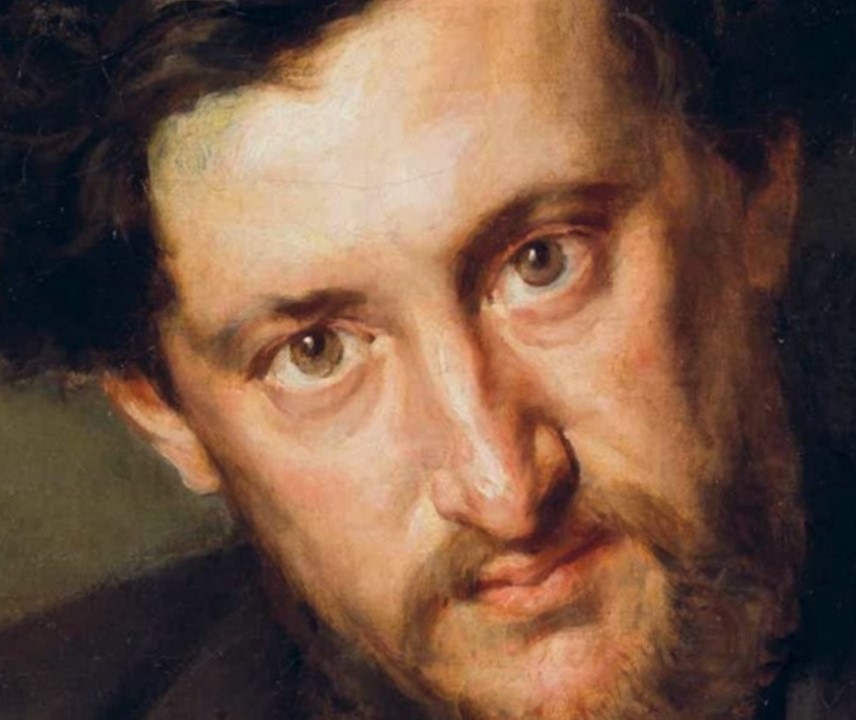
Was Marcellin Desboutin an Impressionist?
Early on in Italy Desboutin was befriended with Degas and De Nittis. 1873 onwards in Paris in Café Guerbois and Café Nouvelles Athènes he had contacts with Impressionists and related artists. He made many portraits of them including the Impressionists Degas, Renoir, Morisot, Lepic and also of related painters like Puvis de Chavannes, Goeneutte, Courbet, Manet and also of related art-critics like Zola, Burty, Duranty and also the art-collector Hoschedé and the art-dealer Durand-Ruel. Desboutin himself posed for Renoir, Degas, Somm and Manet. In this way you could say he was part of the impressionist art-movement. Desboutin made his debut at the Salon in 1869. 1873 onwards, after he moved to Paris, Desboutin would exhibit yearly at the Salon. He only joined the 2nd ‘impressionist’ exposition in 1876. In that sense he was not part of the impressionist art-movement.
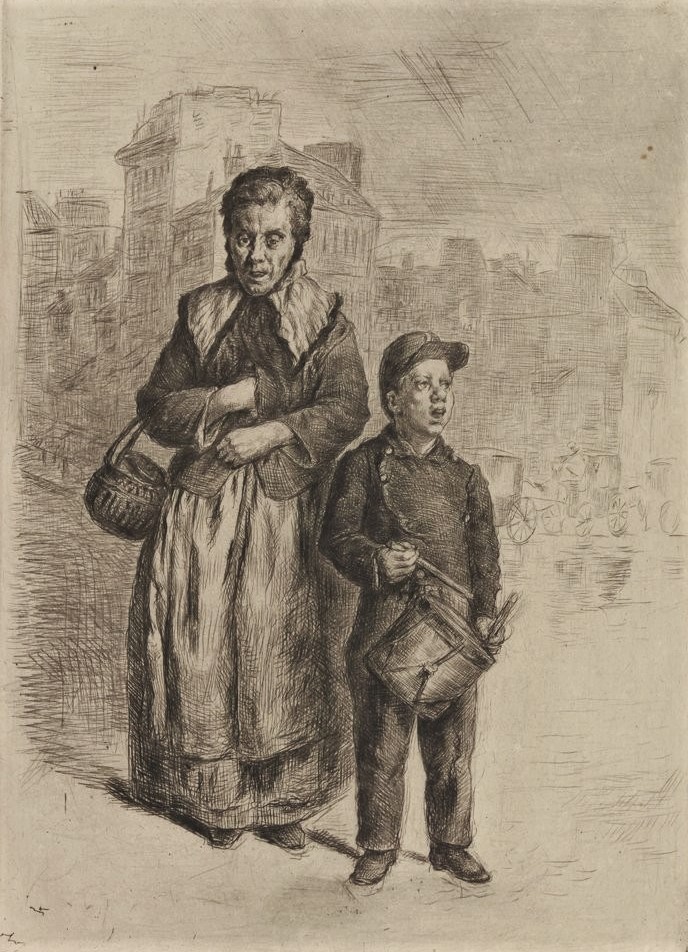
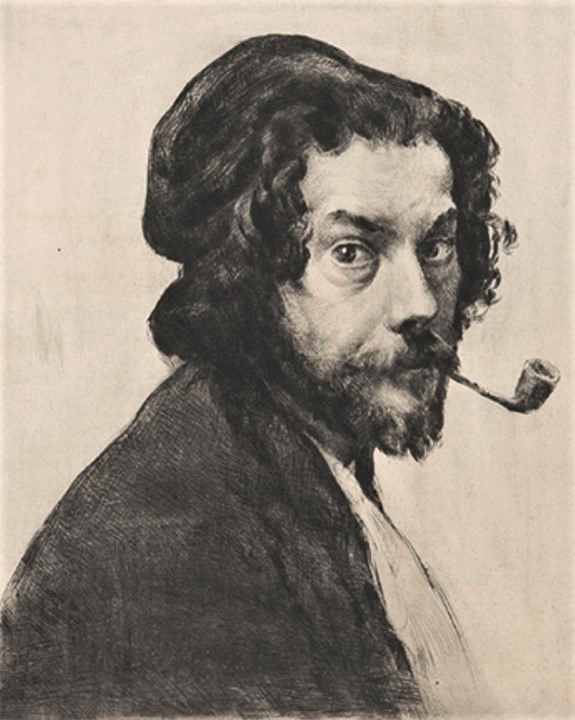
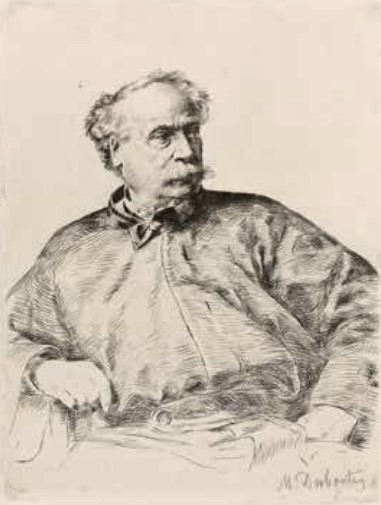
Desboutin most of all is famous for his portraits in (dry point) etchings (iR4). He rendered his portraits in a free, lively, informal and improvised way (iR4). His (oil) portraits were in a neo-baroque, dark and detailed style (R3). He mostly is seen as a Realist (R158). In reviews he is not seen as an Impressionist (R90I). In his paintings Desboutin used many browns and blacks, rendered many details and didn’t use juxtaposed brushstrokes. The influence of light on the colours seems absent. In that way he didn’t paint in an impressionistic style.
See also an overview of his pictures.


Marcellin Desboutin only joined the 2nd ‘impressionist’ exposition:
At the 2nd ‘impressionist’ exposition Desboutin showed at least 20 art-works. This included 8 paintings, including one outside the catalogue (=hc) and at least 12 dry point etchings, all depicting portraits / figures (catalogue numbers 60-72+hc1) (R2,p161). I render 12 compilations to give an accounted impression of his exhibited art-works in 1876. See link for an account. Several books on Impressionism render a painting of Faure↓, that is assumed to have been exhibited in 1876, but the only review (Rv51) ‘a portrait of a young man’ doesn’t seem to confirm this. Of 4 paintings only an engraving of the painting excits, I render them together in a compilation with in some ways comparable paintings. 4 of his exhibited dry points are identified, for some others the reviews render some indication. But, it is unsure how many dry points Desboutin showed and under what number (I assume at least 12). I render 6 compilations with a variable number of dry points. One dry point is now lost; to compare I render 3 pictures of other artists.
Marcellin Desboutin was mentioned in 23 reviews. 11 mention his dry points etchings. Some make clear they hung in room 1 (Rv16+35+43), ‘at the entrance door’ (Rv36). There was ‘a large number’ (Rv41+35), namely portraits (Rv10+35+41+43+51). 6 of them are explicitly mentioned and 2 general descriptions are rendered ‘portraits de femmes’ and ‘plusieurs têtes de femmes’ (Rv51+38+1+10). Bigot (Rv32) reviewed that ‘These (drypoint) portraits are certainly the most remarkable feature of this exhibition’. Rivière (Rv51) praised his ‘series of drypoint portraits, which are marvels of composition and execution… like the etchings of Rembrandt.’ Leroy called him ‘very weak as a painter, but interesting as an etcher’ (Rv44). Others more or less affirm this opinion (Rv1+6+38). Blémont suggests his paintings also did hung in room 1 (Rv35)*. But Rivière (Rv51) first reviews his paintings (and those of others) and at the end of the article he reviews seperately his etchings (and also those of Lepic), which could suggest they hung in two separate rooms. Of his paintings no.63+64 are most often mentioned (8x +9x). No.63 is explicitly described as ‘large’ and ‘quite big for it’s subject’ (Rv6+20+33+35+41). No.64 was described as ‘a small canvas as big as a hand’ (Rv36).
Rivière mentioned ‘First in line is M. Desboutins (sic), not that his exhibition is the most extensive, but it is the most complete.’ (Rv51) Desboutin is sometimes integrated in small lists of the most important partakers (Rv2+15+17+19). Chaumelin asks ‘What reason does Desboutin has to join among the Intransigeants?’ (Rv33). Also some others don’t think he fits in this group (Rv26+32+41+44+51)**, except for no.63 (Rv41).
Note*: Enault and Porcheron could affirm this, but are not very precise in the indentification of the location (Rv36+28). Clayson concludes the paintings hung in room 1 (R2,p146).
Note**: So, several art-critics don’t see Desboutin as an Intransigeant or ‘impressionist’, see also Why Impressionists? and Main Impressionists.

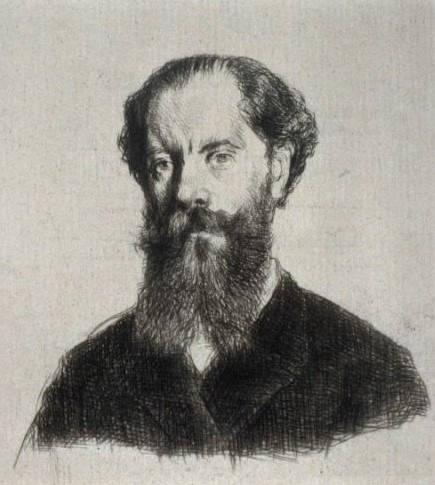
Marcellin(-Gilbert) Desboutin and the Salon and other expositions:
Desboutin made his debut at the Salon in 1869*. 1873 onwards, after he had moved to Paris, he would yearly exhibit at the Salon, even in 1876 when he also joined with the 2nd ‘impressionist’ exposition. He would do so until 1889 (at the Salon de la Société des Artistes Français =SdAF).
Only at the Salon of 1877 Desboutin is called a pupil of Drölling and Robert-Fleury (iR1). In 1879 he received a 3rd class medal (for his etchings) (R231/iR40;R88I,p196;aR9). In 1882 and 1883 he exhibited exempté with his etchings (iR1). In 1883 he received a ‘mention honorably’ for a painting (aR9).
From 1890-1902 he exhibited at the independent Salon de la Société Nationale des Beaux-Arts (=SNBA). (iR1). He was one of the founders (R3;R9;iR3;R88;aR10).
Desboutin exhibited in 1889 at the Exposition Universelle and received a 2nd class medal (R85XIII,p33;R231). 1895/06/08 Desboutin was appointed Chevalier de la ‘Legion d’Honneur‘ (R3;iR3;R88;R9;aR9;aR10;R158,p156). In 1900 at the Exposition Décennale he exhibited 3 portraits (R158,p276) and he received the highest award, the Grand Prix for ‘Gravure et lithographie’ (Classe 8) (R88;R3;R9).
Already in 1873, Desboutin had exhibited 3 art-works in Ghent (R158,p74). In 1886 4 paintings of Desboutin were part of the exposition ‘Works in oil and pastel by the Impressionists of Paris’, organised by Durand-Ruel in New York (R1,p544). Desboutin exhibited with Les XX in 1889, at the Salon de la Rose+Croix (=SRC) in 1892 + 1893 and at several other exhibitions. Also posthumously his work were exhibited at several exhibitions, including a retrospective exposition at the École des Beaux-Arts in 1902 (R88;aR7;aR9).
See link for his art-works at the Salon. See link for an account.
Note*: iR1;aR11,p80; Walther wrongly mentions 1868; R3,p659)
Marcellin Desboutin as an artist:
Desboutin entered in 1845 the Ecole des Beaux-Arts in Paris (iR70). In 1845 he studied under the sculptor Louis-Jules Etex (1810-89). From 1847-48 he studied under Thomas Couture (1815-79), here he met Puvis de Chavannes; they stayed lifelong friends (R465,p10).
From 1857-74 Desboutin was influential on Italian artists within the ‘Macchiaioli’ group (iR70).
Some sources mention that his palet brightened under influence of the ‘impressionists’ (R88;R9), but when I look at his paintings I see subdued colours, dominated by browns, so not very impressionistic. Or as Léon de Groër put it: ‘his colours lack freshness and cheerfulness’ (R466,p4). He also used bitumen black. Most sources see him as a Realist, because he ‘did not correct nature’ (R158,p184).
See also an overview of his pictures.
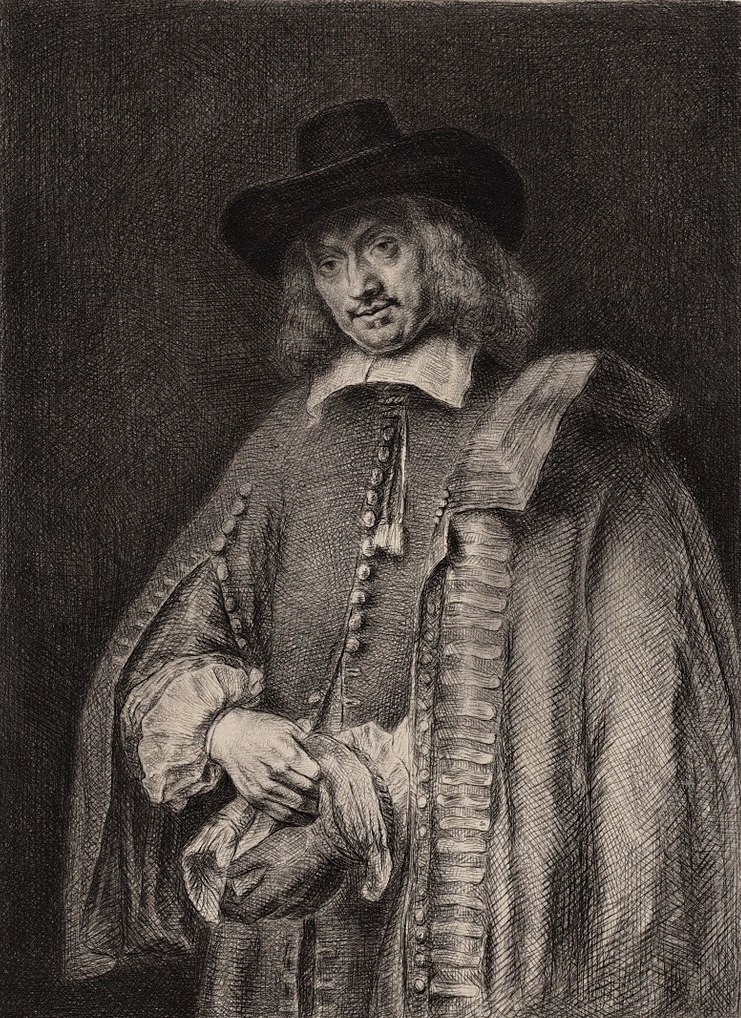
Desboutin is foremost known and rewarded↑ as an engraver↓, namely using the dry point technique.
Desboutin also, wrote, translated and published poetry, namely in 1852 +1872 (iR4). Together with Jules Amigues he wrote a drama play ‘Maurice de Sax’, which was performed at the Comédie-Française in Paris 1870/06/02 onwards (R158,p46;R88;aR9;aR10;R465,p10;R466,p1). Desboutin also wrote ‘Le Cardinal Dubois’ and ‘Madame Rolland’ (R466,p1).


Marcellin Desboutin as an engraver:
Desboutin started with engraving according to Beraldi in 1850 (R85V,p188) and according to Clément-Janin in Florence around 1856, when he made ‘Ma première gravure, Florence (R158,p195). From 1875-1881 he made the largest part of his engraving oeuvre (R85V,p188). He was educated by Ludovic Lepic and inspired by Rembrandt (1606-69), firstly by using the dry-point technique and also in making many self-portraits, in making multiple versions of an image and in using a range of papers, with various texture and tone (R465,p11/13).
Mainly in the 1870s, Desboutin portrayed many from the artistic environment in Paris, including several partakers of the ‘impressionist’ expositions, other artists, art-collectors and art-critics (R88;R85XIII). Deboutin also made several portraits to be illustrations for publications by the bookseller Rouquette, whom he also portrayed (R85V,p189;R85XIII,no107). In 1876 Desboutin made some small portraits (after photographes) for the Opéra (R85V,p191;R85XIII,no134-141;R158,p200). In the 1880s Desboutin worked on 5 dry points of paintings by Fragonard (aR9;R85XIII,no.163-167;R158). He also made reproductions of paintings by Delacroix, Rembrandt and Frans Hals (R158,p198-200). Later on Desboutin also used heliographic printing (in which the picture isn’t rendered reversed); also named photogravure (R158,p208;R465,p13). Desboutin guaranteed that his prints would always be rare and many of his proofs were unique (R465,p13)
Beraldi (1886) called his dry points more full-bodied, than those of his pale disciples (R85V,p191). As an etcher he was innovative; he experimented with wiping and scratching out areas of tone (R158,p172;R465,p13). Others mention his spontaneous and sketchlike technique, his freedom of handling and his transparant effects (R88;aR10;R465,p11). At the 2nd ‘impressionist’ exposition Desboutin is praised for his dry points (R90I). In Januar 1889 Durand-Ruel organised an exhibition with 167 dry point etchings by Desboutin; Zola wrote the introduction to the catalogue (R85XIII,p33;iR65;R3;R88;R158,p145-147). Zola wrote: ‘In the art of dry point… he is king. You must have seen how he attacked a plate with the needle, which he uses like a pencil. …in a single session most often, he captures a portrait… captivated by the direct impression of nature, he copies on the metal what he sees… (R466,p3).
His talent for engraving, especially for using dry point, is most remarquable (aR10). In his portraits he rendered the psychology of the sitter (aR10;R465,p11). Desboutin created sharply characterized portraits in a rather neo-baroque, dark, detailed style. He was a ‘Realist who knows how to choose between the thousand expressions that intertwine on a human face, the one that must be retained because it reveals his personality’ (R158,p181).
In 1873 Desboutin inspired De Nittis in printmaking (iR70) and in 1875 (or later) he inspired Goeneutte in engraving, etching and dry point (iR70). In 1879 Degas planned to include Desboutin for a monthly, illustrated journal of prints, to be entitled ‘Le jour et la nuit’ (R4,p205).
See overview of his pictures.

Marcellin Desboutin his contacts and dwellings:
1823/08/26 Marcellin-Gilbert Desboutin was born in Cérilly (Allier), about 300km south of Paris. Later he would study in Paris, first law and later at the École des Beaux-Arts. From 1849-54 Desboutin traveled to England, Belgium, the Netherlands and at last to Italy. From around 1854* till 1870* ‘baron Desboutin de Rochefort’ lived in the ‘villa dell’Ombrellino’ in Florence, and was a host for many, among them Degas (1857 or 1858/59) and De Nittis and also Jules Claretie and Georges Lafenestre. Desboutin had lived in Florence a life of luxery (R71,p108;R88). By speculating in real estate he was ruined and in 1870* he had to sell L’Ombrellino (R88;R3;R9;iR3;aR10). After that he spent some time in Geneva*. August 1872 Desboutin moved to Paris en Spring 1873 lived at 10, Rue d’Arcet (Batignolles) (R158,p73;iR1;R3).
Note: the dates are obscure. Maybe he bought the villa in 1857 and sold it in 1874 (R466,p1). Namely his movements in the early 1870s are obscure, some write he he spent several years in Geneva (R88;R3).
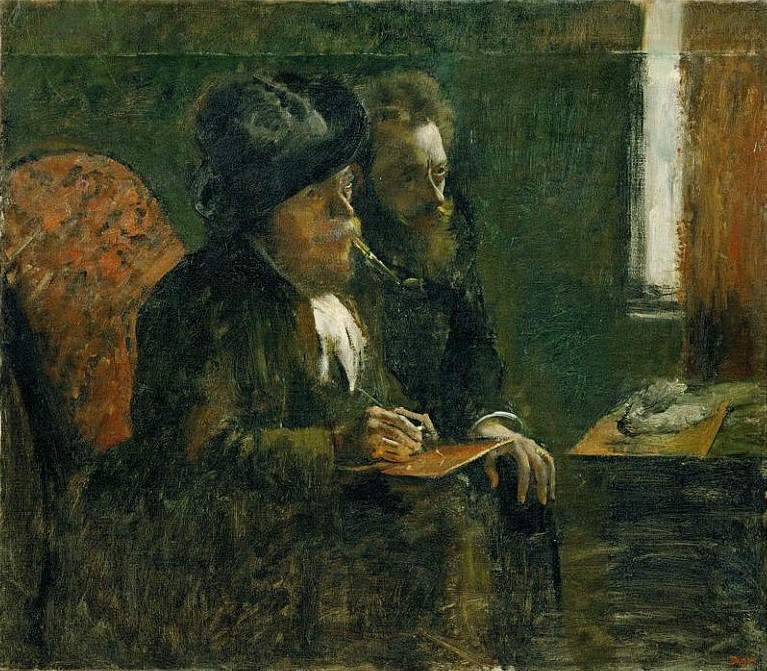
Around 1875/76 Deboutin had contacts with Degas and Manet, who both portrayed him↓. Desboutin met them and others like Émile Zola, Philippe Burty, Duranty, Fantin Latour and Hippolyte Babou in Café Guerbois (according to Armand Sylvestre since 1872; aR9;R158,p89/90). Around 1876 Desboutin was one of the first to frequent Café de la Nouvelle Athènes; others soon would follow (R1,p399;R3;R88). In these cafés Desboutin spent whole days and portrayed his sitters (R465,p11). Desboutin together with Zandomeneghi introduced the Italian art-critic Diego Martelli (R89,p96). In sources on Impressionism Desboutin is mostly mentioned for these contacts and for portraying his friends and being portrayed and living the life of a bohemian↓ (R5,p190;R8,p22+230;R1;R3,p180).
Silvestre called him one of the most striking personalities (R88). Rewald writes that Desboutin was ‘full of original ideas and conversant in many fields of knowledge (…) His presence was highly appreciated…’ (R1,p235;R158,p90). Around 1874 Desboutin met Zola at Manet’s house (iR3;R88); Zola in 1889 would call him ‘an unforgettable figure’ (aR9). Puvis de Chavannes was the friend Desboutin was mostly attracted to (R158,p116). In 1880 Desboutin introduced Henri Rochefort, a communard who had been exiled and recently returned, to Manet. They both did portray him (R5,p123).
From 1880-1887 he lived in Nice. He would decorate a church, he gave painting lessons in a studio (R158,p125). From 1887-1896 he lived in Paris (and partly in Geneva).
1895/06/08 Desboutin was appointed Chevalier de la ‘Legion d’Honneur‘. This let to a quarrel with Degas and they wouldn’t see each other anymore (R158,p157/8;R466,p2).
In 1896 Desboutin would definitively return to Nice, where he died in 1902.


Was Desboutin poor?
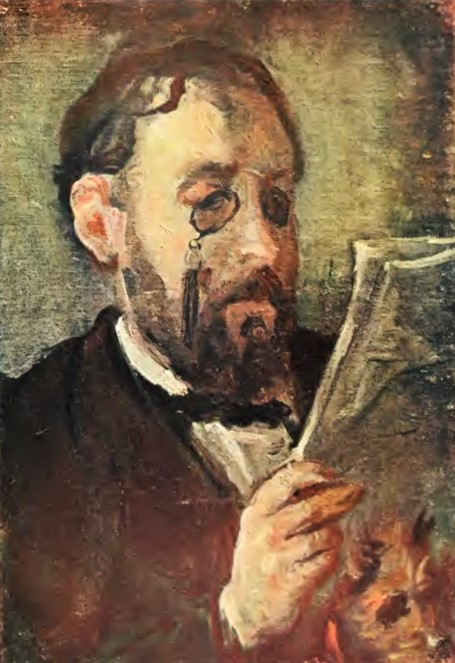
From around 1854 till 1870 Desboutin lived as a baron and had his own estate in Florence, which he lost due to speculations↑. Since 1872* Desboutin lived in Paris. Rewald claimed he was ‘above all a Bohemian’ (R1,p235). In this way Manet depicted him (with his dog) in 1875 (iR6). Dony / Braun adds ‘a bohemien like figure… (who) lived … with his dog in his studio that nearly was a ruin’ and adds he was ’tormented’ (R71,p108). Degas depicted him as a drunk sitting in a café, though he made clear this was a modelled scene (iR6; M1; 3IE-1877-61+hc; R465,p9).
I don’t know if this image of being a bohemien, which is recorded in many sources, is fully correct. It is true that Desboutin dwelled at many different addresses from 1873-1895 (iR1;R158); he did so with his second wife and his children (R3;R88;iR4;R158). But when we look at the pictures of his children, we see a nanny, a baby carriage, a walker for little children and all sorts of toys, which doesn’t seem to indicate severe poverty. Already in 1873 Durand-Ruel bought a painting of Desboutin and Desboutin decorated a salon of his friend Simonnet (R158,p74). Marz 1873 he spent time in London, together with Giuseppe de Nittis (R158,p112). In the mid 1870s Desboutin made many dry point portraits, which brougth him 100 à 200fr each (R465,p11). In 1881 he bought a villa in Nice (R158,p107); this was financed by an auction (1880/12/23) which included 47 ancient bronze objects. All these things don’t indicate a bohemian / poor way of live.
Still, in sources on Impressionism Desboutin is mostly rendered in these two pictures of Manet and Degas. A very one-sided view. The painting of Hodler↑ for example renders a much more truthfull picture.
Note*: Dony / Braun (wrongly) writes this was in 1870 (R71,p108).


Marcellin Desboutin as an Intimist:
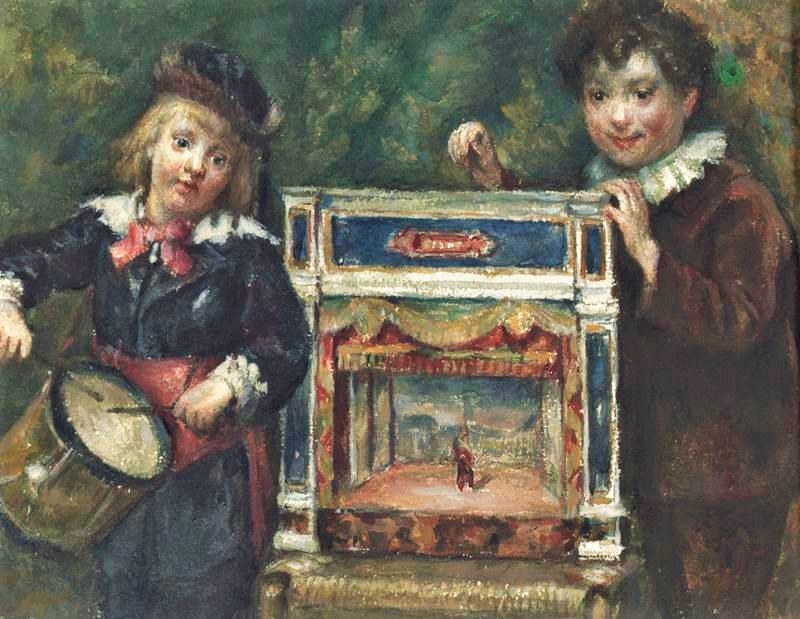
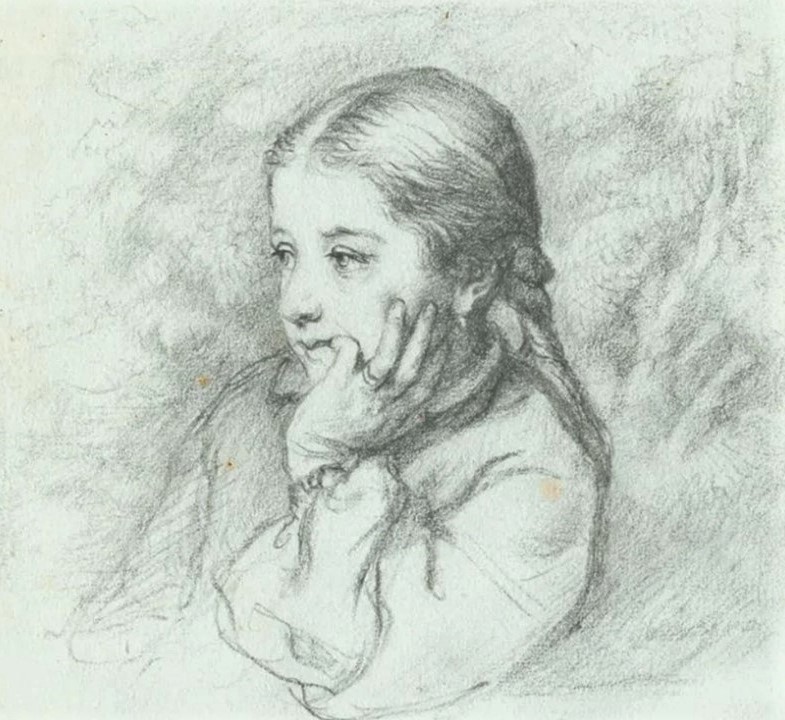
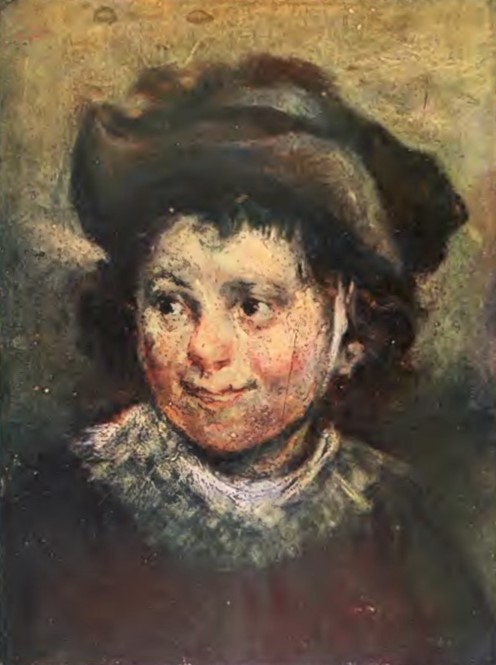
Desboutin often depicted his family, especially his children. In this sense he can be called an Intimist avant-la-lettre (see iR3). He depicted his children and wife in many drawings, especially in Nice from 1881-1887 (R158,p192), but also on paintings and etchings, which he just rarely exhibited.
Sources indicate that his daughter Marie was born, from his first wife, in 1854. And from his second wife, his son André (Mycho) was born in 1870, his son Jean-François (Tchiquine) in 1878 and his daughter Jeanne-Françoise in 1880. Clément-Janin wrote that 3 of the 9 children from his second wife survived (R158,p107). Pierre (1876-1877) is explicitly named (iR79). I think, that is why we find titles of his works made in 1873, like a ‘baby chair’, a ‘mother breastfeeding her child’, ‘baby’, ‘baby playing’ and ’the cradle’ and again in 1874 ‘baby’ (R158,p261).
I think we should be very critical in the dating and naming of the art-works that Desbouting depicted of his children. The double first names and the variety of nicknames doesn’t make it easier to distinguish who is who. We must take into account, that boys were dressed like girls the first years of their lives and also the possibility that a diseased child of Desboutin was depicted or another child. We must first look at art-works that are dated and / or engravings on which a name is depicted.
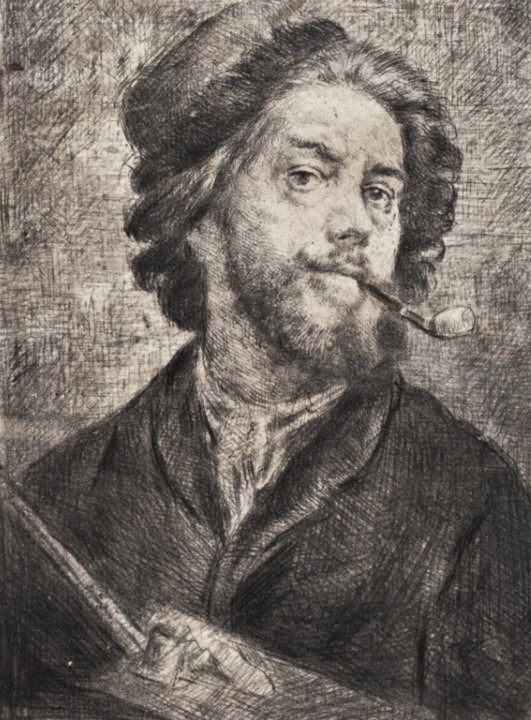
Marcellin Desboutin made many self-portraits as well oil paintings as engravings.
See (partly thematical) overview of his pictures.

Marcellin-Gilbert Desboutin, a short biography:
- 1823/08/26 Marcellin-Gilbert Desboutin was born in Cérilly (Allier), west of Moulins and about 300km south of Paris (iR24;iR26;iR504;iR70;iR79;aR10;R158); Geneanet renders the birth certificate the 27th indicating that Gilbert Marcellin was born yesterday in Cérilly (see; iR79).
Note: Beraldi (1886) wrote that Desboutin was born in 1822 (R85V,p188)
Desboutin was born into a wealthy, aristocratic family and signed as ‘Baron de Rochefort’, after his mother Anne-Sophie Dalie Farges de Rochefort (iR79;iR70;iR3;R85V,p192;R88) - 1828/01/18: his sister Louise Virginie was born;
she would mary Théophile Jacquelin Dubuisson in 1847;
they had 3 children: Marcellin (1848), Marguerite (1849) and Antoinette (1851).
she died in 1852 in Paris; she had 2 children (iR79;aR9) - 1842: his father died (iR79;aR9;R466,p1)
His mother moved to Clermont-Ferrand, 115km south of Cérilly (aR9) - Desboutin first studied law (R88;R9;aR9;R465,p10)
- 1854/04/13: Desboutin married his first wife Justine Gaultier de Biauzat in London / England, who was a widow
(iR79;aR7;R88;R466,p1), or in Issoire south of Clermont-Ferrand (aR7?); another source mentions this was 1854/01/13 (aR9) - end 1854: his daughter Marie Desboutin de Rochefort was born in England (R158;iR79;iR4)


- 1854 till about 1870 Desboutin lived in Italy, especially in ‘villa dell’Ombrellino’ in Florence (R85V,p188;R88;aR7). Others mention that he came to live in Florence in 1857 (R9;R466), or that he acquired the villa in 1857 (iR4).
- 1869: Desboutin lived at Florence, villa dell’Ombrellino; his correspondence address was: chez M. J. Amigues, rue Bellechasse, 29 (iR1)
- 1870/04/29: his mother died in Clermont-Ferrand (R158,p60;iR79;aR9)
- 1870ca: Desboutin started a relationship with Dominica Teresa Bellardi, with whom he would got a son 1870/09/01 and with whom he would officially marry 1877/02/22.
- 1870/09/01: his son Andréa Filippo Marsilio Bellardi Desboutin was born in Florence; mostly mentioned André (or nicknamed Mycho or Michaud); he would die in 1937 (iR79;iR4;aR9;R158,p122)
- 1870-73: Desboutin spend time in Geneva (R88;R3;aR7)
- 1871/08: his daughter Marie married Guillaume or William Brackken (iR79;R158,p67;aR9)
Marquis claims that Desboutin left Florence afterwards (R465,p11); other sources also mention 1871 (R466,p1), but according to others this had happined the year before.
His first wife Justine would stay with her married daughter. - 1873: his first wife, Justine Gaultier de Biauzat, died on a winter morning in Florence (R158,p67;iR79;aR9;R465,p11); other suggest this was in 1870 (aR10)
- 1873 Desboutin moved to Paris, 10, Rue d’Arcet (Batignolles) (iR1;R3)
- 1874: Léon de Groër claims that Desboutin sold his villa in Florence in 1874 (R466,p1), but most sources write that Desboutin left earlier.
Note: Beraldi (1886) (wrongly) mentioned that Desboutin lived untill 1875 in Florence (R85V,p188). - 1874+75 lived at 32, Rue des Dames (Batignolles) (iR1)
- 1876 moved to 21, Rue de Bréda (iR1;R2,p161); this was a gloomy, single room (R465,p11).
Note: I could only find this adres in Montluçon, which is 40km south of his birth place Cérilly. There is not such an address in Paris; but, maybe it has changed throughout the years. - 1876/11/13: his son Pierre was born in Paris and would die after 13 months 1877/12/19 also in Paris (iR79).
- 1877/02/22: Desboutin officially married his second wife Dominica Teresa Bellardi in Paris (aR9;iR79); Geneanet renders a marriage certificate (iR79)
- 1878-80: Desboutin rendered as his (correspondence) address rue Rochechouart, 38, Paris, where he rented a studio (iR1;R158,p82+140)
- 1878/09/01 his son Jean-François was born in Paris; he is known under many names: in Italien Francesco or Franceschino or Cecchino, in French verbalized to Tchiquine or Chiquine); he also would become a painter and was known as Jean Desboutin; he would die in 1951 (R158,p120/122;iR4); Geneanet mentions he was born the 3rd (iR79);
another source mentions his name was Pierre-François and that he was born 1873/11/13 (aR9);
in 1922 he owned several of his father’s art-works (R158). - 1880/02/27: his daughter Jeanne-Françoise Desboutin was born in Paris (she would die in 1962) (iR79;aR9);
note: an almost similar name as her older brother Jean-François;
maybe in 1922 she owned several of her fathers art-works; in the Clément-Janin list the name Jean Desboutin and J. Desboutin is noted; but, 1918/06/03 she married Jacques Barnathan in Alger (iR79); so in 1922 she probably was known under her married name (R158,p259-276)


- 1880/12/23: sale at Hôtel Drouot before leaving for Nice; the catalogue rendered 102 titles, but without indication of technique; 11 engravings (no.103-113); furniture and objects (no.114-121); ancient bronze objects (no.123-169); with a preface by Jules Claretie; Durand-Ruel would buy around 81 art-works; the sale yielded 18.147 francs (R158,p35+36+124;aR15;R466,p2)
- 1881/10/09 Desboutin bought a villa, at 179, rue de France in Nice, for 33.000 francs, which he (later) also rented to others (R158,p107+124+159;R466,p2)
Desboutin would live till 1888 in Nice (R3;R9;iR3;R88)
Some sources mention that he dwelled again in Geneva (around 1887/88) (R88)
Note: that the Salon database mentions that he lived in Nice in 1884 + 85 + 86 +87 and before (also) in Paris (iR1):
1881: Desboutin lived at rue Lepeletier, 47, Paris (iR1)
1882+83: Desboutin lived at rue Pasquier, 31, Paris (iR1)
1884-87?: Desboutin lived at Nice, rue de France, 179 (iR1;R158,p82), close to the Mediterrenean Sea (iR9)
In 1884 his correspondence address was: Paris, chez M. E. Berend, rue Rochechouard, 38 (iR1). Note: from 1878-80 he had a studio there (iR1;R158,p140).
In 1885: chez M. Eberstadt, rue des Abbesses, 11, Paris (iR1) - 1887 April: Desboutin returned to his studio rue Rochechouart, 38, which he rented for a year (R158,p140;iR1)
probably after an earthquake (R466,p2) - 1887 Autumn: probably works of Desboutin were exhibited in Geneva (R158,p142)
- 1888/01/12: Desboutin returned to Nice, where he had his family left behind (R158,p142/3)
- 1888 March: probably there was an exhibition at Bernheim-Jeune in Paris (R158,p142)
- 1888/07/03: Desboutin arrived in Geneva and dwelled at 9, rue de l’École in Paquis (Geneva) for some time (R158,p144); maybe now (iR9)
- 1888/12/30: probably an exhibition at the Musée des Arts Décoratifs in Geneva with 180 etchings (R158,p144-146)
- 1888/89: Desboutin lived again in Paris for 7 years (R466,p2)
- 1889/01: There was an exhibition ‘Peintres-graveurs à Paris’ showing 167 dry point etchings of Desboutin, organised by Durand-Ruel, with a preface by Zola (R158,p145-147;R85XIII,p33;iR65;R3;R88).
- 1889/02/01: Desboutin joined ‘Les Vingts‘ in Brussels with maybe 80 ‘cadres d’epreuves’ (R158,p145/6).
- 1889/07/08 – 08/14: ‘Exposition de l’oeuvre gravé de M. Desboutin’; organised by Durand-Ruel, with a preface by Zola (Ar10,P61)
- 1889: Desboutin lived at rue Rochechouart, 74, Paris (iR1)
- 1890+91: Desboutin lived at 5, impasse de Guelma (Paris-Montmartre) (iR1;R158,p82+149)
- 1892+93: Desboutin lived at 9, cité Véron (place Blanche) in Paris (iR1;R158,p82+149)
- 1894: Desboutin lived at 5, rue Bréda* in Paris (iR1), according to Clément-Janin from 1891-95 (R158,p82+150)
Note: see notation at 1876↑. - 1895+1896: Desboutin lived at 15, rue Bréda (iR1), according to Clément-Janin only in 1896, which doesn’t seem right; Clément-Janin mentioned that Desboutin changed from appartement in the same building (R158,p82+150)
- 1895 Signorini and Uzielli worked on a book about Desboutin (iR70)
- 1896: Desboutin exhibited 3 art-works in Moulins (aR9;M207), 45km east of his native city (iR9)
- 1896-1902 lived again in Nice (R3;iR3;R88;R466,p2)
- 1896-1899?: Desboutin lived at the Villa Mossa, route du Var, Nice (Alpes-Maritimes), close to the pond Magnan (iR1;R158,p82+159); I couldn’t find this location; Clément-Janin suggests this was his first house during his second stay in Nice since 1896.
- 1901: Desboutin lived at rue Saint-François-de-Paul, 24, Nice (iR1;R158,p82)
- 1900/09/16 his daughter Marie died in Bad-Nauheim, Hesse Germany (iR79;iR4)
- 1902/02/18 Marcellin-Gilbert Desboutin died in Nice, along the French Riviera (iR24;iR26;R88;iR79;iR504); Geneanet renders the death certificate (iR79). According to Clément-Janin at Rue Saint-François-de-Paule (R158,p82). Other sources mention he died the 17th (aR10). Note: it is well possible that the death certificate was dated the 18th, noting that Desboutin died the day before, so the 17th.
Other sources (wrongly) mention he died in 1901 (iR23)
Desboutin left behind 2000 paintings, 300 engravings and many drawings (aR9) - 1902: there had been an exhibition in Nice (R466,p2)
- 1902/12/11-31: there was a retrospective exposition at the École des Beaux-Arts (R88;aR7;aR9;R466,p2), according to Clément-Janin with 194 paintings, 477 (or 297) engravings and a legion of drawings (or 34) (R158,p112+167).
- 1912: 1 self-portrait was exhibited at the Centennial exhibition in Saint-Petersbourg (aR3=iR261)
- 1922: publication of Clément-Janin: La curieuse vie de Marcellin Desboutin: peintre, graveur, poète. Paris, 1922 (R158;iR24;iR65;iR3;aR9).
- 1923: there was a retrospective held at the Société Nationale des Beaux-Arts (R466,p2;R88)
- 1925: a large retrospective was held in Moulins (aR7;M207)
- 1943: there was an exposition in Carras (R466,p2)
- 1967/03/17 – 04/17: there was an exposition in Nice; it consisted of 54 paintings (1-53+hc2), 81 engravings (56-136), 27 drawings (137-163), 1 aquarelle (hc1) and 3 portraits of Desboutin: 2 paintings by Degas (54+55) and 1 drawing by Antoine Trachel (1828-1903) (164) (R466)
- 2016/12: there was a large sale at the gallery Paul Prouté in Paris showing 30 drawings (1-30), 1 oil painting (31) and 119 engravings (32-150) (aR10)
- 2017: exposition at the Fitzwilliam Museum in Cambridge of drypoints of Desboutin; with a exhibition catalogue by Amy Marquis (R465)
- 2018/10/20 – 2019/09/15: large exposition ‘Marcellin Desboutin, à la pointe du portrait’, showing about 190 art-works, in the Musée Anne-de-Beaujeu in Moulins (aR5;aR6;aR8;M207)
- 2023/03/18: many works of Desboutin were auctioned at Osenat Fontainebleau (aR18=iR508)


Sources:
My main sources are:
Beraldi (1886=R85V=aR1=B+1885-92=R85XIII=aR2=Bs),
Clément-Janin (1922=R158=aR13=CJ).
Léon de Groër; Nice expo (1967=R466)
Amy Marquis; Cambridge expo (2027=R465)
Other sources are: Rewald (1973=R1), Moffett (1986=R2), Walther (2013=R3,p659), Roe (2006=R4), Denvir (1993=R5), Schurr & Cabanne (2008=R9,p234), Monneret (1978-81=R88I,p196/7), Adler (1998=R89), the Salon database (iR1), archive.org (iR19), Wikipedia (iR3; iR4), RKD (iR24), BNF / gallica (iR26;iR40), Marques (iR65), Benezit (iR69), Grove Art Online (iR70), Geneanet (iR79), Geneastar (iR504).
My main sources (for the pictures) from the internet are the Athenaeum (iR2), Wikimedia (iR6), Google art (iR8), Mutualart (iR11), artnet (iR13), Sothebys (iR14) Christies (iR15), invaluable (iR17), gallica (iR40), Pinterest (iR64), Flickr (iR94), Proantic (iR116), Getty images (iR139), Meisterdrücke (iR155) and Google images (iR10). Collections in musea: Orsay (M1); MAH Geneva (iR141). See link for other general references (=R) and for other references to internet sites (=iR). For other additional references (=aR) see below. See links for practical hints and abbreviations and for the subscription of the paintings.
For further reading see:
Page, Alexandre + Maud Leyoudee (and others): Marcellin Desboutin, 1823-1902; à la pointe du portrait; exhibition catalogue. MAB Moulins, 2018 (R275;aR11;aR9).
Bénézit (1976=R75=iR69), Busse (1977=R77), Witt Library (1978=R78), Allgemeines Künstlerlexikon Vol.26 (2000=R81=iR75) (see iR24).
Additional references:
- gallica.bnf.fr//henri_beraldi_tome_5 (the entire 5th Volume of Henri Beraldi: Les graveurs du XIXe siècle with works about Desboutin; =iR40 = R85V)
- gallica.bnf.fr//henri_beraldi_tome_13 (the entire 13th Volume of Henri Beraldi: Les graveurs du XIXe siècle with supplements about Desboutin; =iR40 = R85XIII)
- “Marcellin Desboutin.” In Database of Modern Exhibitions (DoME). European Paintings and Drawings 1905-1915. Last modified Nov 4, 2019. http://exhibitions.univie.ac.at/person/ulan/500032215 =iR261; overview of contributions of Desboutin in exhibitions and auctions from 1910+1912 (3 entries).
- omnia.ie//Desboutin (overview of his etchings)
- youtube.com/watch/1 (impression of a large exposition about Desboutin in 2018 in the Musée Anne-de-Beaujeu in Moulins (Allier, Auvergne); =M207)
- youtube.com/watch/2 (11 minutes of information in French about a large exposition about Desboutin in 2018 in the Musée Anne-de-Beaujeu in Moulins (Allier, Auvergne); =M207)
- monbourbonnais.com/desboutin (info and pictures on Desboutin; =M207)
- lamontagne.fr/moulins (article on the 2018 exposition)
- vudubourbonnais.worldpress.com/2018 (article on the 2018 exposition)
- galeriepaulproute.fr/Cat150 (sale catalogue of 150 works by Desboutin; 2016/12, Paris; note: the link doesn’t work anymore)
compare: galeriepaulproute.fr//desboutin. - publications.faton.fr/desboutin (preview of the 2018 exhibition catalogue; note the connection doesn’t seem save)
- archive.org/ia802707 (PDF of Clément-Janin: La curieuse vie de Marcellin Desboutin: peintre, graveur, poète. Paris, 1922 (=R158=iR19); note many pages are quite vague.
- forgottenbooks.com/desboutin (PDF of Clément-Janin: La curieuse vie de Marcellin Desboutin: peintre, graveur, poète. Paris, 1922 (=R158=iR364); note some pages are not rendered, only when you pay).
- gallica.bnf.fr/desboutin (starting page with links to engravings of Desboutin; =iR40)
- gallica.bnf.fr/bpt6k851965v (auction catalogue of works of Desboutin at Hôtel Drouot 1880/12/23; =iR40)
- adventures189.rssing.com/9674375 (article on Desboutin and pictures)
- georgeviau.fr//desboutin (art-works of Desboutin in the former collection of Viau; =iR493)
- osenat.com//135665 (many art-works of Desboutin were auctioned at Osenat Fontainebleau 2023/03/18 from the collection of the greatgrandson; no.232-245; =iR508)
- garrystockbridge617.getarchive.net//desboutin (many pictures of Desboutin)
Recommanded citation: “Impressionism: Marcellin-Gilbert Desboutin, a portraitist and engraver with ‘impressionist’ connections, joining the 2nd ‘impressionist’ exposition. Last modified 2026/03/27. https://www.impressionism.nl/desboutin-marcellin/”
Note: additional info and pictures will follow.