Impressionism: a historical reconstruction
Impressionism
according to Duranty
Introduction:
Louis-Emile-Edmond Duranty (1833-80) was a Naturalist, novelist, journalist and a small art-collector.
In 1856/57 he published the journal ‘Réalisme’ (only 7 times) (aR4-9). He wrote in the 1860s novels and short stories in a dogmatically Realist-Naturalist approach. He was a regular visitor of Café Guerbois and Café Nouvelles Athènes. After a quarrel over one of his reviews he duelled 1870/02/23 with Edouard Manet. They stayed friends afterwards.
Duranty defended the ‘impressionists’.
May 1876 Duranty published the pamphlet ‘La nouvelle peinture; à propos du groupe d’artistes qui expose dans les Galeries Durand-Ruel’. It consisted of 38 pages. It was much influenced by Degas and described the ‘impressionists’ as the new Realism. On this page we will look extendedly at this article and the view Duranty had on Impressionism↓.
In 1877 he published a novel ‘La peinture Louis Martin’, on the modern life of an artist, interwoven with theories (R3,p196).
In 1879 he reviewed the 4th ‘impressionist’ exposition in La Chronique des arts et de la curiosité ↓. He namely praises the impressionist Monet and Pissarro and among the others Degas and Cassatt.
Duranty also was a small art-collector.
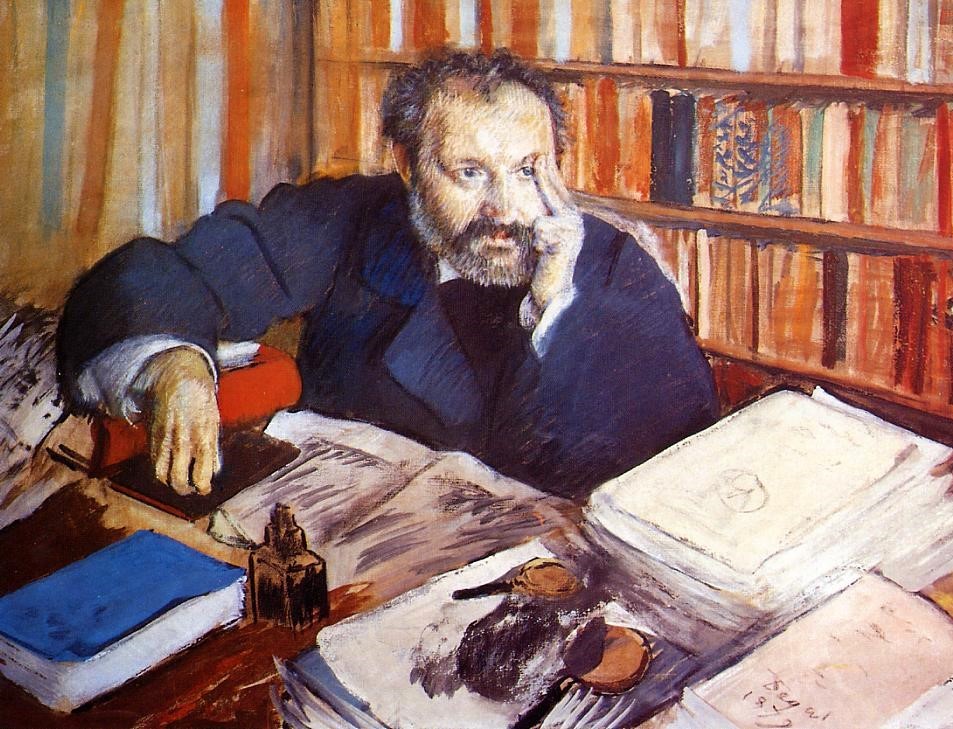
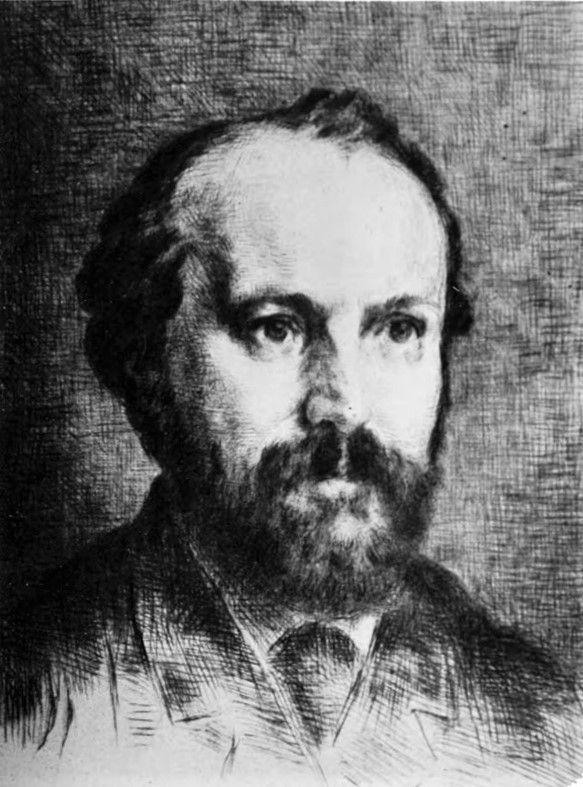
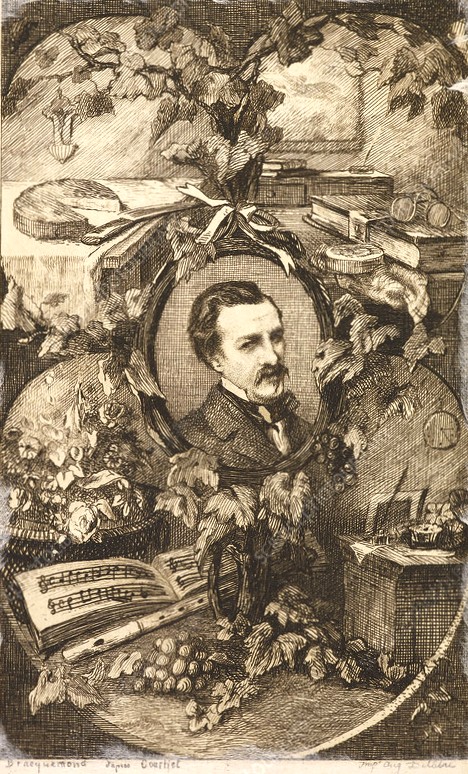
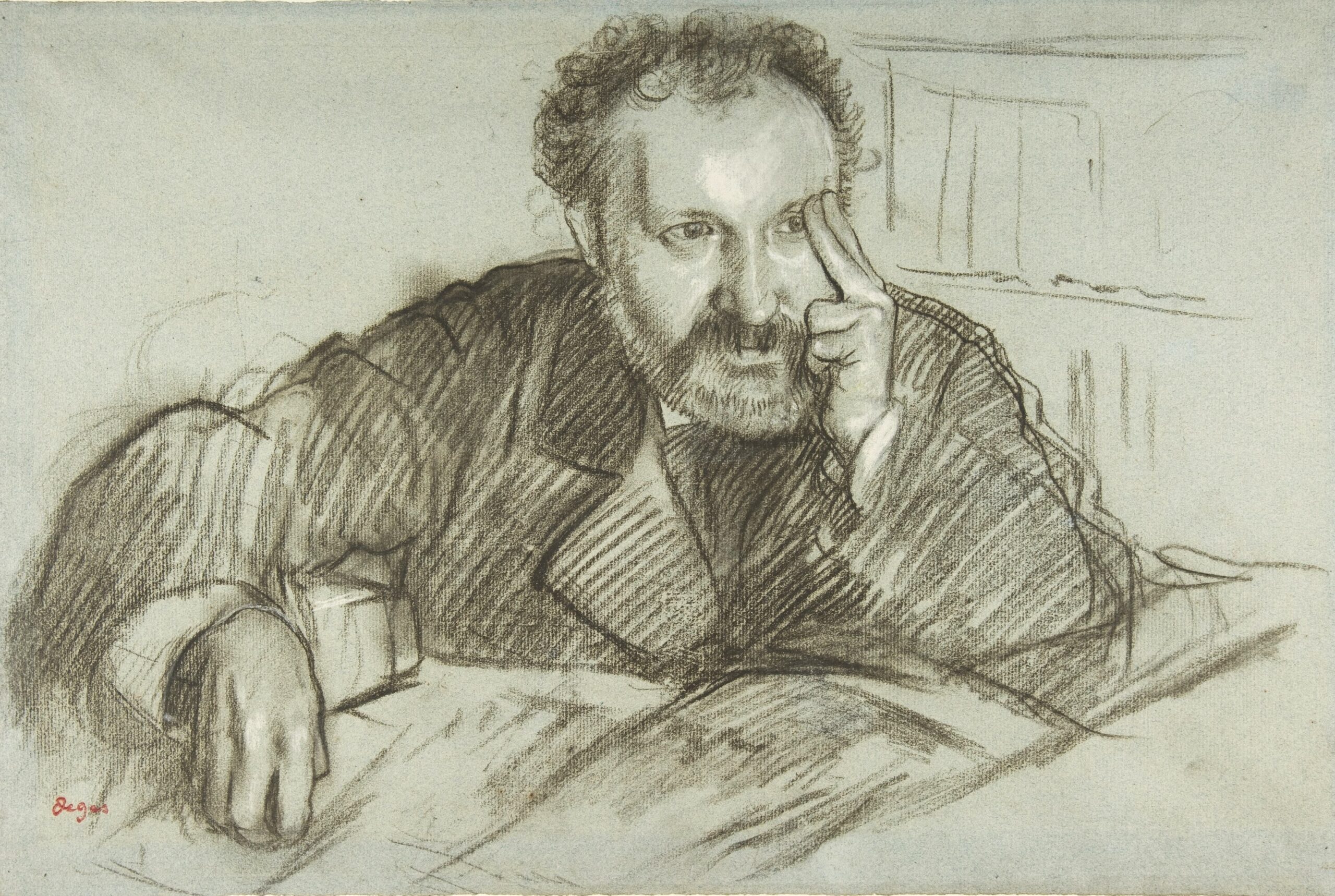
Duranty was portrayed by Fantin-Latour in 1864, by Degas in 1879 (see 4IE-1879-58) and by Desboutin. Probably Félix Bracquemond made an etch after a drawing that Courbet made of Duranty.
Duranty died aged 46 1880/04/09. A few people were present at his funeral, including Degas, Manet, Pissarro and Raffaëlli (R5,p116;iR5). 1885/12/16 he was reburied at the Père Lachaise cemetery in Paris (aR2).

La Nouvelle Peinture:
Probably in April* 1876 Duranty wrote the pamphlet ‘La nouvelle peinture; à propos du groupe d’artistes qui expose dans les Galeries Durand-Ruel**‘. It consisted of 38 pages. In this essay Duranty described the avant-garde art with it’s new stylistic approaches and called it simply ’the new painting’***. He avoided the word ‘Impressionism’ or any other restrictive term that implied stylistic exclusivity. His point of view is predictably prejudiced in favour of Realist-Naturalist thinking and seems to have been influenced by Degas.
Moffett (1986=R2,p477-484) and Berson (1996=R90I,p72-81) both render the original French text. In this text Duranty doesn’t give the names of the artists he is referring to. 1878/09/09 he added those names in a copy send to the Italian art-critic Diego Martelli. I namely use the English translation rendered in Moffett (1986=R2,p38-47).
Note*: Duranty writes ‘I am less concerned with the actural exhibition than its cause and idea’ (R2,p42+37). This refers to the 2nd ‘impressionist’ exposition, that took place April 1876. So, he must have written it somewhere in this month. Denvir writes that Duranty published it in May (R5,p94/5).
Note**: Though Duranty explicitly refers to the 2nd ‘impressionist’ exposition in the subtitle and also a single time in the text and though he hints to some exhibited art-works, namely of Caillebotte and Degas (R90I,p78), he doesn’t explicitly review this exposition.
Note***: The 1986 exposition on the 8 ‘impressionist’ expositions organised by Moffett c.s. was called the New Painting after this pamphlet ‘in order to draw attention to the full spectrum of the modern movement’ (R2,p13; R3,p11). I don’t think it was an appropriate title, see ‘why Impressionist?’.
Some discussions on this pamphlet:
In the introduction to the English translation of the article Moffett writes: ‘The New Painting begins with a refutation of a recent article by Eugène Fromentin (1820-76), who had attacked new tendencies in painting and defended the principles of academicism. In his essay Duranty explores the origins of the new art and defines its position vis-à-vis the principles advocated by the École des Beaux-Arts… he recognized that art was changing profoundly as a result of avant-garde innovations and attitudes. However… Duranty’s point of view is predictably prejudiced in favour of Realist thinking and seems to have been influenced by the example of his friend Degas. (..) The New Painting impresses upon us in a general way the viability and worthiness of subjects from modern life, and the new stylistic approaches appropriate to them. (…) The very first idea, was to eliminate the partition separating the artist’s studio from everyday life, and to introduce the reality of the street…’ (1986=R2,p37)
His colleague Hollis Clayson fortheron in the ‘New Painting’ extensively discusses this pamphlet and calls it ‘a review of the second exhibition’**↑ (1986=R2,p148/9). He writes ‘The first half of the essay concerns the new painting’s history and parentage.’ Naming that they admire tradition and simultaneously attack it. Clayson continues: They are innovative in 4 ways: the use of colour, drawing, composition and subject matter. The colourists / landscape painters represent nature the way it appears to the eye. In their drawing ‘a back should reveal temperament, age, and social position’. In their composition they reveal that things are often seen from pronounced angles and are glimsed only partially. And lastly they record the diverse aspects of modern life. Clayson states that Duranty ‘clearly found the landscape contingent the weaker’.
Earlier on in his History of Impressionism Rewald also discussed this pamphlet, using many citations (1973=R1,p376-378). Rewald starts with the citation Duranty rendered of his own words from 1856 in which he pleaded for Realism, for rendering ordinary life. Duranty saw in Degas above all the commentator of modern life. Rendering individuals in their typical attitudes, their professional actions and revealing through a simple gesture an entire range of feeling. After attacking the École des Beaux-Arts, Duranty set out to prove that the new art movement had its roots in the past, pointing to several artists. He pointed to the new qualities of this group ‘A colour scheme, a king of drawing, and a series of original views. (…) The most erudite physicist could not quarrel with their analysis of light. (…) its essence was to capture the instant*.’ Duranty sees a group of painters with eccentric and ingenuous characters, visionairies alongside profound observers. He ends with uttering his lack of confidence in the future of this modern art-movement. Rewald at last renders some reactions on this pamphlet: ‘Renoir… was extremely annoyed, while Monet treated the publication with mute disdain.’
Note*: Rewald cites more the elements concerning landscape painting, than the elements concerning figure drawing and the ‘series of views’.
Walther shortly discusses this pamphlet (2013=R3,p196/7). Duranty wrote a short history of Realism and a programmatic introduction to further development. he chose side of Degas and Manet and didn’t stand up for the landscape painters* like Monet, Sisley and Pissarro and refused to use the term Impresssionism.
Note*: Still, Duranty pleads to paint the whole painting in situ, praises the landscape painters for analysing and rendering the observed colours influenced by sunlight and the vibration of the rendered colours.
A summary of the pamphlet:
Duranty starts with extendedly citing an article of Eugène Fromentin 1876/02/15 in Revue des Deux Mondes. Fromentin praises the sound observation of the so-called doctrine of Realism. This new painting renders striking, truthful and literal images. It recreates exactly the sensation of what is seen in the street, depicting contemporary costumes, faces, costoms, tastes, habits, and spirit. Fromentin includes open air painting with it’s diffused, real sunlight, using bright colours, leaving out bitum black. Fromentin misses the whole truth which he finds in history painting. He finds this new painting crude and misses refinement, finds it rigid and misses the fluid and also the black and white contrasts (the chiaroscuro).
Duranty criticises Fromentin for depicting contemporary Arabs and their costumes, faces, and customs. Duranty also criticises others from the new generation of the École des Beaux-Arts, namely Gustave Moreau, for finding their inspiration in mythology, ancient history and archeology. He criticises them for blending all art styles and manners in a ‘strange ragout’ of clashing colours and confused forms, naming Jacques Fernand Humbert and Fernand Cormon. They lack individuality and originality. Duranty cites approvingly Lecoq de Boisbaudran (1802-97), who criticises pupils that slavishly follow the path recommended by the École, aiming for the Prix de Rome, with it’s daily repitition of painting models and imitating previously honoured works.
Duranty writes about ‘a battle’ between traditional art (which is in disarray) and the new painting (that already has lasted for a long time); between the 2nd ‘impressionist’ exposition in 1876 at the Durand-Ruel galleries and the Ecole and the Institute (naming Gérôme and Jean Vibert). Duranty mentions that Ingres admired Courbet and Flandrin encouraged Legros (who had a passion for contemporary religious scenes in which he was able to express both naivete and grandeur, whether n his paintings or in his powerful etchings). The new movement little by little evolved and discovered real character in its subjects and in its composition.
Duranty depicts the first manifestations of this new paintings by the following painters: Courbet his Enterrement (M1) and his Demoiselles (M4); Ingres (executed portraits of such simplicity and truth); Millet (depicted the land bathed in radiant light); Corot and Chintreuil; Jongkind (a painter of perfect tonalities); Boudin (rendering the essence of the seascape). They first appeared at the Salon des Refusés in 1863*. Since then several of them have won medals and found fame.
Note*: Only Chintreuil and Jongkind exhibited at this Salon des Refusés.
Duranty continues with the following painters: Legros (in L’ex-voto he depicted ordanary women, dressed in ordinary clothes, with lined faces with a profound intensity); Whistler (who exhibited in the Durand-Ruel galleries in 1873 remarkable portraits and paintings with colour variations of infinite delicacy); Fantin-Latour (the most marvelous flower painter also remarkably depicted characters); Manet (produced the most daring innovations (…) he did not let in only a crack of light, but flung wide the windows (…) he advanced in the open air (…) he placed himself in the forefront of the movement (…) his works are full of depth and originality; later Duranty calls Manet ‘one of their leaders’ (p46).
Duranty also mentions that Théodule Augustin Ribot, Antoine Vollon and Carolus-Duran were shortly associated with this movement. He also mentions Alfred Stevens (a Belgian painter; a man of modernity); Giuseppe de Nittis (who loves to depict the street life). Duranty also mentions the engravers Meryon and Felix Bracquemond (a remarkable portraitist in the manner of Holbein). (Later Duranty also mentions Desboutin and Lepic and the art of dry-point printmaking: ‘literally painting by a clever manipulation of the ink at the moment of printing’ (R2,p45). Duranty sees printmaking as an integral aspect of the new art (R2,p48/note 30.)
Duranty remarks ‘I am less concerned with the present exhibition than its cause and idea’. He sees the ambivalent relationship with the Ecole / Salon: ‘these artists who wrestle with tradition, admire it, and simultaneously want to destroy it’. These painters contribute a new method of colour, of drawing, and a range of original points of view*.
In the field of colour they made a genuine discovery for which no precedent can be found. It lies in their realization that strong light discolours tones and that sunlight reflected by objects tends to restore that luminous unity. Light in nature reflects both the spectrum of all light-rays and the tint of the sky. These new painters succeeded in splitting sunlight into its prismatic rays and then reestablishing its unity in the general harmony of the iridescent colour that they scatter over their canvasses. In certain canvases you feel the vibration and palpitation of light and heat. (Partly this is inspired by Japanese prints.) The Romantic artist has the idea that light could not exist unless surrounded by shadow, without bitumen.
On the subject of drawing, Duranty approvingly sites an Essay on painting of Diderot on the Salon of 1765. In this essay Diderot pleads for a drawing from nature, convincingly demonstrating through the external appearance of the model its age and its condition. Duranty continues and writes that drawing should reflect the inexhaustible diversity of character, the special characteristics of the modern individual. It needs the observation of all aspects of the environment, the clothing, the attitude, the social situations (at home, in the street). Duranty states that the physiognomy of ‘a back should reveal temperament, age, and social position; a pair of hands should reveal the magistrate or the merchant; and a gesture should reveal an entire range of feelings.’ Duranty criticizes the drawing of models in the ateliers and the copying of old paintings, which treats the human body like a vase and in fact is only an imagination.
The range of new ideas that led to the development of this artistic vision came namely from Edgar Degas. A man of uncommon talent who inspired many others. The first idea* is to focus on every day life and to introduce the reality of the street. Duranty remarks that rooms and streets have their own special laws of light and visual language. The colour depends on the hour, the season, and the place in which it is seen. The light in the Dutch interiors of the old paintings is another light than in contemporary homes, in which tonal values vary infinitely. Combining the image of an interior and the same interior shaded by a cloud, will cause that the truth of the impression will have disappeared. And a person never appears against a neutral or vague background, but instead against a surrounding background that indicate financial position, class and profession. Our viewpoint is not always located in the center of a room, but sometimes very high, or very low and the lines and angles do not always follow mathematical regularity and symmetry. Sometimes furniture is abruptly cut off. Through the windows we receive constantly changing views. A figure is never in the center of a scene, nor of the canvas.
The new painters have tried to render the walk, movement, and hustle and bustle of passersby, just as they have tried to render the trembling of leaves, the shimmer of water, and the vibration of sun-drenched air; just as they have managed to capture the hazy atmosphere of a gray day along with the iridescent play of sunshine. But, almost all landscape painters lack a feel for the structure of the land itself. It seems preferable to paint the whole landscape in situ, and not form a sketch brought back to the studio, because one gradually looses the first impression.
At last** the subject matter of art includes the simple intimicies of everyday life. Duranty cites one of his entries in his Journal Réalisme: ‘I have witnessed… a wide range of actions and events… and milieux. (…) Differences in dress played a large role in these scenes and coincided with differences of physiognomy, manner, feeling, and action.’ Duranty dreams of series of paintings of various people, various characters in various activities.
Note*: The first aspect of colour relates more to landscape painting. The drawing and the points of view refer more to the painting style of Degas (and partly Caillebotte).
Note**: Duranty mentions clearly the first and the last of a range of new ideas, but in the middle the ideas merge.
About the group Duranty writes: Rather than acting as a group who share the same goal… these artists above all are people of independent temperaments. They come in search of freedom, not dogma. They want to work without restraint. They are not concerned with finish and correctness. Duranty claims that in studies ‘the thought, intention, and draftsmanship of the painter often are expressed with greater speed and concentration. In this work one sees more grace, vigor, strength, and acute observation than in a finished work’ (p46).
Duranty cites writings of Constable who makes a contradiction between the dogmas of school versus the heart, between imitating works and painting from nature. “When I sit down to make a sketch from nature, the first thing I try to do is, to forget that I have ever seen a picture.” Only the humble mind is permitted to see nature in all her beauty.
Duranty then cites Emile Zola (L’Artiste 1867/01/01) concerning Edouard Manet: Works are judged by the common standard of the Greek ideal of beauty. But, Zola seeks works of art that show a new side of nature with all the power or gentleness of his temperament.
Duranty ends somewhat dishearted. Will these artists achieve their goals? Or will they simply be cannon fodder? Will their ideas be snatched by others? The voyage is dangerous and some of their boats are quite small and narrow. (He sidely remarks these painters are more appreciated in England and Belgium.)
In his essay Duranty also makes some critical remarks on the new painters: ’too often they produce nothing but sketches’ and: ’there are unfortunate attempts that grate on the nerves’.
Characteristics of the new painting are:
In his essay Duranty mentions the following characteristics of the new painting:
- Open air and real sunlight
- Light in nature reflects both the spectrum of all light-rays and the tint of the sky
- Rending the trembling of leaves, the shimmer of water, and the vibration of sun-drenched air… the hazy atmosphere of a gray day… the iridescent play of sunshine
- in studies ‘the thought, intention, and draftsmanship of the painter often are expressed with greater speed and concentration. In this work one sees more grace, vigor, strength, and acute observation than in a finished work’ (p46).
- The observation of all aspects of the environment
- Streets have their own special laws of light and visual language
- ‘the logic of colour … which depends on the hour, the season, and the place in which it is seen’ p44
- Originality and spontaneity
- Real character; faces with profound intensity
- Gestures and sentiments appropriate to their class and rank
- a back should reveal temperament, age, and social position
- An atmosphere is created in every interior, along with a certain personal character that is token on by the objects that fill it.
- A person never appears against neutral or vague backgrounds
- A viewpoint is never the same; sometimes it is high, sometimes low
- A figure is never in the center of a scene
- elements are abruptly cut off
- series of paintings of various people, various characters in various activities
- The simple intimacies of everyday life

1879 review:
1879/04/19 Duranty reviewed in La Chronique des arts et de la curiosité the 4th ‘impressionist’ exposition in a review called “La Quatrième Exposition faite par un groupe d’artistes indépendants”. (R90I,p218/9)
Duranty starts his review by writing ‘We are about to enter a somewhat sensitive territory’ and he labels the exposition as ‘a very curious case in the history of contemporary art’. He explains ‘Independent means they don’t want to exhibit at the Salon‘ and he claims ’this can cause a chance in the general policy of fine arts’.
Duranty writes ‘I will first place myself under the auspices of Paul Mantz and refers to his review given in 1877. He compares this exposition with the exposition of ‘aquarellistes’ praising the works of Jules Jacquemart, an impressionist, at the latter exhibition.
He explains ’they are impressionists, realists and artists without label’. Still, most of the impressionists, wanted to take their chances at the Salon.
Duranty continues: At the l’avenue de l’Opéra one finds only Monet, Pissarro and Caillebotte. The impressionists that are influenced by Jongkind, Boudin and Manet. Since 10 or 12 years Monet, very closely related to Jongkind, became involved with the use of vibrant colours using seperated touches of paint and in full tones intertwined, but not broken, almost always proceeding from a violet and bluish range. The bold, luminous tones in the marines and skies of Boudin have already caught Monet. Finally, the astonishing revelations of clarity, which was taught by no-one but Manet, gave the last and decisive impulse to the group of painters among which Pissarro searched and eagerly explored various paths. In this way this school of full sunlight, so curious in the colour searching, who appeared frequently bizar and chocking. (…) Their close encounter with light was not at all convenient. It was necessary to decompose the elements, to systhematically study the iridescence of colour, of the violet, blue, yellow and pinkish tones. Monet and Pissarro leave out the unnecessary, they sacrifice detail for the sake of the whole. There is a direct connection between Monet and Théodore Rousseau and also between Pissarro and Millet (R2,p288).
As for Caillebotte, it may well be that he was the victim of the blue and violette palette. One sees in 3 or 4 portraits a kind of cruel intensity that captures you by its ponderous insistence. I would like to see him become more playful in his art, and less obstinate in his savage and dreary attempt to violate nature. (R2,p274)
Duranty marks, sofar for the impressionists, now the others:
That surprising artist named Degas is here at the exhibition with all his sarcasm and sharp wit, all his capriciousness. 20 painters owe their success to his influence; he will be esteemed in coming years. (R2,p279)
It is impossible to visit the exhibition without being intensely interested in the portraits by Cassatt. A most remarkable sense of elegance and distinction marks these portraits. (R2,p277)
The watercolours of the widow of Piette remind us of the loss we have suffered with the passing of this sensitive artist, refined and precise, whose talent developed day by day.
The excellent charcoal drawings of Lebourg and a small pleasent sculpture of Gauguin, the only sculpture they have here.
Mme Bracquemond has send in the cardboard for the large earthenware plate shown at the Exposition Universelle, among productions made for the Haviland factory.
M. Bracquemond has shown 3 etchings and a study of a coloured etching.
The misters Rouart, Zan-Domeneghi (sic), Cals, who one sees directly as a pupil of Joseph Israëls, without any interest in the school, originality and execution of the artists I named above, show us paintings that would be considered a good average at the Salon.
A young man, Forain, shows watercolours, namely made at the Folies-Bergères; that look a bit like colourful nonsense, as frozen and constrained, but, as in all chatter, funny words and witty remarks slip in.
Summarizing, we note that the impressionists, at least Monet and Pissarro, are sincere people with a keen sense for art and we had a great treat seeing the paintings of Degas and Mlle Cassatt.
Other sources refer to this review in the following way:
In which he praised Degas, Manet and Pissarro. (R5,p115).
In which he praised the Realist / Naturalist representation of modern life (R3,p226).
Duranty as an art-collector:
Duranty also was a small art-collector.
He did loan only 1 work to the 8 ‘impressionist’ expositions (R90II,p288).
In 1880 he did loan 1 work of Raffaëlli (5IE-1880-175).
Duranty once owned the following art-works:
Of Caillebotte: 2CR42 Le Jardin du Luxembourg en Autmone (R102,no42).
1881/01/28+29 there was an posthumous auction of his collection at Hôtel Drouot.
It included 2 works of Pissarro (maybe including CCP616; iR6) (R116I,p427).
And 1 painting of Monet, namely CR76 (iR14).
And a pastel of Manet (R120II,P27 +p268).
As far as I know Duranty never owned works of Boudin (R122,pCXXXIII), Sisley (R396,p517),

Duranty portrayed:
Duranty was portrayed by Fantin-Latour in a group portrait depicting writers and artists (1864↑) (R5,p28).
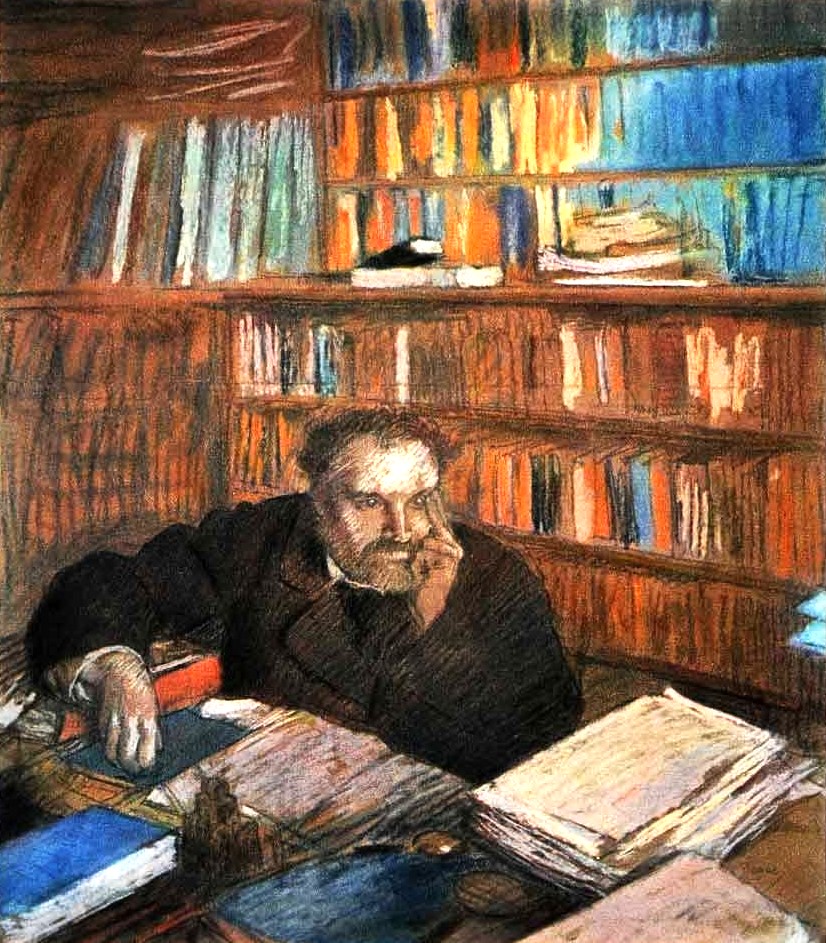
Degas depicted him among his books and writings in 1879 (including some studies)↑↑ (R1,p440/1; ). Earlier, around 1870, he had depicted him together with Emma Dobigny (M23; iR6).
Desboutin portrayed Duranty in an oil painting and in an etch↑↑ (R5,p95;R1,p377).
Courbet made a drawing of Duranty, which probably Félix Bracquemond used in an etch for a frontispice of a novel of Edmond Duranty (aR10). But, note that Duranty has no beard in this portrait, unlike all the other portrayels of him.
There are a few photographs known of Duranty (R1,p441; aR2).
Sources:
Main source: R140=iR40=aR1; R2,p38-47 + 477-484; R90I,p72-81.
Other sources: R2,p19+20+37+48+49+; R1,p376/7; R3,p659+196; R5,p46+94-96; R90I,p478; iR3; iR4; iR5; iR6.
See links for other general references (=R), internet sites (=iR) and musea (=M). For other additional references (=aR) see below.
See links for practical hints and abbreviations and for the subscription of the paintings.
Additional references (=aRx):
- gallica.bnf.fr//bpt6k317411g (online document van ‘La nouvelle peinture’; =iR40 =R140)
- appl-lachaise.net//duranty (article with pictures on Duranty)
- album-online.com//duranty (showing an engraving published shortly after his departure)
- gallica.bnf.fr//bpt6k10509546 (online version of Réalisme 1856/07/10, edited by Duranty; =iR40)
- gallica.bnf.fr//bpt6k10511021?rk (online version of Réalisme 1856/11/15, edited by Duranty; =iR40)
- gallica.bnf.fr//bpt6k1051104v?rk (online version of Réalisme 1856/12/15, edited by Duranty; =iR40)
- gallica.bnf.fr//bpt6k1051106p?rk (online version of Réalisme 1857/01/15, edited by Duranty; =iR40)
- gallica.bnf.fr//bpt6k1051108h?rk (online version of Réalisme 1857/02/15, edited by Duranty; =iR40)
- gallica.bnf.fr//bpt6k1051110k?rk (online version of Réalisme 1857/03/15, edited by Duranty; =iR40)
- sciencephoto.com//562544 (rendering an etch probably of Félix Bracquemond after a drawing of Courbet, being the frontispice of a novel of Edmond Duranty)
- x
Recommanded citation: “Impressionism according to Duranty. Last modified 2026/01/31. https://www.impressionism.nl/impressionism-according-to-duranty/”
Note: additional info will follow.