Impressionism, a historical reconstruction:
Claude Monet
(1840-1926)
An overview of his series
a painter of mists
Intro:
Painting in series is a characteristic of the impressionist painting style. Besides Monet, Pissarro and Sisley also painted series. In 1877 Claude Monet started with a serie of the Saint-Lazare station (see; R22,CR438-448). He often painted a subject more than once (from different angles), sometimes spread over several years. Examples are the coast of Étretat and the cliffs of Pourville and Fécamps (see 1882) and the Seine at Port-Villez. 1890 onwards Monet starts to make series in a more systematic way. In the Summer of 1890 Monet starts with serie of 25 paintings of grain stacks (R22,CR1266-1290). In 1891 he makes a serie of Poplars on the banks of the river Epte (R22,CR1291-1313). Early 1892 en early 1893 he makes 30 paintings of the Rouen Cathedral (R22,CR1317-1329+1345-1361). In 1896 and 97 Monet paints his ‘matinée-series’ (R22,CR1435-1437+1472-1488). In 1899, 90 and 91 he paints in London a serie of 85 paintings of the Charing Cross Bridge, the Waterloo Bridge and the Houses of Parliament (R22III,p650, CR1521-1614). In Giverny Monet will, until his death, paint series of the Japanese bridge (1895 onwards; see R22,CR1392+1419), the garden and the water-lilies (1897 onwards; R22III,p632). In 1914 he starts painting the ‘Grande décorations de Nymphéas’, who were 1927/05/17 exhibited in the l’Orangerie in Paris (R22I,p400; R5,p240).
On this page you will find an overview of the series that Claude Monet painted.
They will be rendered in a chronological order.
The emphasis will be on the rendering of atmospherical influences.
There are references to the Catalogue Raisonné by Wildenstein (1996=R22; iR3+iR182).
Sometimes the making of a serie coincides with an extended trip. In that case, the most information you will find on this page.
Note: additional info and pictures will be added.
Monet, a painter of mists:
Typical for many series made by Claude Monet is a vagueness, is painting his object in the mist.
We will see Monet was inspired by Turner and Whistler.
We will also see that Alfred Sisley in his series, retained to reproduce the volume of the rendered object (R53,p5).
Note: additional info will be added.
Floating ice:
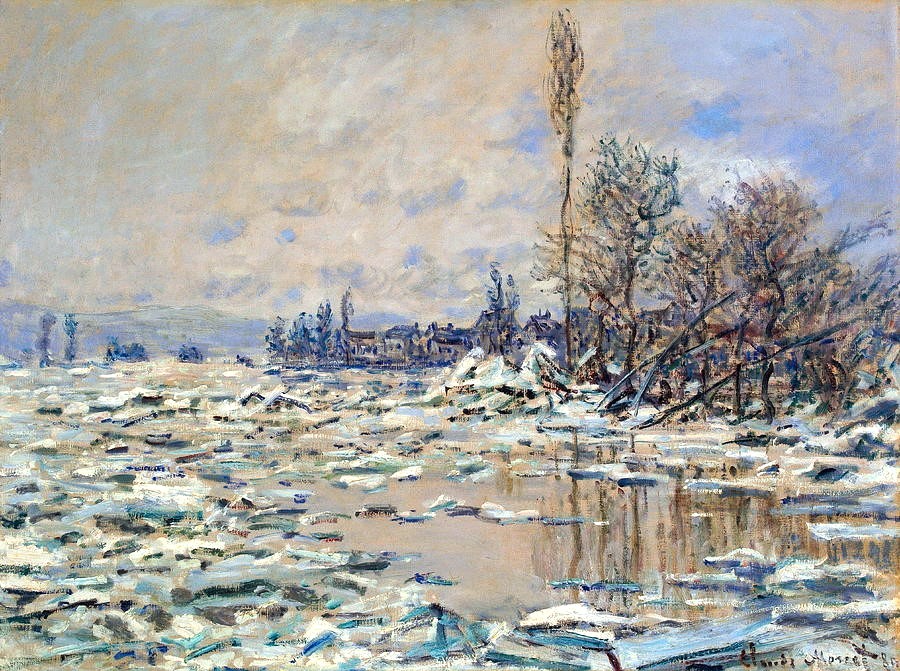
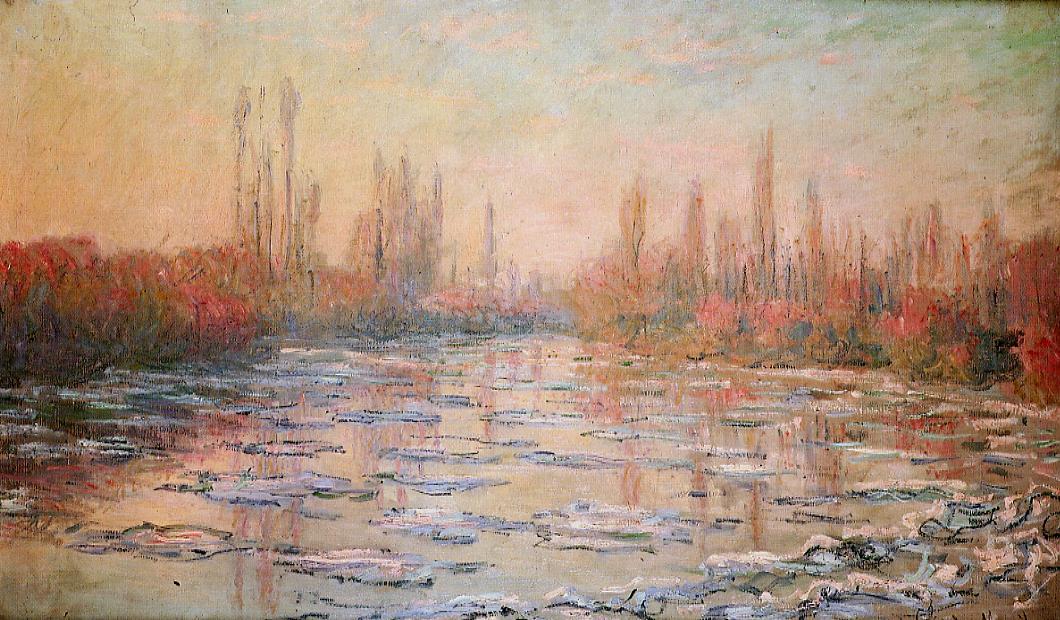
In December 1879 and January 1880 Claude Monet depicted the floating ice* in the Seine between Vétheuil and Lavacourt: CR556-576 (R22).
Some have specific subtitles: Winter (CR558 +573), Winter + sunset (CR574 +576), sunset (CR575), Winter sun (CR557), grey weather (CR560). So, 14 paintings don’t have an indication of atmospherical conditions.
January 1893 Claude Monet Monet also depicted the floating ice in the Seine, this time painting from the banks of Bennecourt (iR468; iR9) near Giverny, often with the now disappeared islet of Forée in the middle and Port-Villez at the opposite bank: CR1333-1344 (R22IV,p1057). Some paintings have specific subtitles: Winter (CR1333), mist (CR1338), dusk (1344). So, most haven’t got an indication of atmospherical conditions.
Note*: 1879/09/05 his wife Camille had died. Shortly before Claude depicted here on her deathbed (CR543; iR3; M1) looking like an ice mummy. I see some comparison with the paintings of the floating ice.


1888-1890, the haystacks (=Meules):
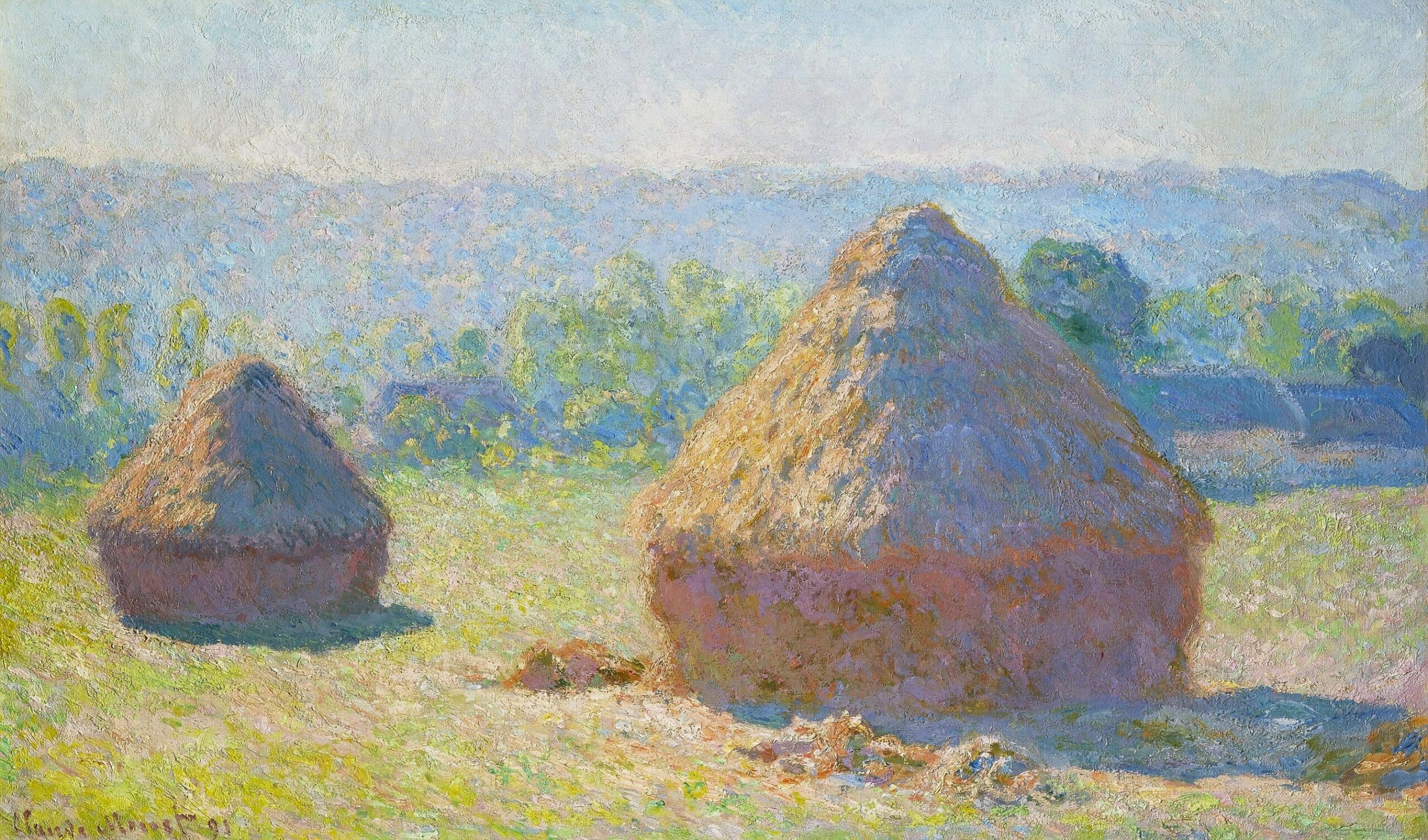
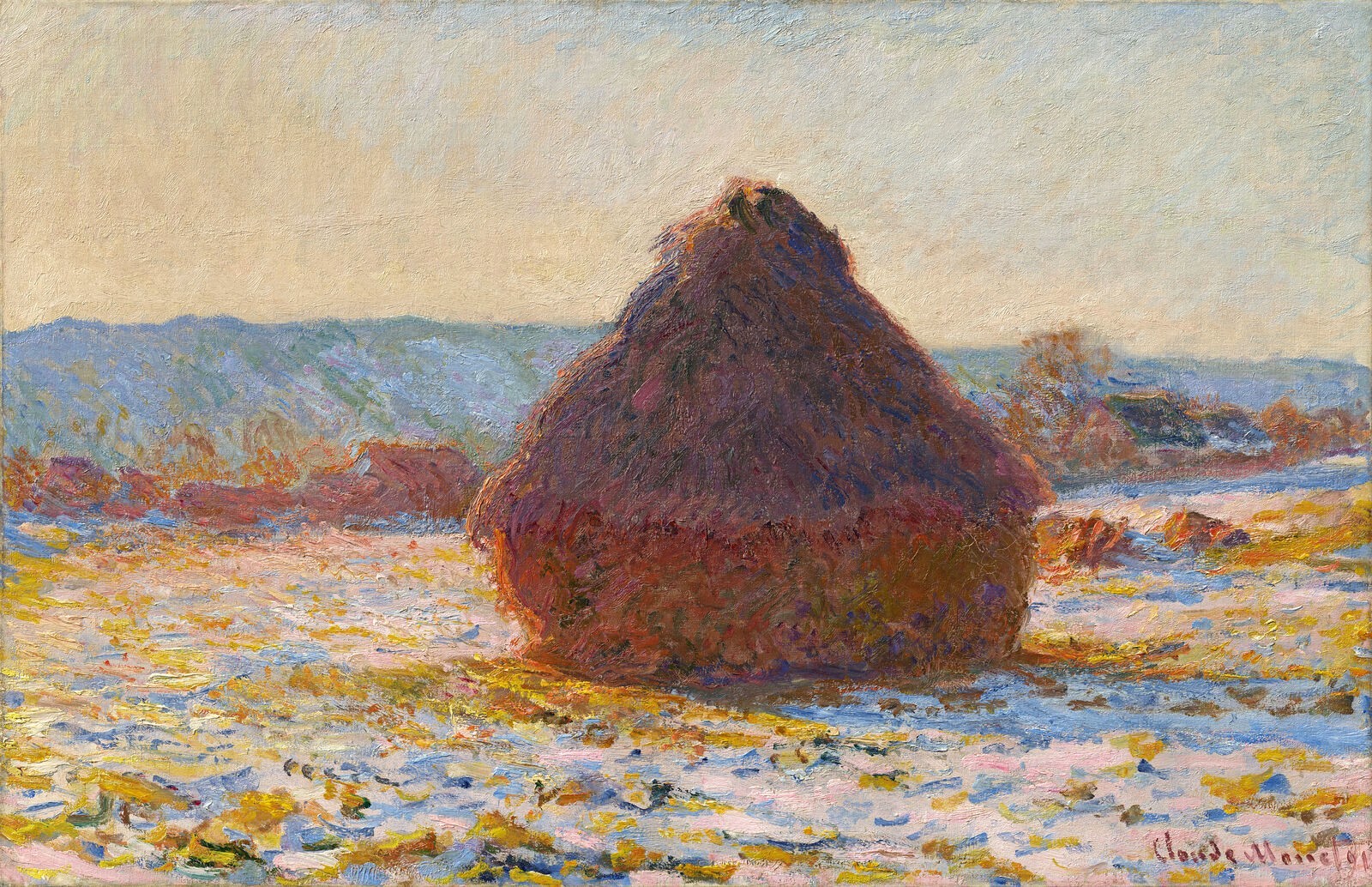
From late Summer 1888 until early 1891 Claude Monet painted the haystacks that had been erected in the fields (called ‘le Clos Morin’) near his house in Giverny (R22,no1213). He did so in the late summers, autumns and winters on various times of day and in various weather conditions. He would always show one, two or three haystacks. Note: many paintings are dated 1891 due to the exhibition May 1891 at Durand-Ruel (R22,CR1266).
Note: earlier and later on Monet also depicted haystacks (in the surroundings of Giverny). And sometimes they look like a small serie, see CR1362-64.
See the Catalogue Raisonné of Wildenstein: CR1213-1217a +1266-1290 (1996=R22; iR3; iR182/III).



1891, Poplars:
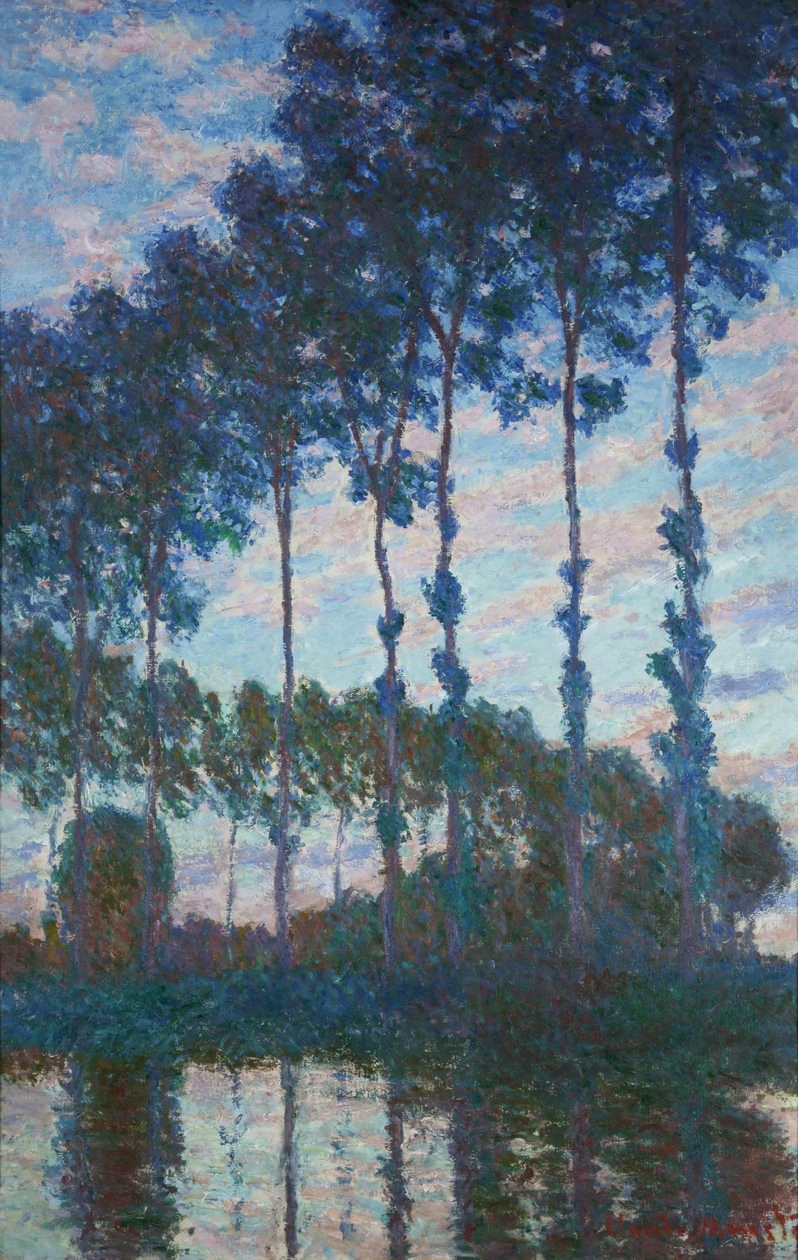
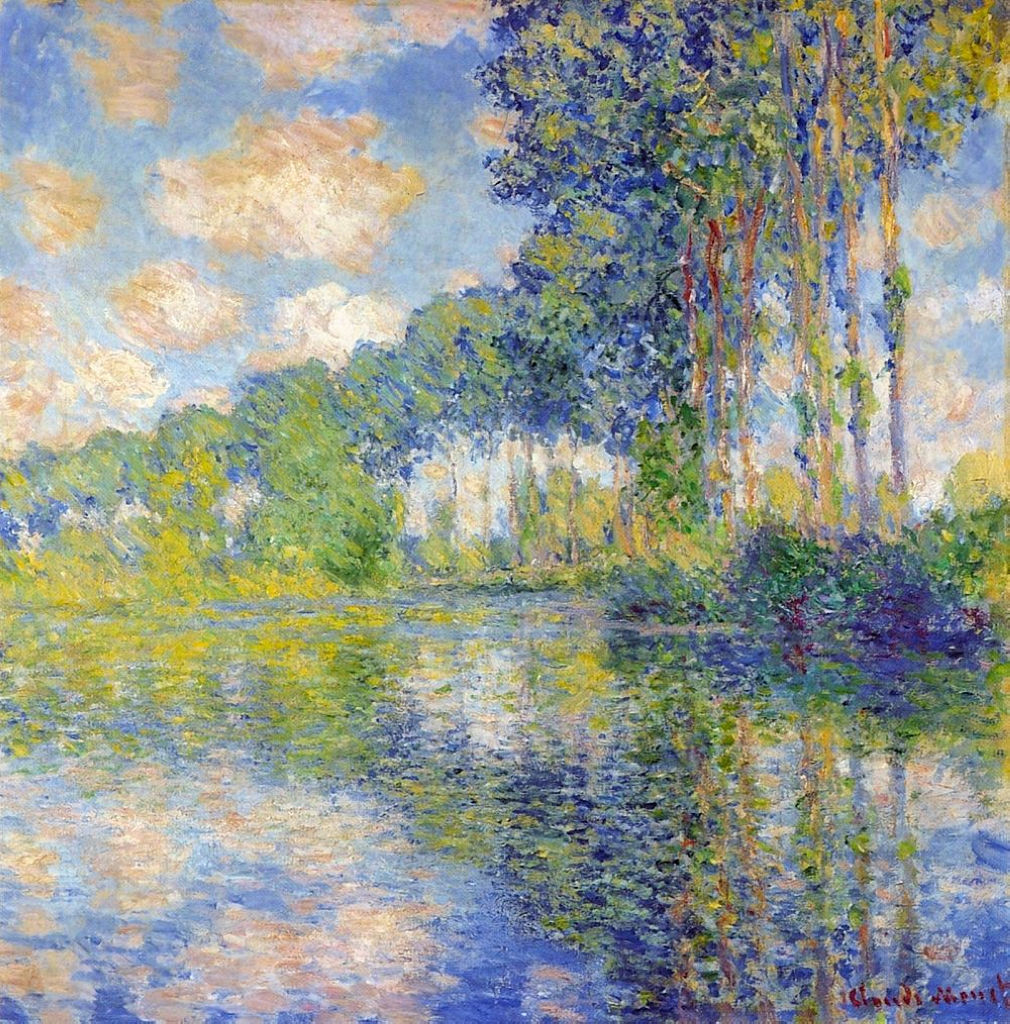
In 1891 Claude Monet started a new serie depicted rows of Poplars. The poplars stood on the left bank of the Epte, at the edge of the Limetz marsh, 2km upstream of Giverny. According to Wildenstein, Monet painted this serie in the Summer of 1891 (CR1291). Monet even paid to postpone the trees from being felled after the 2nd of August. Several paintings have as subtitle autumn (CR1297 +1306a; 1307 +1308 +1311), so probably Monet continued painting until autumn. But one painting has as subtitle ‘Spring’ (CR1304). Does this mean, that Monet started this serie in the Spring?
Monet depicted the poplars along the ‘S’ like curve of the river Epte. He did so at various times of day and in various weather conditions.
Several of these paintings were exhibited at Durand-Ruel in 1892 (R22IV,p1017).
See the Catalogue Raisonné of Wildenstein: CR1291-1313 (1996=R22; iR3; iR182/III).



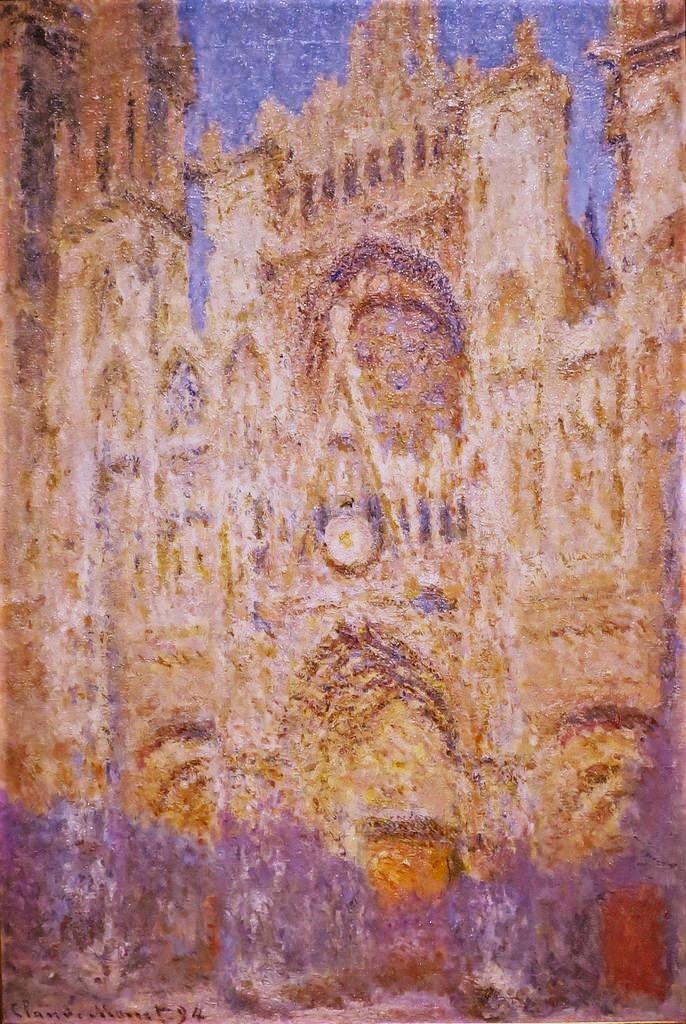
1892 +1893, Rouen cathedral:
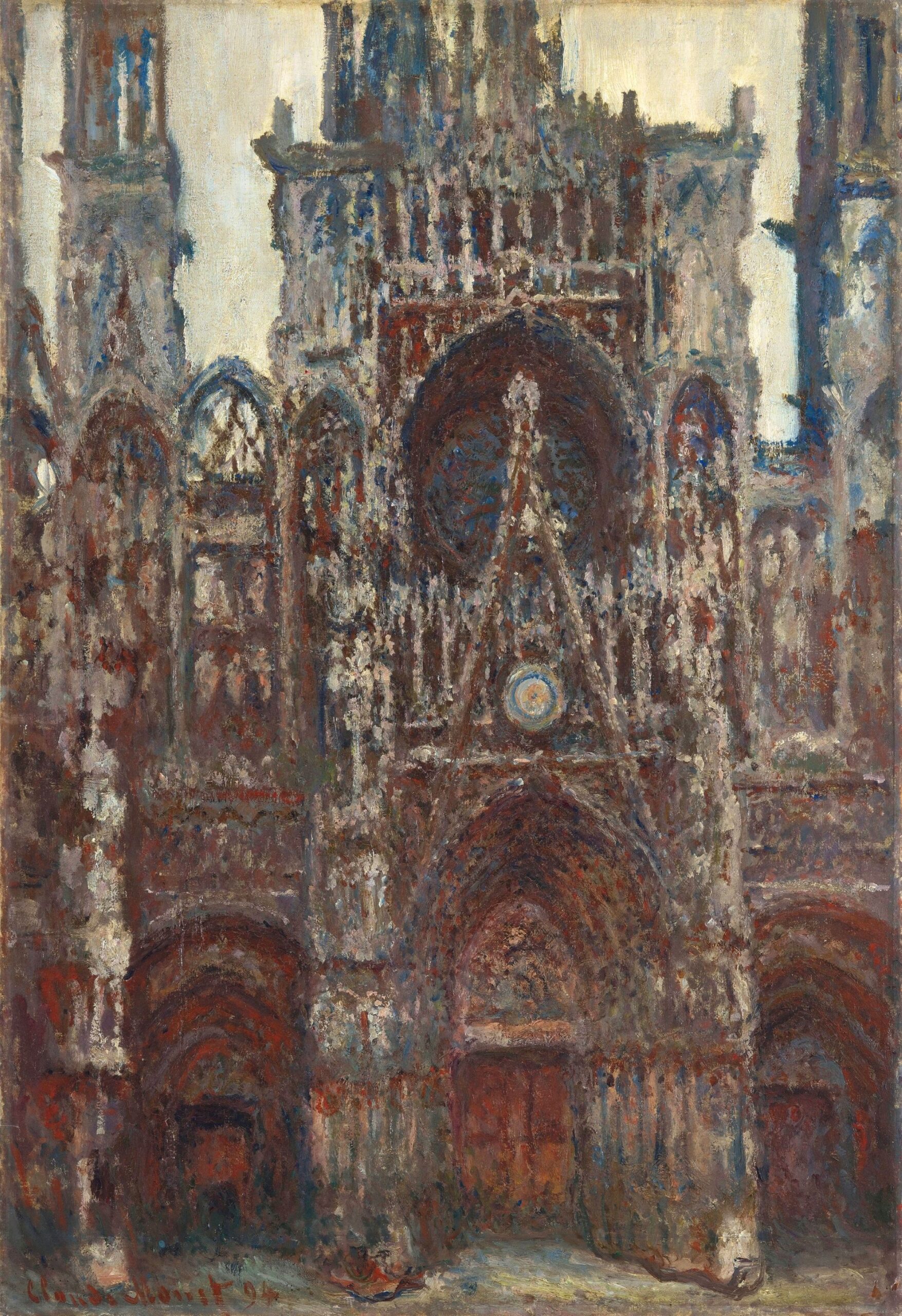
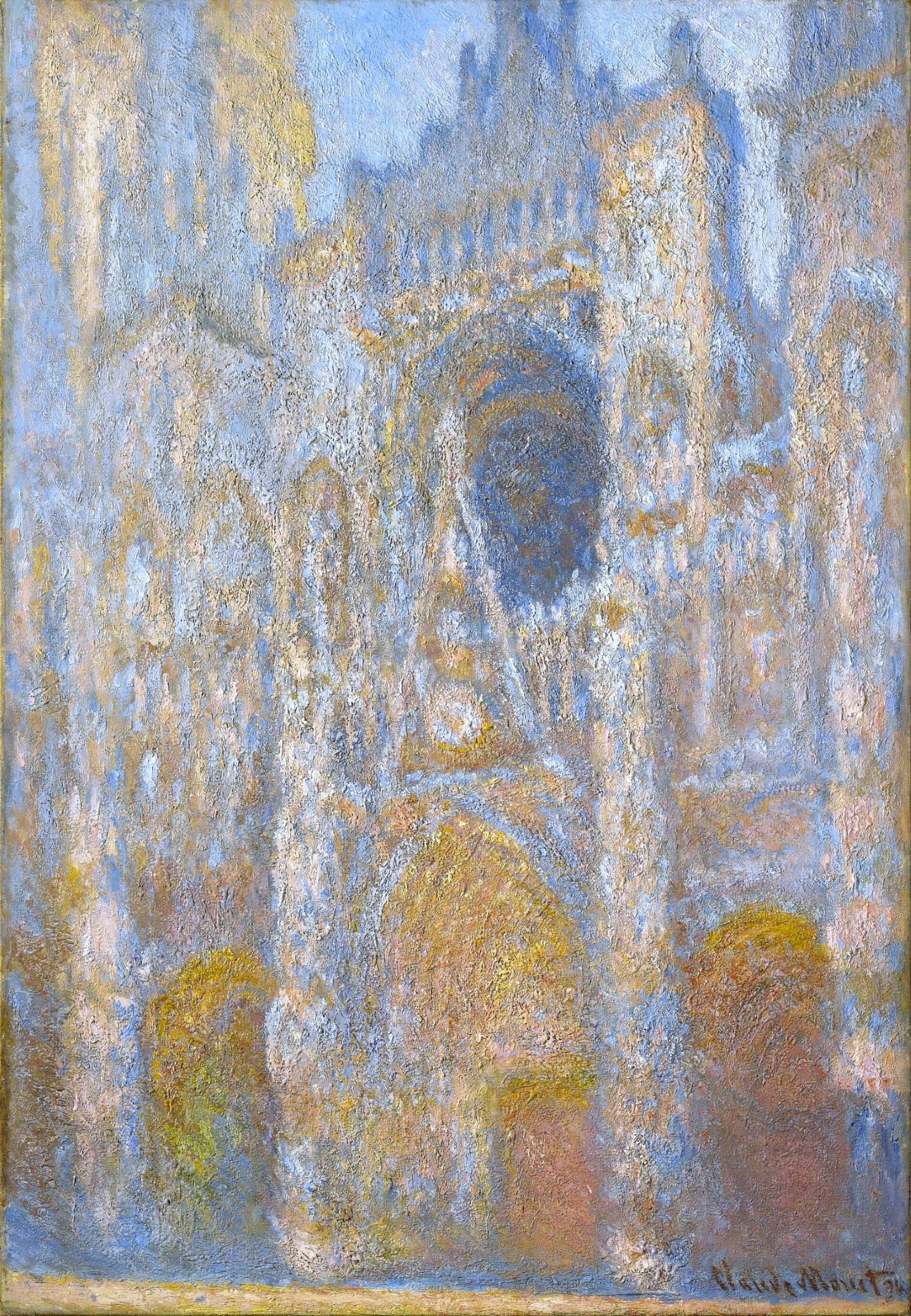
Claude Monet made a serie of the Rouen cathedral. They are all dated 1894, but they were made (started) in 1892 +1893 (CR1317).
His first stay was from early Februar until mid April (CR1314).
His second stay started mid-February 1893 (CR1345).
Monet used 3 view points, apart from some other works (CR1314-1318), all looking eastwards facing the main (or west) façade of the Cathedral (=the Portal), with (partly depicted) to the left (=north) the Tour d’Albane (=Tour Saint Romain) and to the right (=south) the Tour de Beurre. (iR4; R22,CR1316 +1317 +1319 +1345)
31, Place de la Cathédrale, an appartement belonging to J. Louvet. From here he painted in 1892 CR1319 +1320, depicting the Cathedral in a frontal view. In 1893 he again used this view point. From this viewpoint he made in 1893 CR1351-1361*, depicting namely the Portal.
23, Place de la Cathédrale; from the first floor of the shop of Fernand Lévy. Nowadays this building houses the tourist office. From here Monet painted in 1892 CR1321-1329. In these paintings Monet namely depicted the Portal of the Cathedral, looking to the east, but also a bit to the north. (CR1321)
47, Rue Grand-Pont (than no.81), the appartment of M. Mauquit a bit more to the south, seeing the Cathedral more from aside, again looking to the east but now more to the north, depicting the Portal, the left tower (Tour d’Albane or Saint-Romain) and the adjacent buildings that disappeared in World War II (CR1316 +1317 +1345). From this view point he depicted CR1345-1350.
Note*: I wonder if Wildenstein is mistaking. The viewpoint of CR1351-1361 match more those of CR1321-1329, there is just a slide difference. This would mean that the viewpoint was no.23 instead of no.31.
Monet depicted the Cathédral at various times of day. In the morning the Tour d’Albane is lit from behind from the south-east. After 12 o’clock (Greenwich mean time) the sun begins to illuminated the façade of the Cathedral (CR1322). In the late afternoon the the shadows spread upwards from the ground (see in chronological order CR1326, 1327, 1329 and 1328. Monet also depicted the Cathédral in various weather conditions, like grey weather (CR1318 +1321 +1345), mist (CR1349 +1352).
Monet sometimes called his work a ‘Harmonie’ or a ‘Symphony’, adding various colours. Compare the titles of the works of Whistler and Signac.
Monet also made preliminary pencil sketches that are now in the Musée Marmottan in Paris (M2).
Lucien Pissarro once noted: ‘Monet is working mad on his cathedrals, painting from a window over a shop, from 6 in the morning till 8 at night, 10 pictures at the same time, turning from one to another as the effects of light change.’ (R312,p70)
Many of these works were exhibited at Durand-Ruel May 1895 (R22IV,p1017).
See the Catalogue Raisonné of Wildenstein: CR1319-1329 +1345-1361 (1996=R22; iR3; iR182/III).





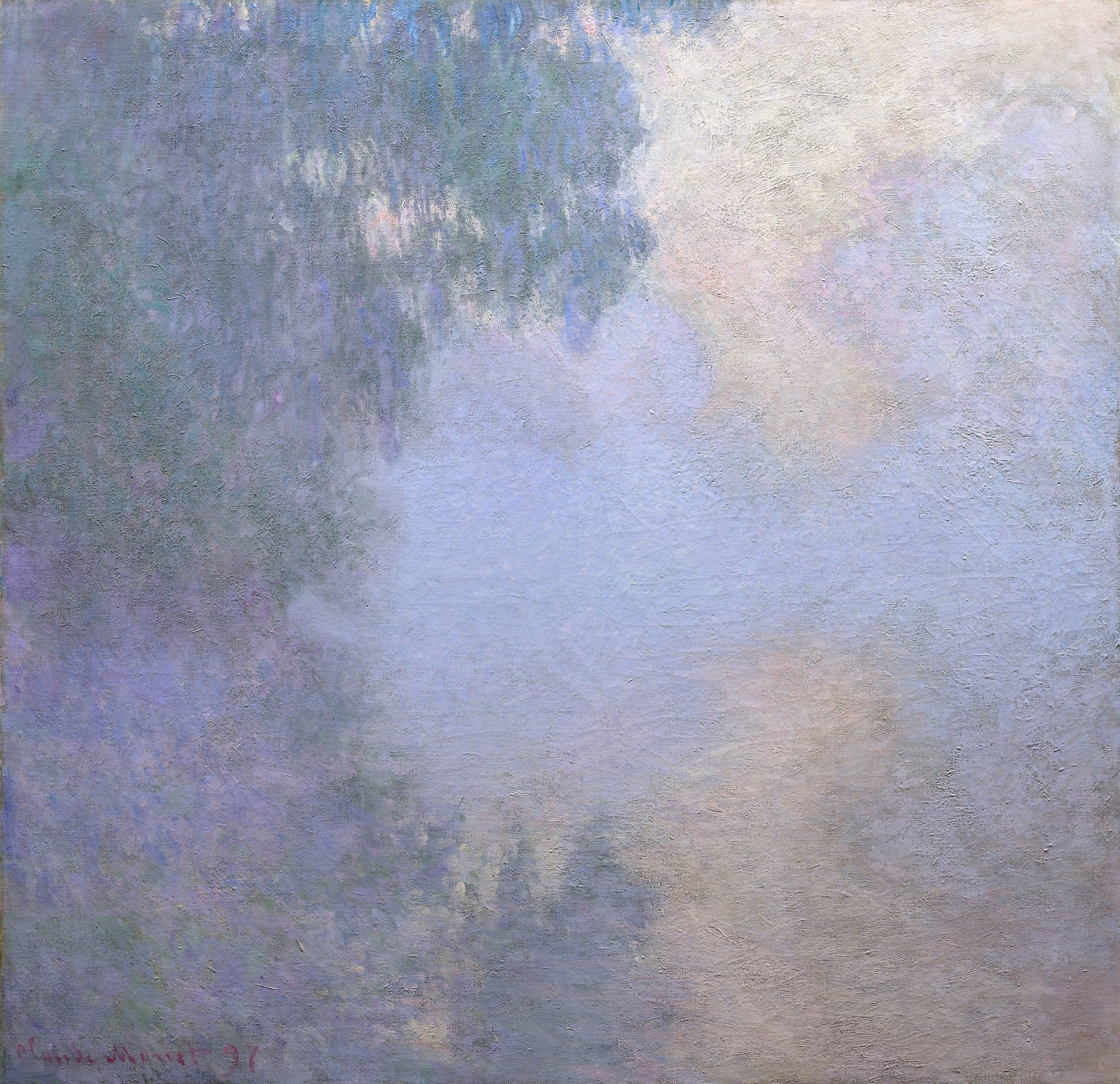
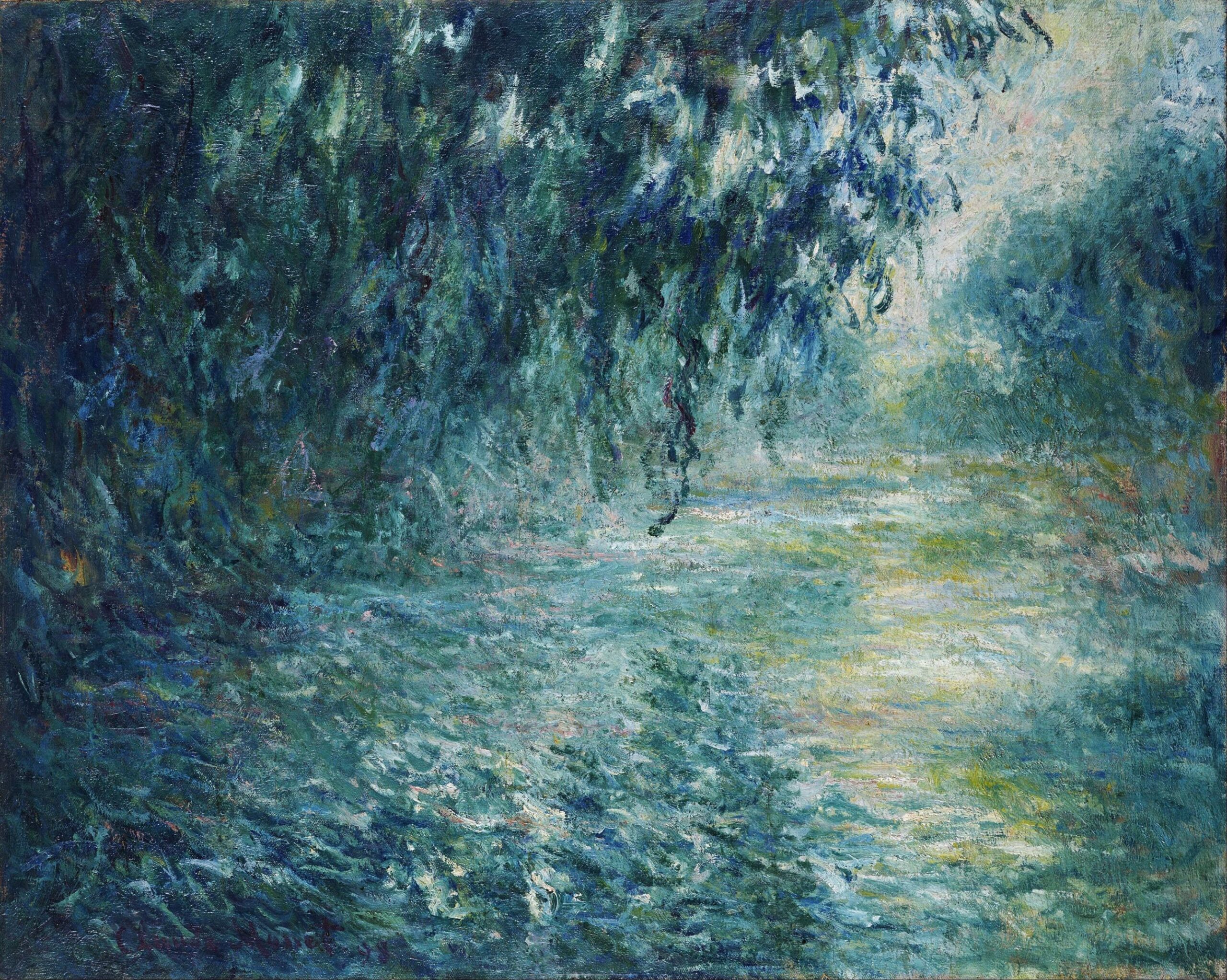
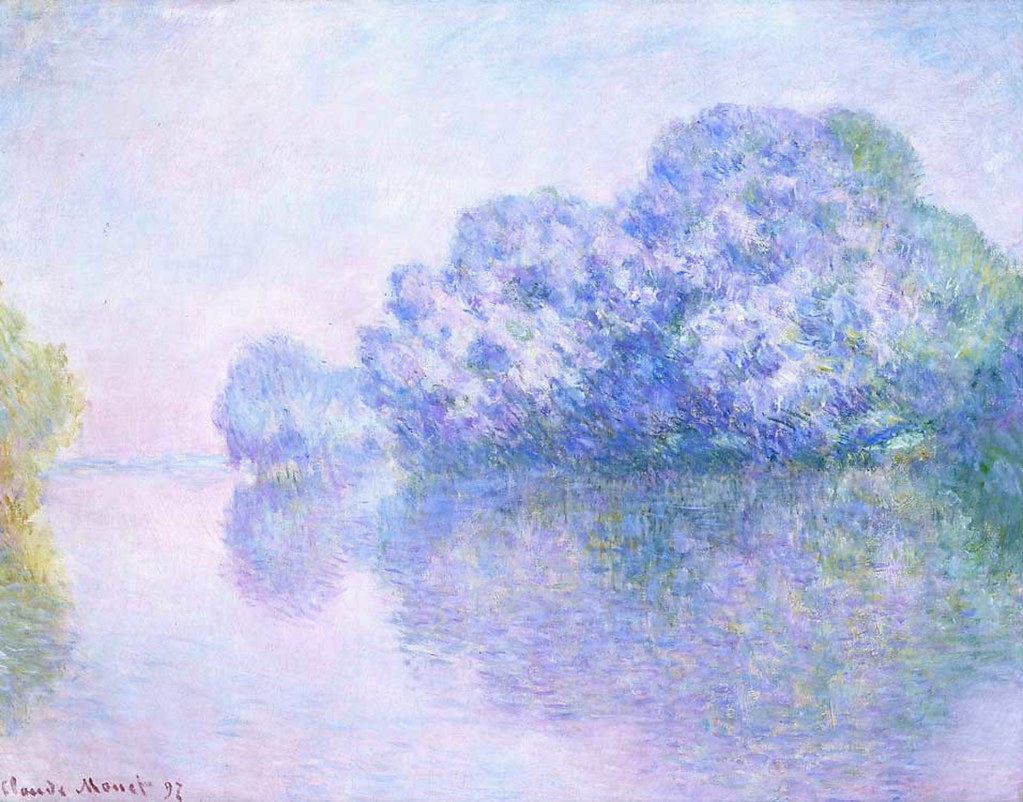
1896, Morning mist, arm of the Seine:
Claude Monet started to depicted the arm of the Seine, where the Epte meets the Seine at the Île aux Orties*, just south(-east) of his estate, in 1896. He namely depicted the early morning mist. In 1897 he continued with this theme and finished paintings started in 1896. (CR1472) Most works were called ‘Arm of the Seine near Giverny’ or ‘Morning on the Seine’. Some have subtitles rendering weather conditions**: mist or fog (CR1473 +1474 +1476), sunrise (CR1478 +1479), clear weather (CR1480 +1482); in the rain (CR1499***). The last one was made in 1898 and has similarities with CR1487 +1488.
Monet also made a small serie depicting namely the Île aux Orties* (Nettle Islet) between Vernon and Port-Villez (CR1489-1494); they also are all painted in the morning mist.
Monet worked at 14 paintings at a time rendering the effect of ’the time of day, the sun and the clouds’. (See Guillemot in La Revue illustrée, 1898/03/15; CR1474).
15 of these paintings were exhibited in 1898 at the Georges Petit gallery (R22IV,p1018); the identification is often uncertain.
Note*: these Islands have now disappeared (CR1493); Monet earlier depicted them in 1883 (CR840 +841 +834-836).
Note**: these subtitles seem quite random; CR1475 most thickly depicts the mist; the sunrise in CR1476 is more clear than in CR1478; CR1487 +1488 (and 1499) clearly depict a later moment in the morning and are more clear than CR1480 +1482 (the mist is faded away).
Note***: CR1500, made around 1897/98 probably is made about the same spot, but with a clearly different view point. I don’t include it in this serie.
See the Catalogue Raisonné of Wildenstein: CR1435-1437 +1472-1488 +1489-1494 (1996=R22; iR3; iR182/III).


1899-1901, London:
Claude Monet made 3 trip to London: in 1899, 1900 and 1901.
He stayed in the Savoy Hotel on the Victoria Embankment, along the Thames, where the river takes a bend.
In 1899 he stayed at the 6th floor (room 610 +611) and in 1900 +1901 on the fifth floor (room 512 +513). ().
In 1899 he left around 15 September with his second wife and Germaine Hoschedé to visit his son Michel, who was studying in London. They returned late October.
In 1899 he started with at least 11 canvases depicting the Charing Cross bridge and the Waterloo bridge.
In 1900 he went alone. He started the 11th of February. By the 18th of March he had worked on 65 paintings. He had added the Houses of Parliament at Westminster to his themes.
In 1901 he worked here from 23 January until early April.
Most works that are dated later, were probably started earlier.
37 of these paintings made in London were shown at Durand-Ruel in 1904 called ‘Vues de la Tamise à Londres’ (R22IV,p1019).
Monet also made at least 26 pastels.
Sources: R22III,p650; iR468; iR3; blog; iR228; Savoy.
1899 -1901: London, Charing Cross bridge:
The Charing Cross bridge is now called the Hungerford bridge or Golden Jubilee bridge (iR468).
Claude Monet painted it from his room in the Savoy Hotel looking to the south (south-west).
In the background one can see the Westminster bridge, the Houses of Parliament, the Victoria tower and the Big Ben.
The titles hardly render weather conditions, 3 depict fog (CR1535 +1541 +1554) and 1 overcast weather (CR1526).
The following works are dated 1899: CR1521-1524 +1531.
The following works are dated 1900: CR1526.
The following works are dated 1901: CR1527.
The following works are dated 1902: CR1529 +1533 +1534 +1535 +1540 +1541 +1546 +1547.
The following works are dated 1903: CR1528 +1530 +1532 +1536 +1537 +1548 +1549 +1554.
The following works are dated 1904: CR1538 +1539 +1545 +1552.
The following works are dated not dated: CR1525 +1526 +1530 +1542 +1543 +1544 +1550 +1551 +1552a +1553.
See the Catalogue Raisonné of Wildenstein: CR1521-1554 (1996=R22III; iR3; iR182/III).


1899 -1901: London, Waterloo bridge:
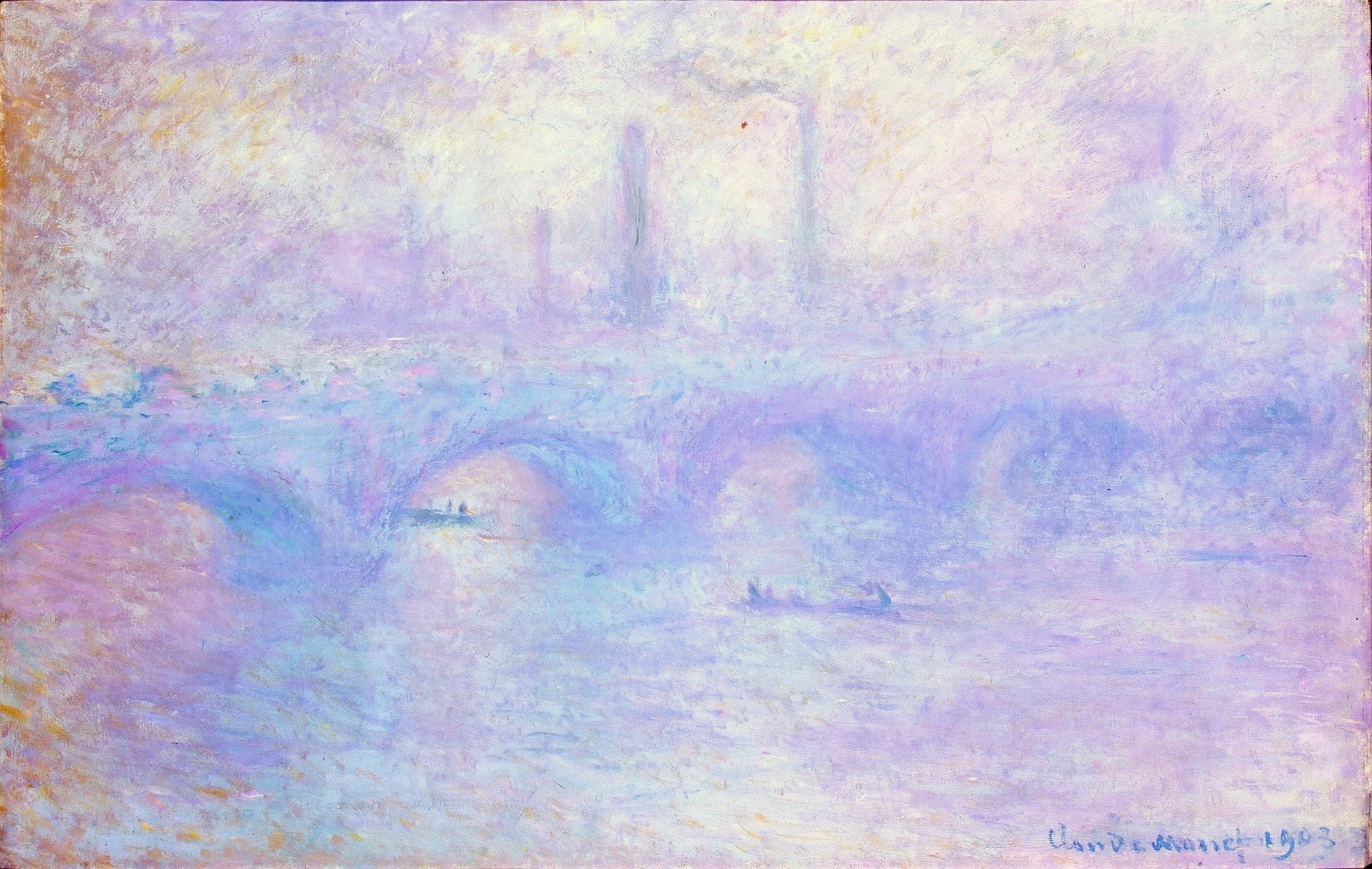
Claude Monet painted the Waterloo bridge from his room in the Savoy Hotel looking east (south-east).
Often the factory chimneys on the opposite bank are depicted.
The titles often render weather conditions, namely overcast weather, grey weather, a misty morning and sunlight effect.
No works are dated 1899.
The following works are dated 1900: CR1555 +1556 +1557.
The following works are dated 1901: CR1558.
The following works are dated 1902: CR1560 +1577 +1581 +1594.
The following works are dated 1903: CR1561 +1562 +1565 +1566 +1567 +1568 +1569 +1573 +1580 +1586 +1587 +1588 +1589 +1590 +1591 +1592 +1595.
The following works are dated 1904: CR1563 +1570 +1571 +1572 +1582.
The following works are dated not dated: CR1559 +1564 +1574 +1575 +1576 +1578 +1579 +1583 +1584 +1585 +1593.
See the Catalogue Raisonné of Wildenstein: CR1555-1595 (1996=R22III; iR3; iR182/III).

1900 +1901: London, Houses of Parliament:
Claude Monet began to paint the Westminster Palace 1900/02/13. He worked at a terrace at St. Thomas’s Hospital at the opposite bank (iR468; iR3). He only did so the late afternoons, so he only painted backlit and sunset effects.
The following works are dated 1902: CR1603.
The following works are dated 1903: CR1597 +1598 +1601 +1604 +1608 +1609 +1612 +1614.
The following works are dated 1904: CR1596 +1602 +1605 +1607 +1610 +1611 +1613.
The following works are dated 1905: CR1606.
The following works are dated not dated: CR1599 +1600.
See the Catalogue Raisonné of Wildenstein: CR1596-1614 (1996=R22III; iR3; =iR182IV; =iR19vIV).


1901, London, Leicester Square:
Early March 1901 Claude Monet made a short serie of 3 sketches depicting Leicester Square at night. He did so from the Green Room, a club on the corner of St. Martin’s Street. They all were not dated. An illness prevented him from painting more. (CR1615; iR9).
See the Catalogue Raisonné of Wildenstein: CR1615-1617 (1996=R22III; iR3; =iR182IV; =iR19vIV).
1901, Vétheuil:
In the summer of 1901 Claude Monet rented a room with a balcony in Lavacourt. Until somewhere in the autumn he painted his old dwelling place Vétheuil. He did so as a short serie, depicting the effect of light and weather conditions. He had went here in his recently purchased car. (CR1635; M20).
Several of these paintings were exhibited at the Bernheim-Jeune gallery in February 1902 (R22IV,p1018).
See the Catalogue Raisonné of Wildenstein: CR1635-1649 (1996=R22III; iR3; =iR182IV; =iR19vIV).


Giverny, the garden and the pond:
1893/02/03 Claude Monet acquired south of his estate, opposite the road, a plot of land on which he established his famous Water-Lily Pond. In the winter of 1901/02 the pool was enlarged (CR1650).
Here Monet found many motives that he repeatedly depicted untill his death in 1926.
1895-1924, The Japanese bridge:
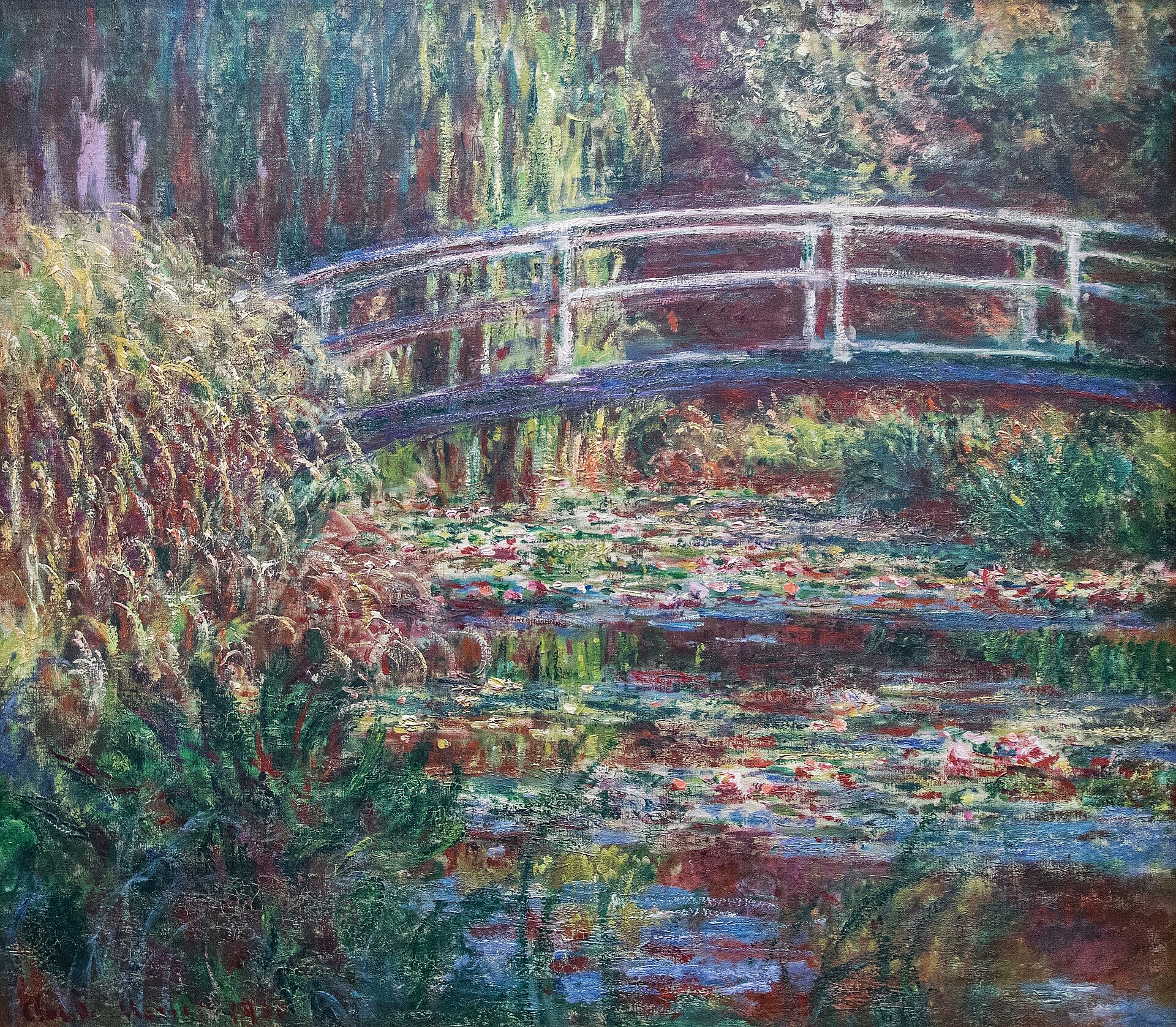
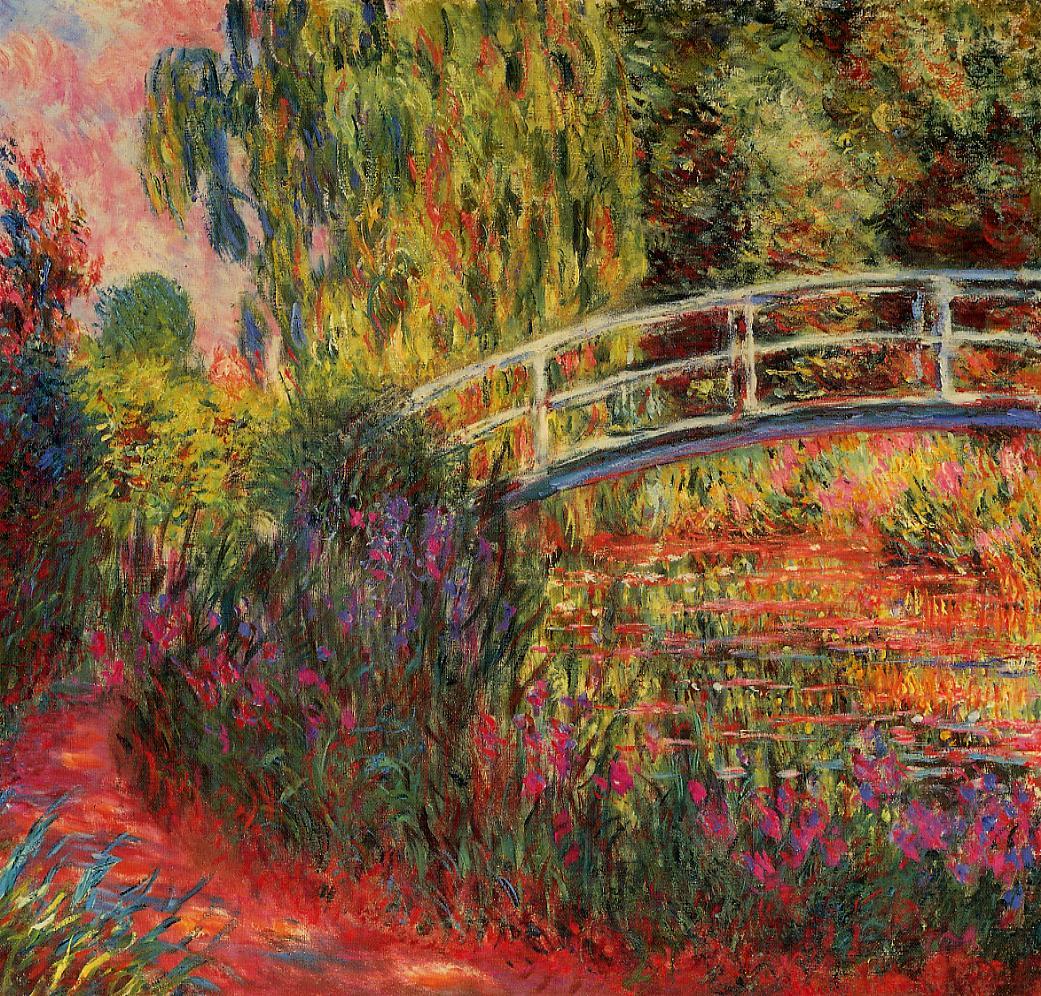
Over the pond Claude Monet constructed the so-called Japanese bridge. Early January 1895 he made his first picture of this bridge (CR1392). In the Summer he made 2 more paintings (CR1419 +1419a). He dated several of these paintings 1899 and showed them at Durand-Ruel in 1900. But, probably he already started with this serie in 1897.
He never depicted the Japanese bridge from exactly the same viewpoint (CR1628).
Monet made a serie from 1918-1924 in the summer and early autumn after lunch (CR1911-1933). These pictures also depict the Wisteria trees. In this serie the signs of distored vision are visible and also of (the partly) recovered sight after the cataract operation 1923/01 and the appropriate glasses. (R22IV,p912)
See the Catalogue Raisonné of Wildenstein: CR1392 +1419+1419a +1509-1520 +1628-1633 +1668-1670 +1911-1933 (1996=R22III+IV; iR3; =iR182IV; =iR19vIV).



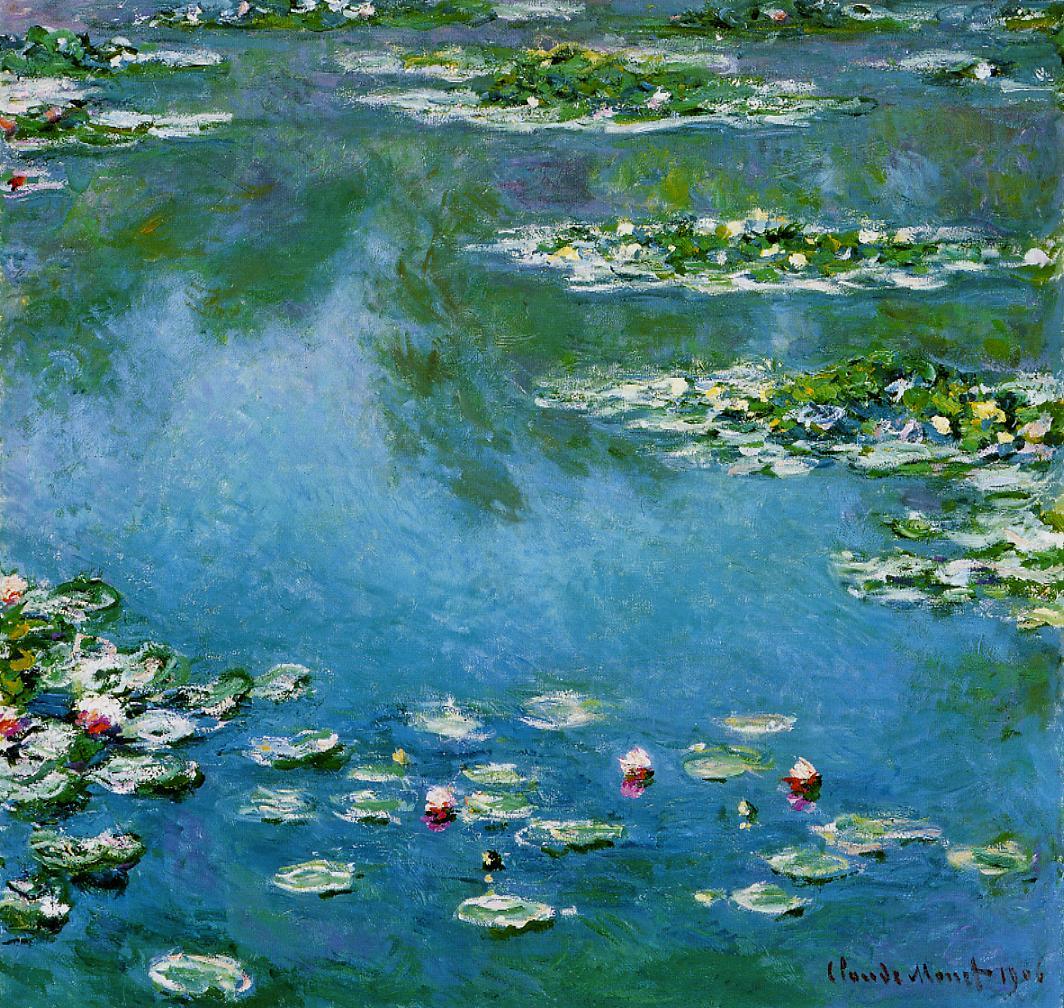
1897-1926, Water-Lilies / Nymphéas:
Claude Monet is famous because of his many paintings of Water-Lilies (Nymphéas in French).
He started to do so around 1897. Between 1897 and 1899 he made 8 paintings; they were not exhibited during his life.
In the winter of 1901/02 Monet had begun to renovate and enlarge and the water-lily pond.
In 1903 Monet again used it as a motif for his paintings. He did so until 1908. (CR1650+CR1654). Almost 50 of them were exhibited at the Durand-Ruel gallery in 1909 (6 May – 5 June) (R22IV,p1020).
After an interruption of some years he again took up this motiv from about 1914-1920. In this period he used larger canvasses. Very few of them are dated and those that are, were dated afterwards at the moment of sale, which makes the dating disputable. None of them were exhibited during his life. In these years his eyesight deteriorated, until he underwent a cataract operation. (R22IV,p839)
In his last years until his death in 1926 he would only work on his Grande Décorations↓.
Monet made also other pictures of his pond in which other water plants or the surrounding trees and other vegetation were more prominent subjects, see the overview of the Catalogue Raisonné.
See the Catalogue Raisonné of Wildenstein: CR1501-1508 +1656-67 +1671-91 +1694-1735 +1782-1817 +1852-65 +1883-1902 (+1964-91↓)(1996=R22IV; iR3; =iR182IV; =iR19vIV).






1897-1926, Water-Lilies / Nymphéas, Grandes Décorations:
At the end in the years 1920-26 Claude Monet worked on his Grandes Décorations. In 1914 he had build an immense studio in which he could house canvasses of two meter high. Already 1917/11 he worked on 10 panels. In 1920 Arsène Alexandre counted 40. Throughout the years the idea grew to donate a serie to the French state as a hommage to his friend Georges Clemenceau, who had been Président du Conseil from 1906-09 and 1917-20. In the end it was decided that the donation of 8 panels would be given to the Orangerie, where it can be seen up till today (see virtual tour). Other panels were not included and can now be seen on various locations. (R22IV,p945; iR3; iR4; M3)
Note: Monet painted these works in his studio, which is not in line with the impressionist painting style. But, probably his inspiration came from observations en-plein-air.
Did Monet depict atmosperical influences in this serie, in accordance with the impressionist painting style?
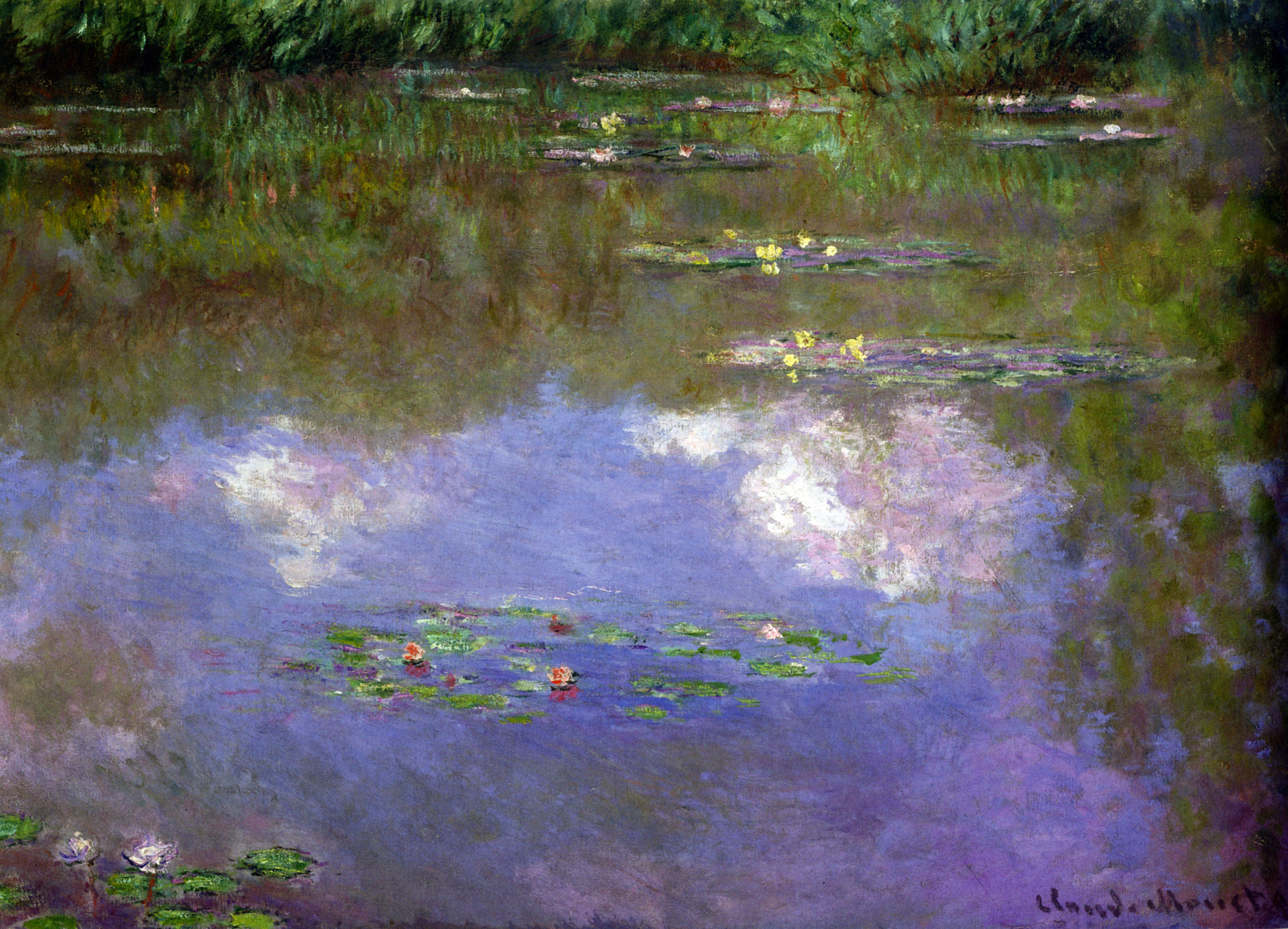
When we look at the titles, this limitly seems the case, except: the reflections of clouds (CR1972-74 +1985*); the setting sun (CR1984*) the rendering of morning (CR1987* +CR1989* + CR1991*).
As expected in most pictures blues are dominant (the colour of the pond) and greens (the reflection of the greenery + the depicted willows). Still, Monet renders a variaty of other colours: whites (often reflection of clouds), yellows (probably reflections of sunlight), reds (probably reflections of twilight). So, in that sense Monet depicts atmospheral influences. But, Monet doesn’t seem to render the typical leaves-filtered-light.
Note*: the numbers of the Orangerie paintings are not sequentially numbered in the catalogue raisonné of Wildenstein; I took the liberty to do so and to render them the numbers CR1984-CR1991 (R22IV,p972-979).
See the Catalogue Raisonné of Wildenstein: CR1694-1735 (1996=R22IV; iR3; =iR182IV; =iR19vIV).


Sources:
My main source is the Catalogue Raisonné of Wildenstein (1996=R22=iR182). See for more sources the main page on Claude Monet. See at the bottom of this page at the additional references aR5-aR11 for links to online publications (iR182 +iR19). See also the list of all paintings on the English WikiPedia page (iR3).
For other general references (=R) see. For other references to internet sites (=iR) see. For other additional references (=aR) see below. See links for practical hints and abbreviations and for the subscription of the paintings.
Further readings:
x
Additional references (=aRx):
- x
Recommanded citation: “Impressionism: Claude Monet, a painter of mists, an overview of his series. Last modified 2026/07/06. https://www.impressionism.nl/monet-series/”
Note: additional info and pictures will follow.