Impressionism, locations
where the ‘impressionists’ did paint:
The Fontainebleau forest
a topographical overview
Introduction:
The forest of Fontainebleau is a large forest between 50 and 70km south-east of Paris. Bordered in the north-west with Chailly and Barbizon, in the south-east with Marlotte and Moret and in the east by the Seine and the Loing. In the middle lies the village Fontainebleau. (iR9) It was famous because of the Barbizon-school. Since the late 1820s these artists often painted here. Rousseau even moved to Barbizon in 1836, Jean-François Millet followed in 1849 and had Charles Jacque as neighbour (R59,p144+154). Many other painters would follow them in painting in these surroundings. So did Monet, Renoir, Sisley and Bazille who namely painted here in the 1860s. There were encounters with Daubigny, Diaz and Corot (R32,p10). Renoir even destroyed his ‘Esmeralda’ exhibited at the Salon of 1864 because Diaz criticised his use of bitumen (R32,p11). But also other partakers of the ‘impressionist’ expositions painted and even lived here. Here below you will find more information*.
On this page you will find an impression of the works all these artists made in the Fontainebleau forest and it’s surrounding villages. First you will find several locations, then some general topics. You will find that the colours are often sub-dued, that many brownish and greyish hues are used, namely in the shadow parts. So, a more pre-impressionist, than an impressionist painting style. Still, many paintings are (partly) done on the spot (en-plein-air) and depict atmospherical influences like time of day, seasons and weather conditions.
Note*: For information on the involvement of the Barbizon painters in the forest of Fontainebleau, see the seperate page.
Note: additional info and pictures will follow.
The impressionists in the Fontainebleau forest
Here below you will find some information on the activities of the impressionists in the Fontainebleau forest.
Key-Impressionists in the Fontainebleau forest:
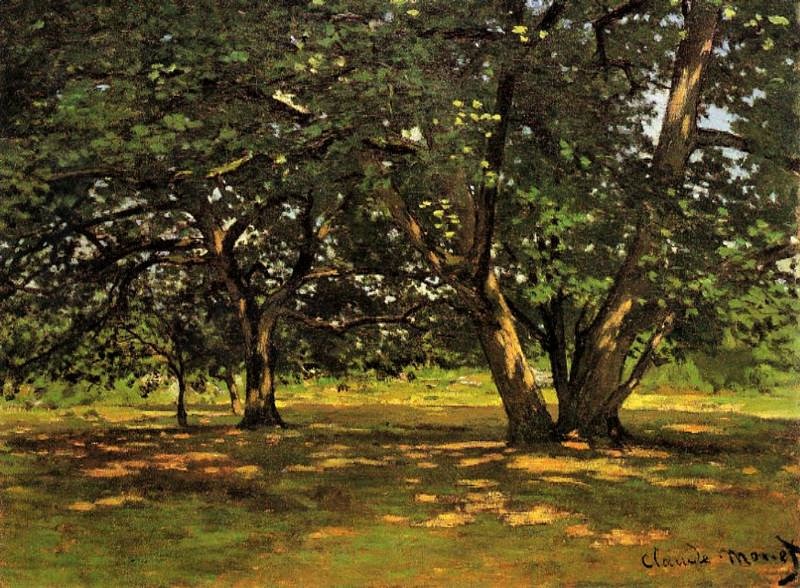
Monet, Renoir, Sisley and Bazille wanted to paint en-plein-air inspired by the Barbizon-painters. All four being pupils of Gleyre, they formed one of the circles of friends. Their painting in the Fontainebleau forest is an important step for the ‘impressionist’ art-movement. They went there many times during the years 1862-1871, but it is not always clear who went when, see chronology.
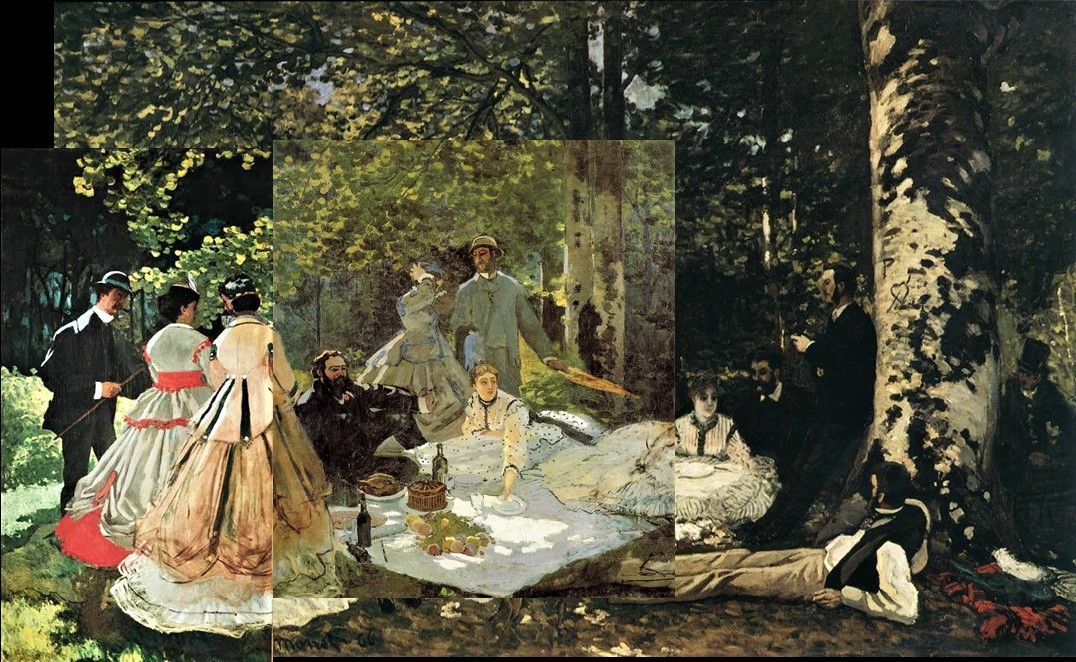
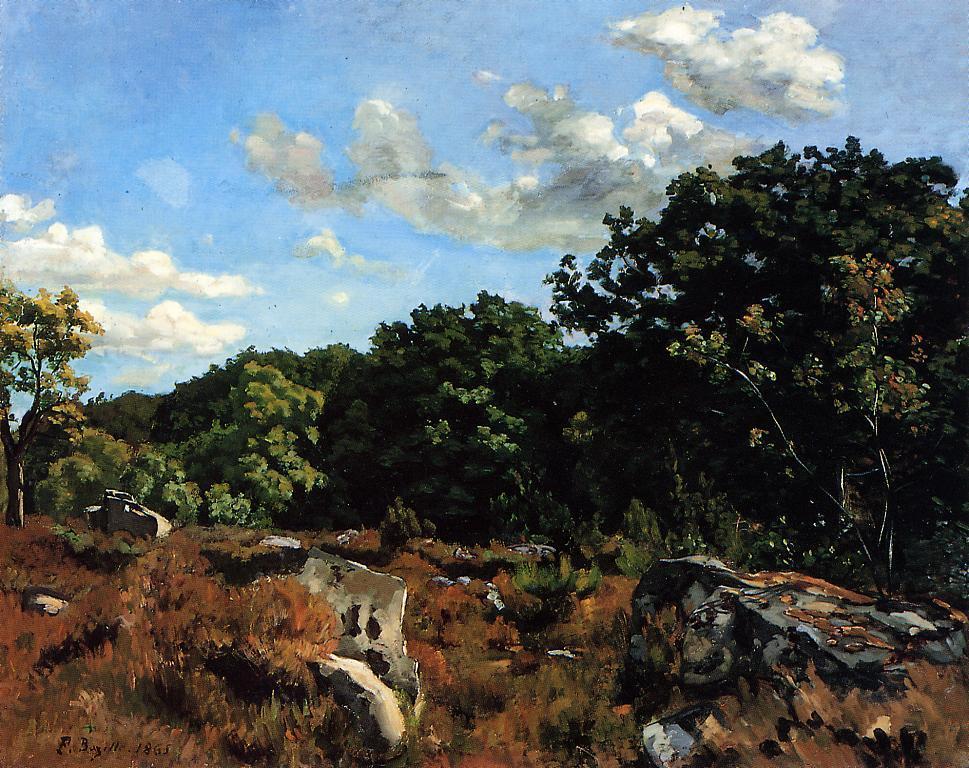
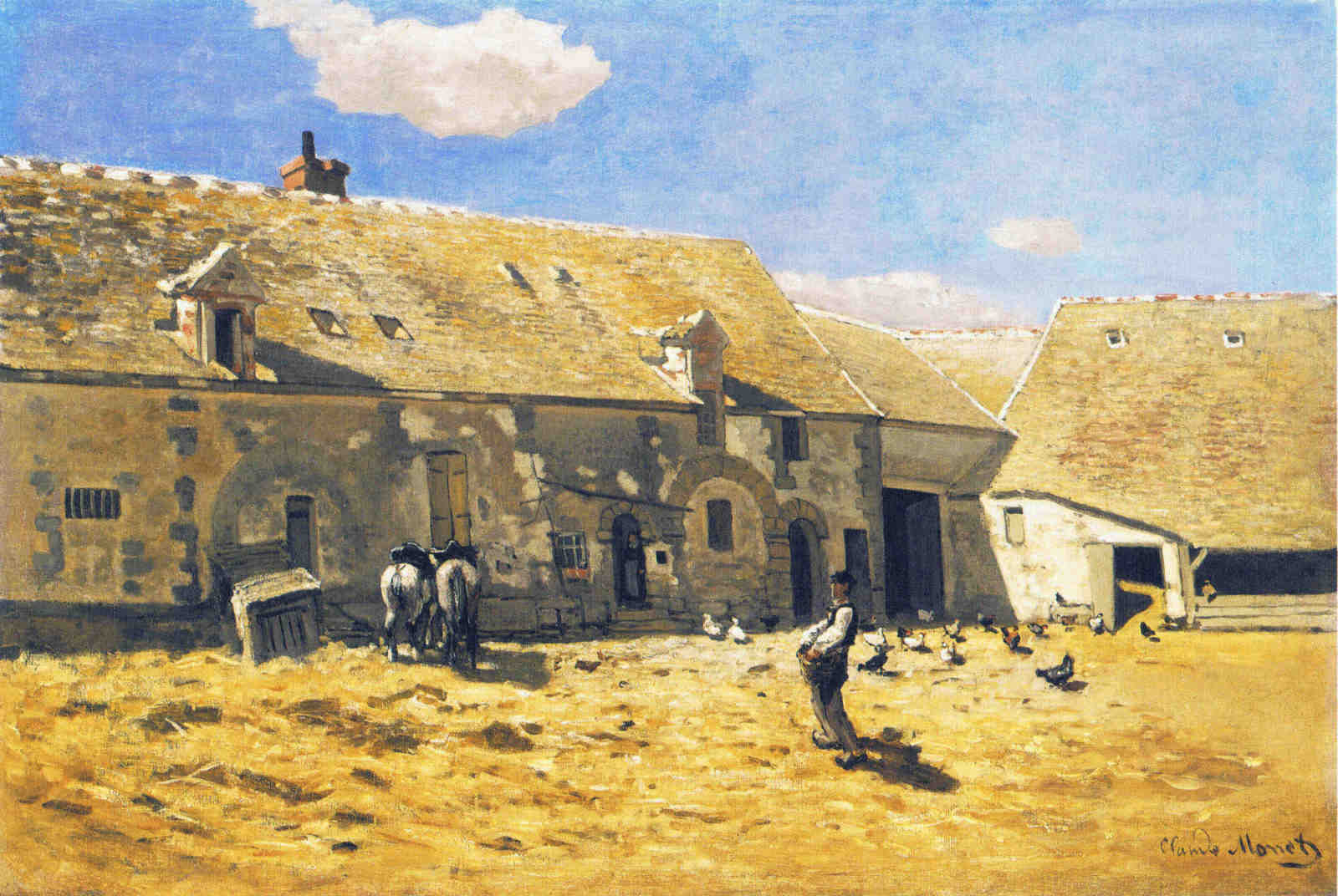
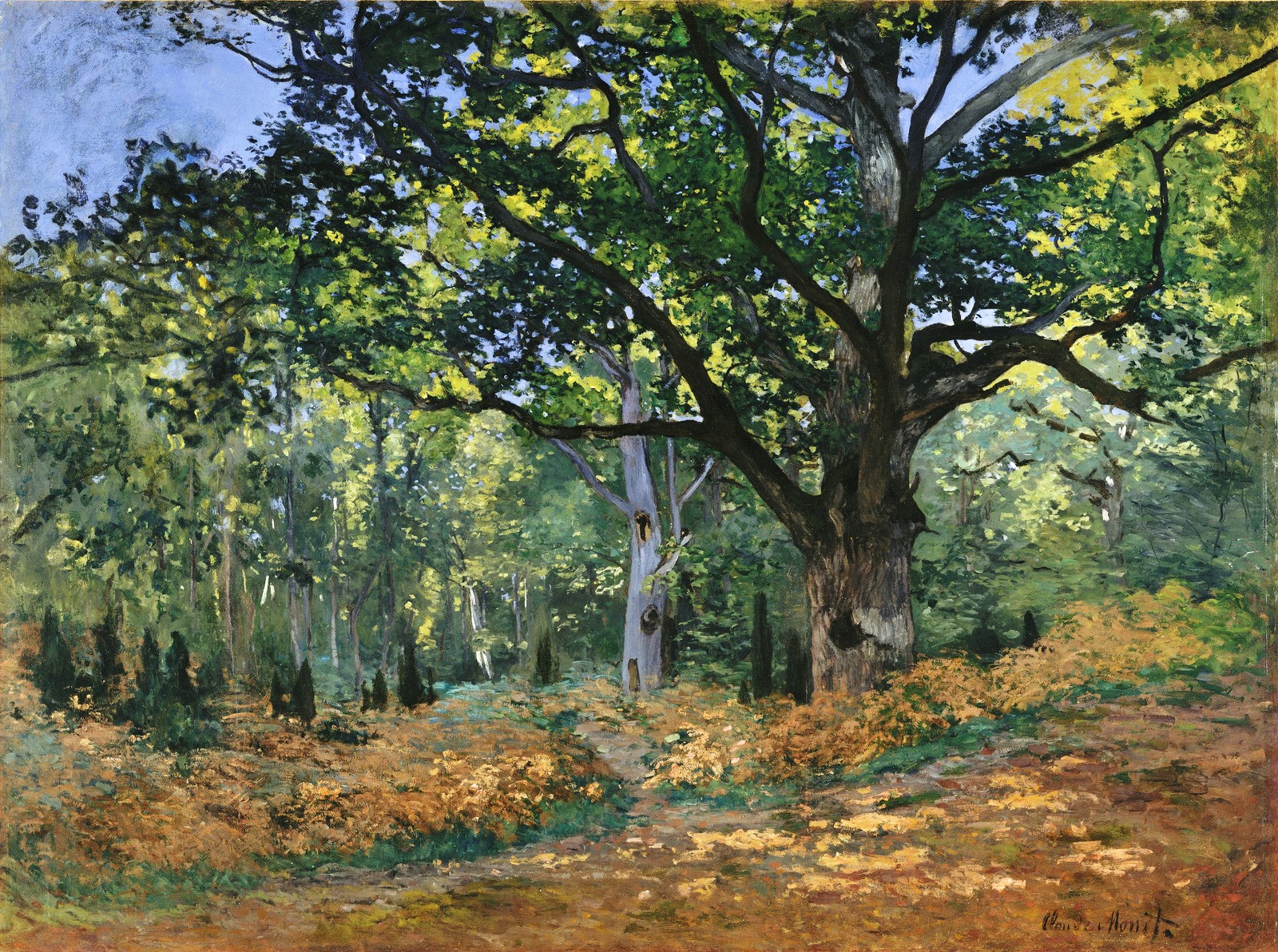
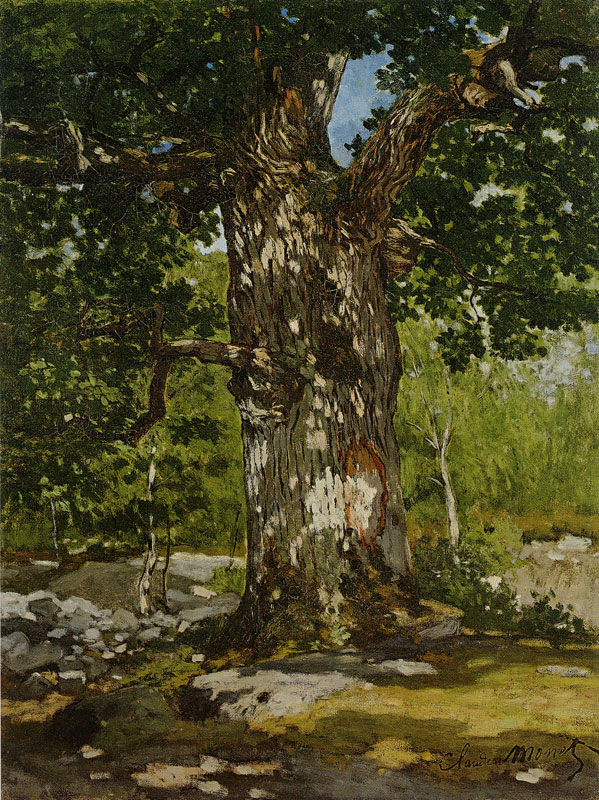
Claude Monet painted in the Forest of Fontainebleau between 1863 and 1865 (R22I,p49 +58-61). He painted the forest (CR59); the edge of the forest (CR18); the Bodmer tree in Bas-Bréau (CR60 +60a); roads (CR17 +58) and namely Le Pavé de Chailly (CR19 +56 +57); a farm in Chailly (CR55); the fields near Chailly (CR55a). In 1865 Claude Monet worked, in the forests surrounding Chailly, on his large unfinished masterpiece↑↑, including prepatory paintings (R22,no.61-63).
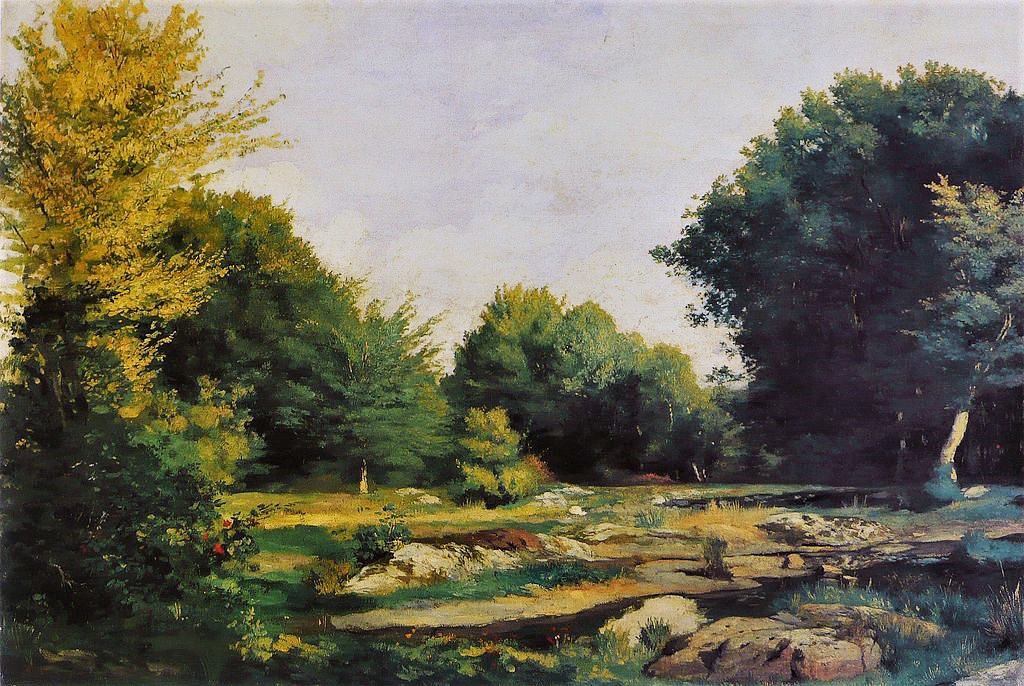
Auguste Renoir painted in the Forest of Fontainebleau between 1863 and 1871 (R31,p295-7;R30,p9-13). Renoir met Diaz in 1862 or 1864, who adviced him to lighten up his palet (R31,p295;R5,p30;R3,p70;R460,p90). Renoir stayed often with Jules le Coeur, who had bought a house 1865/04 in Marlotte (R31,p295) and whom he depicted in the forest (R31,no5;R30,no11;R460,no3). Famous is Renoir his painting of the Cabaret of Mother Antony in Marlotte, depicting Sisley and Le Coeur (1866;R31,no4;R30,no14). In July 1867 Renoir portrayed Lise Tréhot in Chailly-en-Bière (R30,no22). Renoir also depicted the forest (R30,no9+10;R460,fig.57), a road near Marlotte (R460,no1) and maybe a clearing (R460,no2↓).
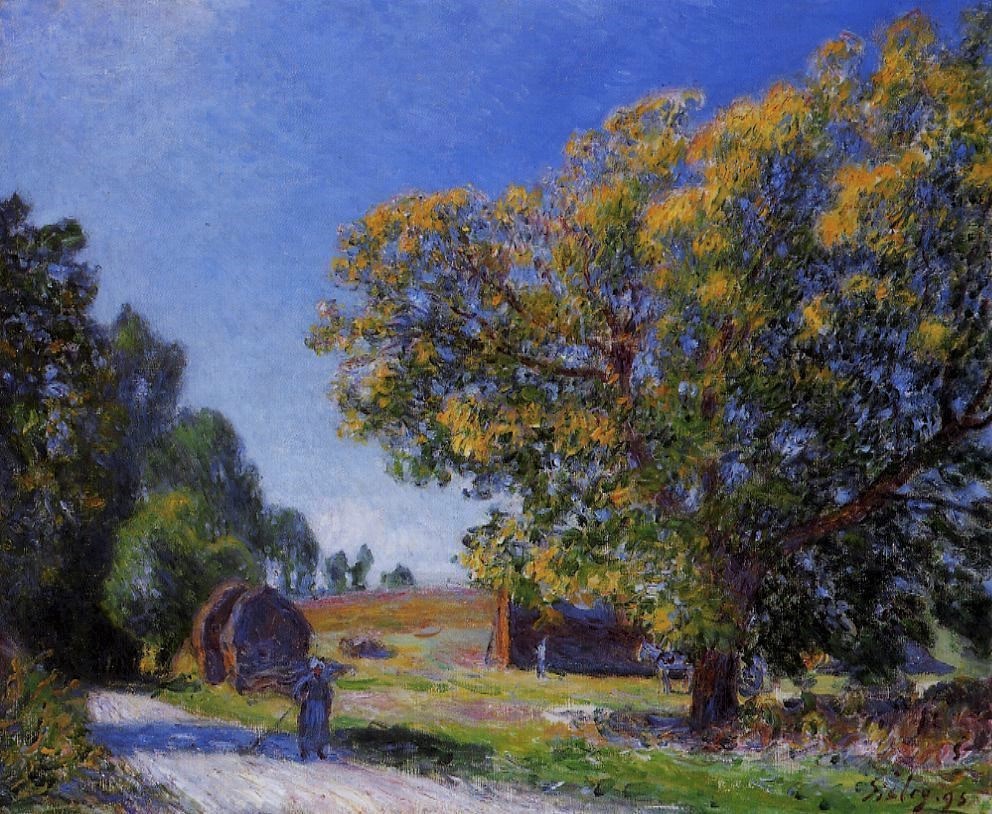
Between 1865 and 1870 Alfred Sisley several times depicted the forest of Fontainebleau (R396,CCPP1 +2 +12 +19) and more specific Marlotte in 1866 (CCPP5 +6). Later, between 1882 till his death in 1899, he also depicted the east and south-east parts of the forest of Fontainebleau, while living in Veneux-les-Sablons and Moret-sur-Loing.
Note: One source claims that Renoir, Sisley, Monet and Pissarro spend time in the forest of Fontainebleau in the Spring of 1865 (R30,p9). But, this is not affirmed by an extended source on Pissarro (R116I,p117/8). Still, Pissarro made in 1860 a painting of a sunken lane near Chailly (R116,CCP48).

Other partakers in the Fontainebleau forest:
Two partakers of the ‘impressionist’ expositions lived for some years in Barbizon, namely Jean-Baptiste Millet and Charles Tillot.
Jean-Baptiste Millet lived in Barbizon with his elder brother Jean-François (aR5;aR6). After the death of Jean-François in 1875, Jean-Baptiste began to wander around (aR6). In a letter it is noted that Jean-Baptiste flew from Paris to Barbizon in 1870/11 (iR40/bpt6k96868782 =R349III,p64). So, I assume most of his works made in and around Barbizon were made between 1870 and 1875. This seems to be affirmed by the fact that many of the works exhibited in these years carry these locations (except SdAF-1880-5409).
Jean-Baptiste Millet namely noted Barbizon and it’s surroundings: Chailly-en-Bière (just north), Fleury-en-Bière (just west), Cély (just west of Fleury), Saint-Martin-en-Bière (just south; including Macherin), Fontainebleau (to the east-south) and the forest of Fontainebleau (just east).
In 1860 Charles Tillot moved to Barbizon, about 60km south-east of Paris, bought the house ‘La Taupinière’, and lived across his neighbour Jean-François Millet (iR4;R9;iR3;iR1;R92,p16), who would become his friend. Tillot made paintings of Barbizon, Bas-Bréau, the Gorges d’Apremont and the surrounding fields and woods. Many of them he exhibited at the Salon and the ‘impressionist’ expositions, see overview.
In 1882 + 1884 Mulot-Durivage lived at the Rue Saint-Jean, 28, Changis-Avon, just east of Fontainebleau. There are hardly paintings known of him. Anyway, he exhibited two works made in the Forest of Fontainebleau, in 1882 at the Salon and in 1884 in Rouen, see overview.

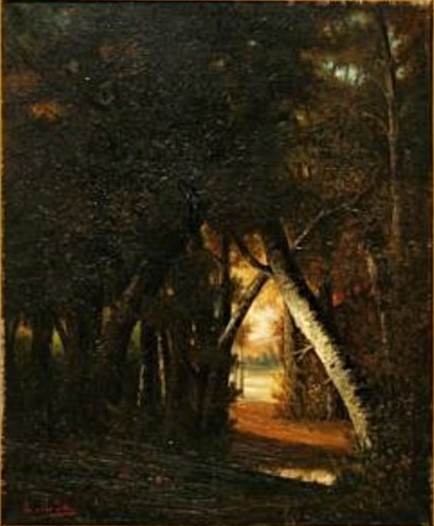

Other partakers of the ‘impressionist’ expositions made just a few paintings in the Forest of Fontainebleau, namely Colin, de Molins, Levert, Redon, Rouart and maybe Vignon.
Two paintings of Gustave Colin, that were auctioned in 1909, were called ‘Forêt de Fontainebleau’, see overview.
Léopold Levert made some works in the Fontainebleau forest, he exhibited two paintings (3IE-1877-83, Sablonnière, forêt de Fontainebleau and 5IE-1880-108, Plaine de Barbizon) and some were shown at a posthumous sale (see account).
Auguste de Molins made many hunting scenes, but it is unknown at which location. Sure is that one of his paintings is titled ‘Fontainebleau’↑.
Odilon Redon made an undated painting depicting the Barbizon forest in Autumn↑. I assume he didn’t paint here often, but I still have to check. Anyway, the titles of his exhibited works doesn’t indicate so, see account.
Henri Rouart exhibited one painting in Bas-Bréau (4IE-1879-211); this is the only painting I know of that he made in the Fontainebleau forest.
There is a painting known of Victor Vignon, supposedly to have been made in the forest of Fontainebleau: 1869-70ca, Sbl, Mother and child on a wintry forestpath (Fontainebleau), 34×41, A2021/09/04 (iR317;iR17)↓. But, when we look at the locations of the paintings he exhibited and that are known nowadays, than this would be the only painting Vignon made in the forest of Fontainebleau. So, I think it is also a possibility that Vignon made this painting in another forest.


Locations in the Fontainebleau forest
Here below you will find important locations in the Fontainebleau forest.
Chailly:
Chailly-en-Bière lies about 50km south-east of Paris (iR9;R290,p6).
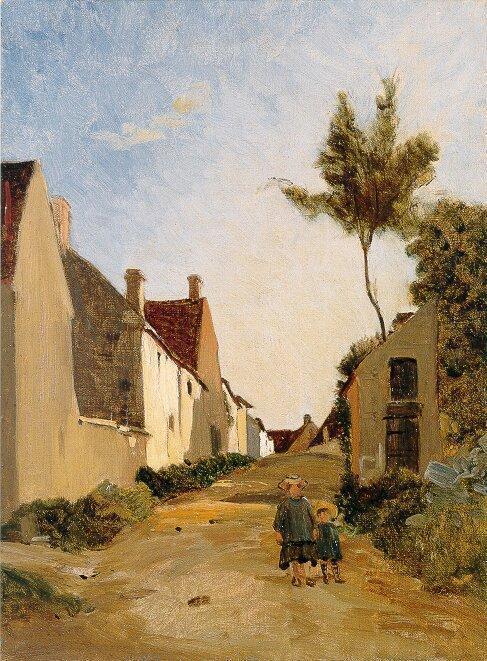
In April 1863 Renoir, Monet, Bazille and Sisley stayed at Auberge du Cheval-Blanc in Chailly-en-Bière (iR9; R30,p9; R22, p49). In 1865 Claude Monet worked here on his large unfinished masterpiece↑↑, including prepatory paintings (R22,no.61-63). He also painted the surrounding farms and fields (R22,no55 +55a); Monet depicted at least 3x Le Pavé de Chailly (CR19 +56 +57); the first one was shown at the Salon of 1866. Monet worked here also together with Frédéric Bazille, who also modelled for his unfinished masterpiece. Bazille depicted Monet while lying injured in a bed in the Hôtel du Lion. Bazille also depicted a village street and the landscape in the surroundings of Chailly.
In July 1867 Renoir portrayed Lise Tréhot in Chailly-en-Bière (R30,no22).
Jean-Baptiste Millet depicted the meadows near Chailly.
Pissarro made in 1860 a painting of a sunken lane near Chailly (R116,CCP48).




Barbizon:
Barbizon is a small village and lies just south of Chailly (iR9).
Barbizon is maybe the most famous village in the Forest of Fontainebleau. The School of Barbizon is named after it.
Many painters stayed in Auberge Ganne, 92, Grande Rue, now housed by the Musée des Peintres de Barbizon (Musée départemental de l’Ecole de Barbizon) (aR5;iR9;M285).
Théodore Rousseau moved to Barbizon in 1836 and went to live on 55, Grande Rue (iR9). His house was depicted by Georges Gassies↓. In 1849 Jean-François Millet went to live on 27, Grande Rue; for some time his younger brother Jean-Baptiste Millet also lived here (iR9). They had Charles Jacque as neighbour (R59,p144+154). In 1860 Charles Tillot came to live across the street.
Jean-Baptiste Millet lived in Barbizon with his elder brother Jean-François (aR5;aR6). After the death of Jean-François in 1875, Jean-Baptiste began to wander around (aR6). In a letter it is noted that Jean-Baptiste flew from Paris to Barbizon in 1870/11 (iR40/bpt6k96868782 =R349III,p64). So, I assume most of his works made in and around Barbizon were made between 1870 and 1875. This seems to be affirmed by the fact that many of the works exhibited in these years carry these locations (except SdAF-1880-5409).
Jean-Baptiste Millet namely noted Barbizon and it’s surroundings: Chailly-en-Bière (just north), Fleury-en-Bière (just west), Cély (just west of Fleury), Saint-Martin-en-Bière (just south; including Macherin), Fontainebleau (to the east-south) and the forest of Fontainebleau (just east).
In 1860 Charles Tillot moved to Barbizon, about 60km south-east of Paris, bought the house ‘La Taupinière’, and lived across his neighbour Jean-François Millet (iR4;R9;iR3;iR1;R92,p16), who would become his friend. Tillot made paintings of Barbizon, Bas-Bréau, the Gorges d’Apremont and the surrounding fields and woods. Many of them he exhibited at the Salon and the ‘impressionist’ expositions, see overview.
Odilon Redon made an undated painting depicting the Barbizon forest in Autumn↑↑.
There also is a Route de Barbizon, east of Barbizon heading towards Fontainebleau (iR9); in the past it started with the Allée des Vaches (iR9; see=aR1). This was probably the south border of Bas-Bréau.


The fields surrounding Barbizon and Chailly:
Several artists depicted the fields that surrounded Barbizon and Chailly. Sometimes showing haystacks or the edge of the forest of Fontainebleau.
Levert also depicted and exhibited the ‘plaine de Barbizon’ (5IE-1880-108).
Monet several times depicted the Pavé de Chailly (R22,CR19 +56 +57) and also the fields near Chailly (CR55a).


Bas-Bréau:
In former days Bas-Bréau seems to have been a hamlet east of Barbizon with the Route de Bas-Bréau (iR9) in the middle, the former Carrefour de Bas-Bréau in the south (now near the Parking ‘Allée des Vaches’) (see=aR1).
Famous was the Bodmer oak, depicted by Monet (R22,no.60 +60a).
Charles Tillot painted here and exhibited two paintings (2IE-1876-252 + 3IE-1877-229).
Henri Rouart painted here and exhibited one painting (4IE-1879-211).
Diaz also painted in Bas-Bréau and made at least one study.

Gorges d’Apremont:
The Gorges d’Apremont are a rock formation and it lies south of Bas-Bréau (iR9; aR3).
This was depicted and exhibited by Charles Tillot (S1870-2740 +3IE-1877-236).
Several landscapists from the Netherlands painted in the Forest of Fontainebleau. Martinus Kuytenbrouwer (iR66)also depicted the surroundings of Gorges d’Apremont (M70).
Just south of the Gorges d’Apremont there is the Monts Girards (iR9).
See also a painting of Diaz de la Peña (1807-76): 1867, Les Hauteurs du Jean-de-Paris (Gorges d’Apremont), 84×106, Orsay (M1)


Belle-Croix:
The Belle-Croix is a cross in the middle of the forest and lies east of Bas-Bréau (R290,p6; iR9).
Fontainebleau:
Fontainebleau lies in the middle of the Fontainebleau forest (iR9). But, I couln’t find one painting depicting this village or it’s direct surroundings.
In Fontainebleau, on the place Charles de Gaulle, you will find the Musée National du Château de Fontainebleau (M284;iR23;iR9). The collection seems to show namely more classical paintings (M284).
Changis-Avon:
In 1882 + 1884 Mulot-Durivage lived at the Rue Saint-Jean, 28, Changis-Avon, just east of Fontainebleau. There are hardly paintings known of him. Anyway, he exhibited two works made in the Forest of Fontainebleau, in 1882 at the Salon and in 1884 in Rouen, see overview.
Gorge-aux-Loups:
Between Fontainebleau and Marlotte lies the Gorge-aux-Loups (iR9). Depicted by Cabat.


Mare-aux-Fées:
The forest of Fontainebleau counted several ponds. Between Fontainebleau and Marlotte lies the Mare-aux-Fées, just south of the Gorge-aux-Loups (iR9; R290,p6).
This was depicted and exhibited by Albert Rigolot (EU-1900-D-1613)↑.
Marlotte:
Bourron-Marlotte lies in the south-east just outside the Forest of Fontainebleau (iR9).
Alfred Sisley painted the village of Marlotte and exhibited them at the Salon of 1866.
Renoir and others often stayed at ‘Cabaret de la Mère Anthony’ in Marlotte (R3). He painted the Inn in 1866, with Jules le Coeur standing* and Sisley with the hat on (R31,no4). In Februar 1866 Sisley, Renoir and Jules le Coeur painted in the surroundings of Marlotte (where le Coeur had bought a house in 1865) (they also painted in Milly and Courances) (R166,p91). By then Monet and Bazille were working in Chailly-en-Bière (R166,p91). In 1865 Renoir lived in Marlotte with his brother Edmond and met Courbet (R30,p9). From February till April Renoir stayed frequently with Sisley and Le Coeur in Marlotte (R31,p295). In the summer of 1866 Renoir alternately stays with Jules le Coeur and in ‘Mère Anthony’ (R30,p9)
Note*: The figure standing is formerly (wrongly) identified as Monet. In a way this confirmed the myth that Bazille, Monet, Renoir and Sisley always spend their time together as a closed group of friends. In reality they often worked alone and in pairs. Renoir namely was very close to Jules le Coeur.


Moret:
Moret-sur-Loing lies south-east of the Forest of Fontainebleau. See seperate page.
Alfred Sisley Sisley lived here a year from September 1882 till October 1883 (R166,p268/9). Later in November 1889 Sisley moved to 19, Rue Montmartre, Moret-sur-Loing. Here Sisley also depicted the edges of (probably) the Forest of Fontainebleau (R396,CCPP 691-699 +721 +805 +810 +956 +957).
North of Moret lies Veneux-les-Sablons (where Sisley also lived). Here he also depicted the edges of (probably) the Forest of Fontainebleau (R396,CCPP 433 +436 +489 +552-554)

The forest of Fontainebleau:
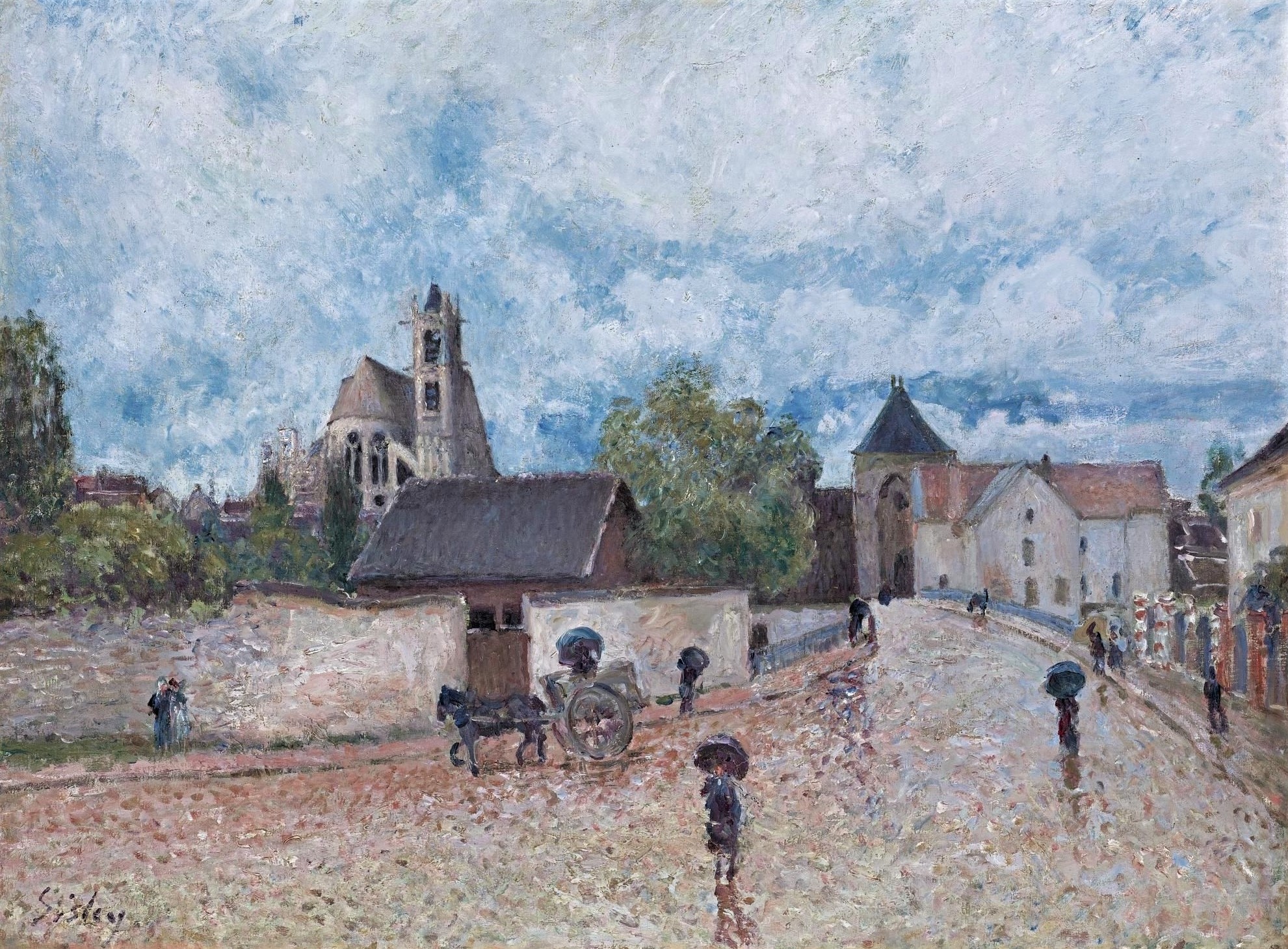
Here below you will find some pictures made in the forest of Fontainebleau, that are not specified.


Topics in the Fontainebleau forest
Here below you will find some general topics in the Fontainebleau forest depicted by various artists.
Clearings:
The forest of Fontainebleau has several clearings.
These were namely depicted by Renoir↑↑, Rousseau and Sisley↑↑.

Impressive trees:
The forest of Fontainebleau had several impressive trees. Famous is namely the Bodmer Oak in Bas-Bréau↑↑.


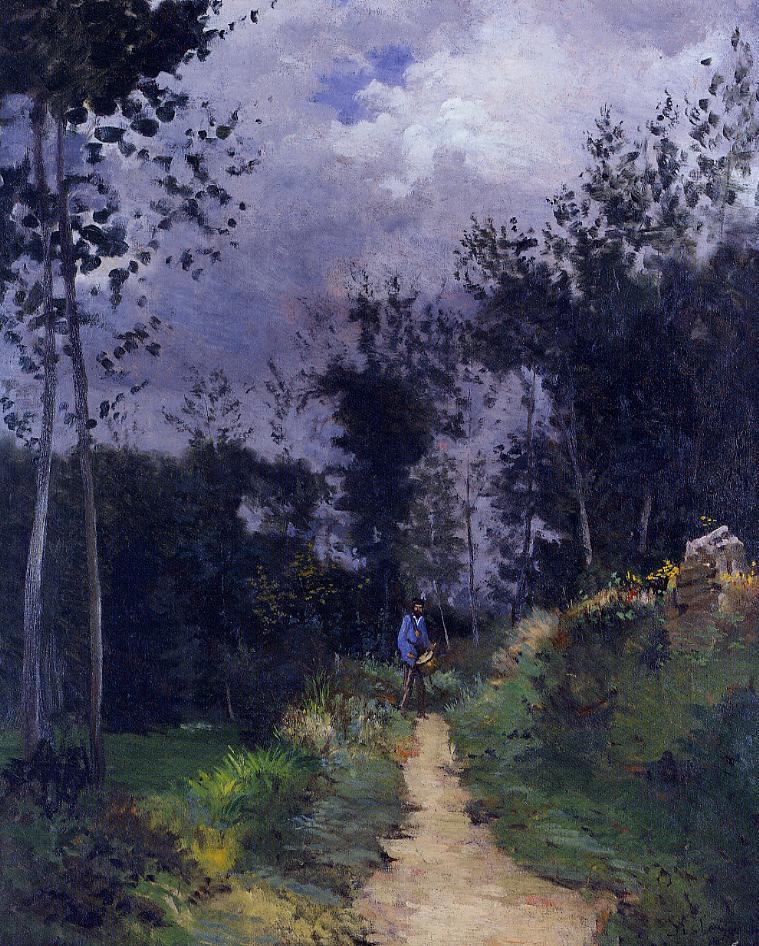
Paths and roads:
Throughout the Fontainebleau forest there are several longer roads. The most important ones are:
Le Pavé de Chailly, depicted by Monet (R22,CR19 +56 +57)
The Route de Bas-Bréau (iR9).
There is a Route de Barbizon, east of Barbizon heading towards Fontainebleau (iR9); in the past it started with the Allée des Vaches (iR9; see=aR1). This was probably the south border of Bas-Bréau.
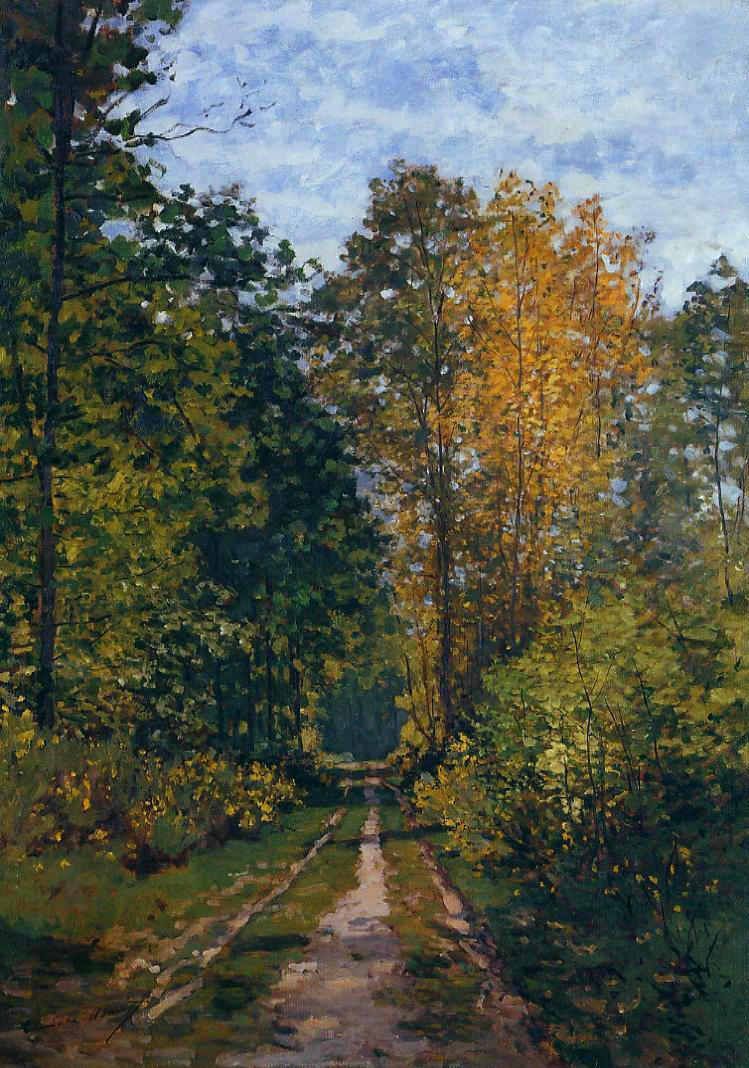
The artists that painted in the Fontainebleau forest also depicted smaller paths. Monet did so too (R22,CR17+58↑).
Careers (carrières):
The forest of Fontainebleau has several careers (carrières) and other rockformations.
Namely depicted by Aligny and Bonington.
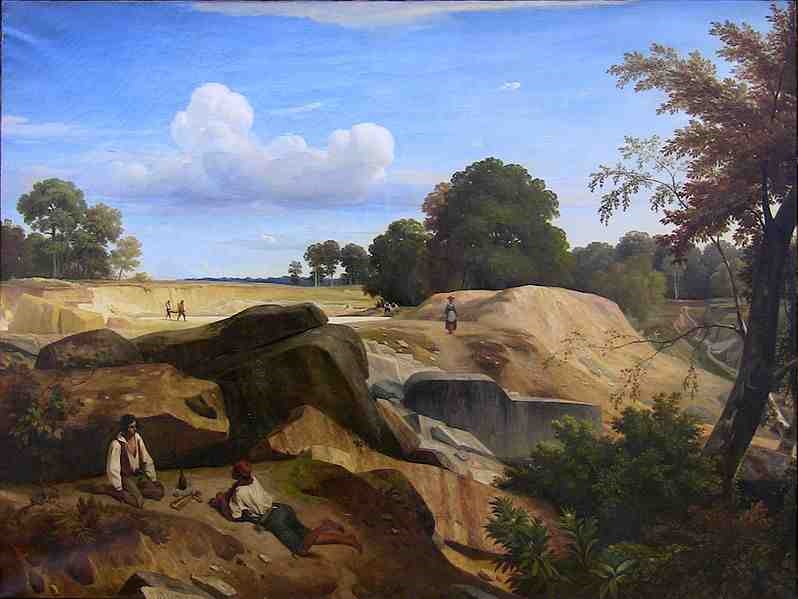

Sandpits (sablonnière):
The forest of Fontainebleau has several sandpits (sablonnière).
Levert depicted and exhibited one (3IE-1877-83).

Ponds:
The forest of Fontainebleau counted several ponds. More famous are the Mare-aux-Fées↑ between Fontainebleau and Marlotte. And also the Mare-aux-Evées, north-east of Chailly. On paintings we often can discern a (non-located) pond.
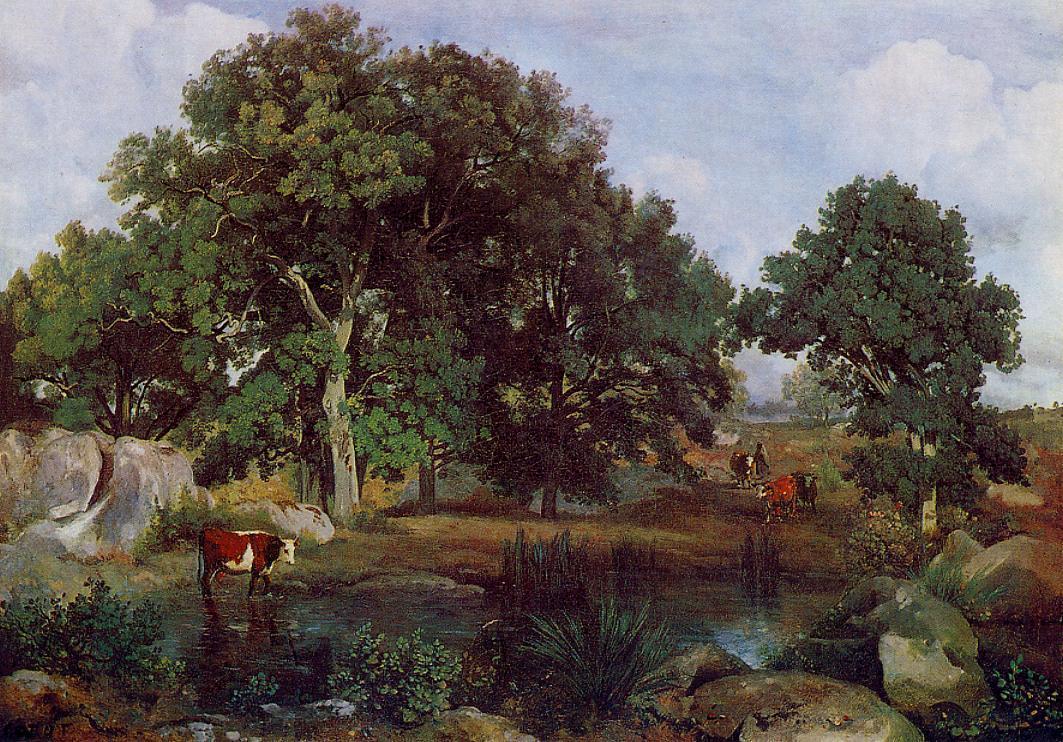


Human activity:
Though being namely landscape painters, sometimes the painters explicitly depicted human activity. Such as a shepherd guarding it’s flock of sheep, a hunter or people strolling through the woods.


Sources:
My most important sources are the works of Dony (R30) and Raeburn (R31) about Renoir and of Wildenstein (R22) about Monet. For the locations I used Google maps (iR9). For background information on the places I mostly used WikiPedia (iR3).
For other general references (=R) see. For other references to internet sites (=iR) see. For other additional references (=aR) see below. See links for practical hints and abbreviations and for the subscription of the paintings.
Further readings:
x
Additional references (=aRx):
- fontainebleau-photo.fr//Bas-Bréau (article with pictures on the hamlet Bas-Bréau, just east of Barbizon)
- fontainebleau-photo.fr//Belle-Croix (article with pictures on the plateau of Belle-Croix)
- fontainebleau-photo.fr//gorges-dapremont (article with pictures on the Gorges d’Apremont)
- fontainebleau-photo.fr//gorge-aux-loups (article with pictures on the Gorges-aux-Loups)
- cotegite.eu//barbizon (article with pictures on Le circuit des peintres in Barbizon)
- ile-de-france.jeditoo.com//barbizon (article with pictures on Barbizon)
- x
Recommanded citation: “Impressionism, locations where the ‘impressionists’ did paint: the Fontainebleau forest. Last modified 2025/12/24. https://www.impressionism.nl/fontainebleau/”
Note: additional info and pictures will follow.