Impressionism: a historical reconstruction
The 2nd ‘impressionist’ exposition
1876
extended overview
The 2nd ‘impressionist’ exposition:
There were 19 partakers showing about 298 art-works, which is more than the 252 catalogue numbers. (See slideshow.) Officially it was called the ‘2e exposition de peinture‘. Caillebotte was an important newcomer and one of the organisers. Lepic was a sort of guest of honour, showing far out the most (49) art-works, more than 16% of the whole. Many etchings and aquarelles were exhibited. Renoir showed paintings in a mature Impressionist style. Faure and Chocquet were important lenders. On this page you will find information on the organisation, the partakers, the used techniques, the lenders, the reviews and the results of the 2nd ‘impressionist’ exposition held in 1876 in Paris.
Note: in the links of the artists I sometimes refer to the main page on this artist, sometimes to the works exhibited and sometimes to the account, see also the overview of partakers.


1876, the organisation:
Caillebotte, who joined the ‘impressionist’ expositions for the first time also was one of the principal organisers, together with Degas, Renoir and Rouart. The catalogue indicates, that it was held in April. L’Audience explicitly mentions ‘since the 1st of April…’ (Rv34). But, Degas made clear that it already opened Thursday the 30th of March*. This date is affirmed by Bigot (Rv32), Burty (Rv43).
The exposition was held in the galleries of Durand-Ruel spread over 3 rooms, 11, Rue le Peletier in Paris.
In a footnote Alfred de Lostalot (1876/04/01=Rv10) remarks that the catalogue hadn’t been written yet. (R90I,p87)
Note: more info will be added.
Note*: See the letter of Degas to Berthe Morisot late March (Reff 2020, letter no.56 =R433III,p39).
Sources: R2,p146+158+160; R90I,p47; R433III,p39; iR417.

1876, the partakers:
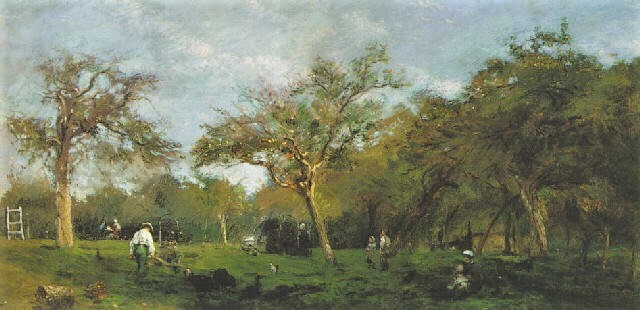
The second impressionist exposition had 19+1hc-1=19* partakers showing about 298 art-works, which is more than the 252 catalogue numbers. (See slideshow.) Apparently Mme de Rambure exhibited without being in the catalogue (R102,p275), but probably she was the same as ‘Jacques François‘, a pseudonym for an unknown woman, who was a newcomer. Guest of honour was Lepic, who had participated in 1874 and now showed the most (=49) art-works. Other guests of honour were the newcomers Desboutin (20 art-works) and Legros (25 art-works). All 3 showed many etchings. The most important new-comer was Caillebotte, who also was one of the principal organisers. Other new-comers were Jean-Baptiste Millet and Tillot (though he stayed unknown, he joined 6 of the 8 expositions). Degas, Monet, Morisot, Léon Ottin and Renoir showed many art-works. Other partakers were: Béliard, Bureau, Cals, Levert, Pissarro, Rouart and Sisley. 7 of the 19 partakers would stop exhibiting at the ‘impressionist’ expositions: Béliard, Bureau, Desboutin, Legros, Lepic, Jean-Baptiste Millet, Léon Ottin.
In a letter late March to Berthe Morisot, Degas rendered a ‘final list’ of partakers. Bureau wasn’t mentioned in it. Sisley and de Molins were noted as doubtful, the last one didn’t join. (R433III,p36=letter 56) Bureau wasn’t mentioned in the reviews that were written in the first days, when the catalogue wasn’t published yet.
Note*: some sources state there were 20 partakers, but this is not specified (iR426).


1876, the used techniques:
See link for an overview of the used techniques.
Most art-works exhibited were oil paintings. Probably 200, about 67,1% of the total amount of 298 art-works. (See slideshow.) Legros probably didn’t show oil paintings.
Notable were the many engravings exhibited by 3 partakers. Desboutin showed at least 12+1hc=13 engravings, all dry points. Maybe all the 25 art-works of Legros were engravings, with the numbers 81-4 +82 +83-4 +85 +88-1 being dry points and no. 83-5 containing two lithographes. Lepic showed at least 7 and probably 11 etchings (nos 134-137). So in total there were probably 49 engravings exhibited, about 16,4% of the total amount of art-works.
The following 4 partakers exhibited aquarelles: Lepic in total 16 (nos. 124-133; note: no.124 contained 5 aquarelles; no.126+127 each two); Jean-Baptiste Millet showed at least 5 aquarelles (nos 138-141 +147); Morisot 3 (no.179-181). The technique of Léon Ottin his art-works was not indicated in the catalogue; still it is suggested that 10 works were aquarelles (no.195+196), but it is even possible that all his 22 works were aquarelles; for the counting I assume 10. So in total there were probably 34 aquarelles exhibited, about 11,4% of the total amount of art-works.
The following 3 partakers exhibited pastels: Degas 1x (no.42); Morisot showed 3 ‘dessins au pastel’ (no.182); Renoir 1 (no.226). So in total there were 5 pastels exhibited, about 1,7% of the total amount of art-works.
The following 4 partakers exhibited drawings: Cals 3x (no.33+34+35); Degas 1x (no.59); Jean-Baptiste Millet probably showed 2 (sépia) drawings (nos 145+146); Rouart showed 2 drawings, 1 with chinese ink (no.234) and 1 with sépia (no.235). So in total there were probably 8 drawings exhibited, about 2% of the total amount of art-works.
Probably Degas used for some of his oil paintings mixed techniques. for no.56 (not exhibited) he used thinned oil, probably also for no.54 and maybe also for no. 39 +40; I discern works made with thinned oil (essence), but I count them as oil paintings. A review indicated no.44 of Degas as a grisaille and no.55 maybe was a pastel over monotype, but because the identification is too uncertain, I will count them all as oil paintings. No.51 of Degas consisted of at least 2 art-works, probably it were drawings enhanced with thinned oil and pastel; I count them as mixed techniques. So in total there were probably 2 art-works exhibited made with mixed techniques, less than 1% of the total amount of art-works.
The ‘paneau decoratif’ of Monet (no.162) probably was a normal oil painting.
There is discussion if Degas showed a photograph outside the catalogue, but I assume he didn’t.


The display of the works:
The exposition was held in the galleries of Durand-Ruel spread over three rooms, 11, Rue le Peletier in Paris. The intention was that the works were hung grouped by artist. But, in fact in room 1 namely engravings, aquarelles, pastels and drawings were shown (of Desboutin, Legros, Degas, Jean-Baptiste Millet and of Morisot). In room 2 the paintings of Morisot were hung and also marines of Lepic, portraits and figure paintings by Renoir, landscapes by Monet (including no.153) and Sisley and the works of Caillebotte. In room 3 landscapes of Tillot and Pissarro; works of Léon Ottin, Cals, Rouart, Béliard; still lifes of Jacques François; (other) works of Degas*. Silvestre remarked the several small canvases of Morisot were displayed on one panel (Rv21).
Note*: see the review of Burty 1876/04/15 (=Rv43; R90I,p65).
Was this an impressionist exposition?
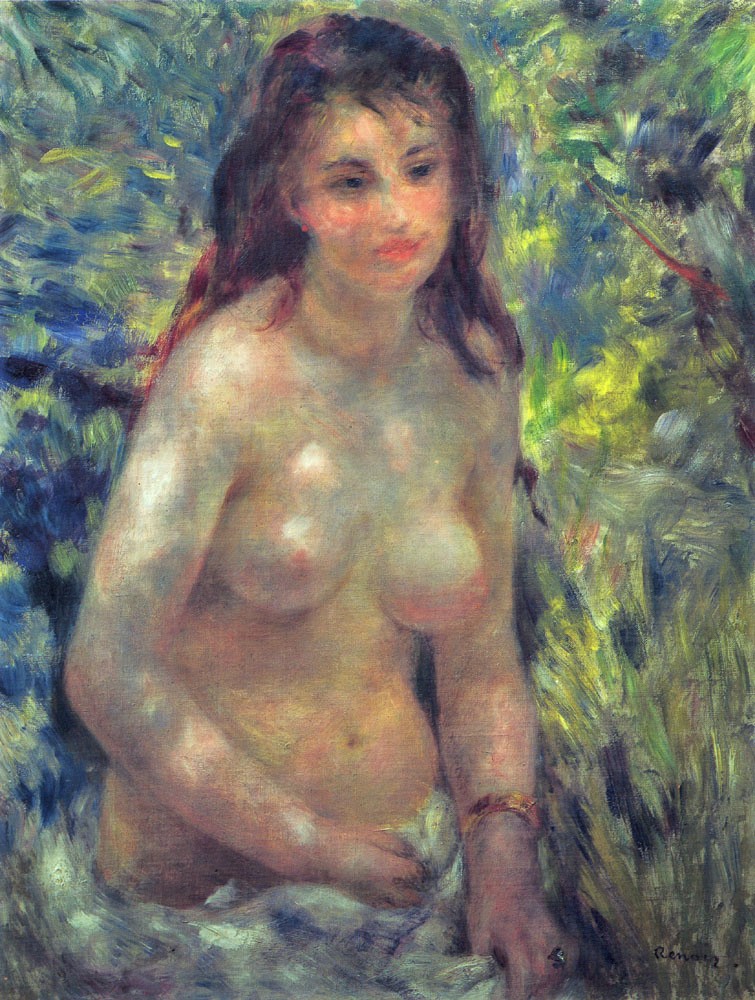
When we see Impressionism as a painting style, was this exposition in 1876 than an impressionist exposition? Most of the paintings of many partakers still had subdued colours and many greyish, brownish and blackish hues were used. This also applies to Morisot and Pissarro. Namely Monet, Renoir and (partly) Sisley used a mature impressionist painting style. They often used juxta-posed brushstrokes and bright colours, namely see Monet (no.149+152+155+160) and Sisley (no.239+244). For the black coat of Monet (no.220) Renoir used a mix of purple, blue and red hues. In several portraits the model merges with the background (no.200+213+212), in the latter he also used leaves filtered light. Still, he called this work a study, which is not in line with the impressionist conviction that a sketchy painting is the best way of rendering an ever changing moment. Caillebotte still painted in a more realist style.


1876, the lenders:
Many works of Sisley, Renoir, Jean-Baptiste Millet and Monet were loans: 8 out of 10 of Sisley; 12 out of 19 of Renoir; 6 out of 10 of Millet; 10 out of 19 of Monet. Other loans were of Degas (1 out of 24), Lepic (1 out of 49), Léon Ottin (3 out of 22) and Pissarro (1 out of 12). So, in total there had been 42 loans, which is about 14% of all the works exhibited.
The most important lenders were Fauré and Chocquet. Fauré did lend 9 paintings of Monet (nos.148-160) and 1 of Degas (no.37). Victor Chocquet, mostly miswritten as Choquet, did lend 6 paintings of Renoir and 1 of Monet (no.158) and 1 of Pissarro (no.199). Other important lenders were the art-dealers Père Martin, who did lend 4 paintings of Sisley (nos.237+239+240+243) and Georges Petit, who did lend 3 works of Millet (nos.140+141+144). Other lenders were Brame lending 1 work of Millet (no.138), Dollfus lending 2 works of Renoir (nos.217 +220), Durand-Ruel lending 2 paintings of Sisley (nos.241+242), André Gill lending 1 work of Léon Ottin (no.196), Haro lending 2 works of Jean-Baptiste Millet (no.139+143), Arsène Houssaye lending 1 work of Lepic (no.134), Mme Latouche 1 painting of Sisley (no.238), Legrand lending 1 painting of Renoir (no.233) and 1 of Sisley (no.244), Manet lending 1 work of Renoir (no.224), Poupin lending 2 paintings of Renoir (no.209+219). There were also anonymous lenders: for Léon Ottin L.M. (no.188) and Mme O. (no.193).


1876, reviews:
Note: see the extended page on the reviews with also an overview numbered as Rv1, 2, 3, etc.
Clayson (R2,p145) states that there were more reviews in the press than the 58 reviews in 1874, but Berson renders 59, so the amount seems to be about the same (R90I,p53-113). Clayson mentions that about 1/2 was positive and 1/2 negative. When we attentively read the reviews rendered in Berson, we find that about 1/3 was more positive, 1/3 more negative and 1/3 mixed or more neutral.
Most art-critics used both the terms ‘impressionists‘ and ‘intransigeants‘, added with some other terms; see.
Most of them focusing on the sketch-like lack of finish of the paintings and not on the newness of suburban subjects. (R2,p145+157+158)
Béliard is praised in two (partly similar) reviews of Zola (Rv50+54). Zola calls his works ‘perfectly drawn, with a true tone and with an absolute faithfullness’. He calls Béliard a ‘careful copyist of nature’, but criticises ’the personality is still a bit lacking’. Béliard is also shortly praised in two other reviews (Rv34+40).
On Pierre-Isidore Bureau there were no reviews except the remark in L’Audience (Rv34) that no.13 +15 ‘require special attention’ (R90I,p53).
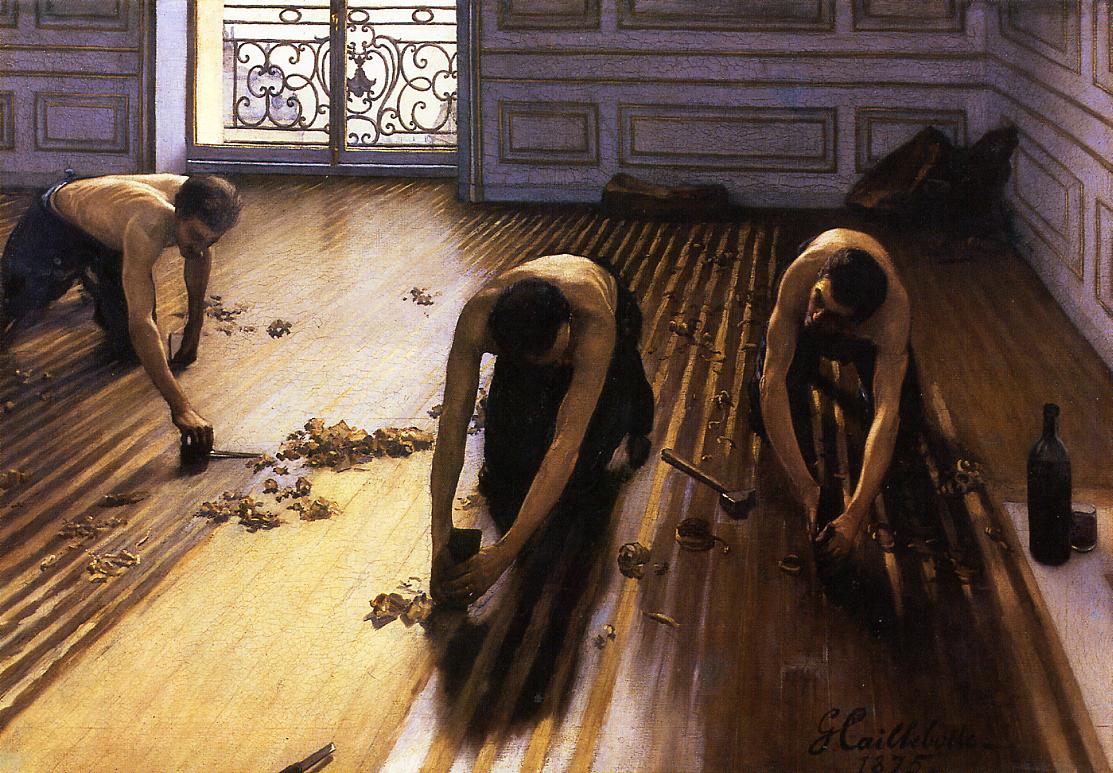
Caillebotte is extendedly reviewed. Namely his numbers 17-20. Some call him original (Rv33+43). He renders a ‘faithful representation of life’ (Rv43+35). He is praised for his skill, his craft and is called a draftsman (Rv29+36+10); but Zola is more critical ‘because of their precision, the paintings are entirely anti-artistic’ (Rv54). The high perspective in these works is noted and labelled as ‘bizarre’ (Rv10), ‘scorning’ (Rv42), ‘astonishingly’ (Rv54). Chaumelin (Rv33) calls him a ‘Realist as crude as but far more witty than Courbet, as violent as but far more precise than Manet.’ Enault complains ‘The arms of the scrapers are too thin, and their chests are too narrow. (…) let your nude be beautiful, or leave the subject alone.’ (Rv36) L’Audience (Rv34) calls him the ‘primus interpares’, but Baignières (Rv41) writes that Caillebotte ‘remains far behind Degas‘. A. de L. calls him ‘The success of the exhibition’ (Rv10)
There were hardly reviews on Cals. The review of L’audience (Rv34) only mentions that no.29 +34 draw attention. Laurent-Pichet (Rv60) reviewed no.28 quite extendedly, but probably misunderstood it.
Enault (Rv36) remarks ‘Degas is perhaps one of the most intransigent of this intransigent company’. Bagnières (Rv41) called Degas ’the pontificate of the sect of the intransigent impressionists’ and also that when they one day will be masters ‘M. Degas will hold the place that M. Ingres occupies among us, while that of M. Delacroix is reserved for M. Claude Monet, the dazzling colorist of the club.’
His Nouvelle-Orléans (no.36) is often reviewed and praised (R2,p171;R90II,p34), but Zola (Rv54) is critical ‘The misfortune is that he spoils everything by finishing.’ Some notice that Degas cuts of his canvasses (Rv41). Others remark that Degas tents ’to look rather at the bizarre or the ugly than the graceful’ (Rv32). In the same line Laurent-Pichet (Rv60) writes ‘Degas has achieved perfection in unpleasantness and incompleteness’. Some find his pictures unfinished (Rv40), but Burty (Rv43) finds them ‘sufficient to prove … his intimate acquaintance with modern life’. And Dax (=Rivière; Rv51) even calls him an ‘impeccable draftsman’.
Jacques François (=Mme de Rambures) was mentioned in 5 reviews. Namely no.77 was highly praised by Dax / Rivière (Rv51). Laurent-Pichet described no.75, but is critical on her still-lifes (Rv60).
Berthe Morisot was mentioned in 20 reviews. She is often criticised of not finishing her paintings. Some mention the works must be seen from a far distance (Rv33). Some praise her delicacy, but Wolff remarked ‘Her feminine grace remains unchanged among the excesses of a delerious mind.’ (Rv24) Some resemble her with Goya and Manet.
Charles Tillot his works were not reviewed (R90II,p46).
Note: more info will be added.


1876, the results:
The exhibition was financed by Rouart (iR318). Financially it was relatively successful, but there were less visitors. Fewer visitors attended this exhibition than the first (so let’s say about 3.000). The partaking artists had to pay a contribution of 120 franc. (R2,p158) The rent was 3.000 franc (R5,p97).
Though held in the Durand-Ruel galleries the artists had to finance the costs themselves (R3,p192). The partaking artists received their contribution of 120 franc back, together with a dividend of 3 franc (R2,p158; R5,p97; R3,p193). A total of 2337 franc. Considering the lesser amount of visitors this probably implicates that there were more works sold of which the artist paid commission.
General sources:
My main sources are Moffett (1986=R2=aR1), Berson (1996=R90), Dayez (1974=R87=aR2), Patry/Robbins (2024=R410), Rewald (1973=R1), Walther (2013=R3), Roe (2006=R4), Denvir (1993=R5), Monneret (1978-81=R88), Adler (1998=R89), Reff (2020=R433). See the link for other general References (=Rx) and to the internet references (=iRx). See here below for additional references (=aRx). See links for practical hints and abbreviations and for the subscription of the paintings.
Additional references (=aRx):
- archive.org//t7cr6bg0d (Online version of Moffett: The New Painting, 1986 =R2=iR19)
- culture.gouv.fr//1876 (extended article on the 2nd ‘impressionist’ exposition; =iR424)
- applebooks.apple.com//1876 second impressions (preview of Robert Cormican: In 1876: second impressions. 2014.)
- www.youtube.com//art_101_1876 (video on the 2nd ‘impressionist’ exposition by Mr. Burgher with extended info, beautiful pictures and irritating clips)
- magrasku.de/zweite_impressionisten-ausstellung (page in German on the 2nd ‘impressionist’ exposition; =iR59)
- commons.wikimedia.org//second impressionist exhibition (some pictures that have been exhibited; =iR6)
- impressionistarts.com/second (webpage on the 2nd ‘impressionist’ exposition; =iR374)
Recommanded citation: “Impressionism, a historical reconstruction: The 2nd ‘impressionist’ exposition in 1876; general info. Last modified 2026/02/23. https://www.impressionism.nl/2nd-impressionist-exposition-1876/.”
Note: More info will be added.