Pre-Impressionism
Pre-Impressionists
artists that preceeded and inspired the Impressionists
Introduction:
The pre-impressionists were artists that preceeded and inspired the Impressionists. On this page you will find (in alphabetical order) short info on artists, the were predecessors of the ‘impressionists’.
They were artists that rendered landscapes in a realist way, so not as a decoration for a Néo-Classical theme or for rendering a romantic scene, but just as they saw it. They at least started their art-works on the spot (in-situ; en-plein-air). Often rendering the location in the title of their art-work. More or less they depicted the influence of the atmospherical light on the colours. Sometimes this was also part of the title. The English landscapists and the Barbizon painters are important examples. Some of them had a (direct) influence on the painting style of the Impressionists. Namely they were known as Barbizon painters (namely Corot) and painters from the School of Honfleur (namely Jongkind).
The pre-impressionists were also artists that rendered every day life. Often they stood in a Realist tradition. Many partakers of the ‘impressionist’ expositions (like Degas) and para-impressionists (like Manet) also stood in this tradition. Courbet was an important realist forerunner.
Characteristic for the painting style of the pre-impressionists (compared with the impressionist painting style) is the use of sub-dued colours. They also used many browns, greys and even blacks. The brushstrooke varied from more smooth to more loose and lively, but not juxtaposed. Sometimes they rendered details, sometimes they didn’t. All this also implies to many partakers of the ‘impressionist’ expositions and also to the earlier works of the key-Impressionists.
The pre-impressionists also proceeded the Impressionists in age. Most of them were born before 1820 and most were already active as artist before most ‘impressionists’ became active. I discern them from the para-impressionists, who had connections with the ‘impressionists’ (and with the ‘impressionist’ expositions) and were active during the same period as the Impressionists.
Aligny (Claude-Félix-Théodore Caruelle d’Aligny; 1798-1871):
Aligny made his debut at the Salon of 1822, he received a 2nd class medal (Paysage) in 1831 and a 1st class medal in 1837. He was appointed Chevalier de Légion d’Honneur 1842/07/02, as director of the École des Beaux-Arts in Lyon in 1860 and in 1861 as Membre correspondant de l’Institut (iR1;R290,p129;R60,p39). At the Exposition Universelle of 1855 he was present with 5 paintings and 2 drawings (iR1). He also was present at the World Exhibition in London in 1862 (iR3). At the Centennale Exposition of 1889 2 drawings were exhibited and in 1900 1 study (R231).
From 1824 till 1827 he stayed in Rome and painted together with Corot and Édouard Bertin (1797-1871). The friendships would last and they would meet in the Ganne Inn in Barbizon. (R290,p129;R60,p39) Aligny yearly painted in Fontainebleau since 1828 (R59,p8; till 1840 doesn’t seem correct, since 1824 neither; R290,p60). In 1851 he bought a house at 22, Rue Delort in Bourron-Marlotte, after first renting it since 1831 or 1837. Here he received Barye, Bertin, Brascassat, Corot, Descamps, Diaz and Rousseau, who also were called the ‘Groupe de Marlotte’. (R290,p129+130+48+60). He is seen as a forerunner of the Barbizon school (R290,p10).
Aligny mainly painted mythological and biblical scenes in idealized landscapes with classical architecture (R290,p129). In that sense he is not a pre-impressionist. He also rendered the contrasts between light and shadow (R60,p39).
Sources: more info;
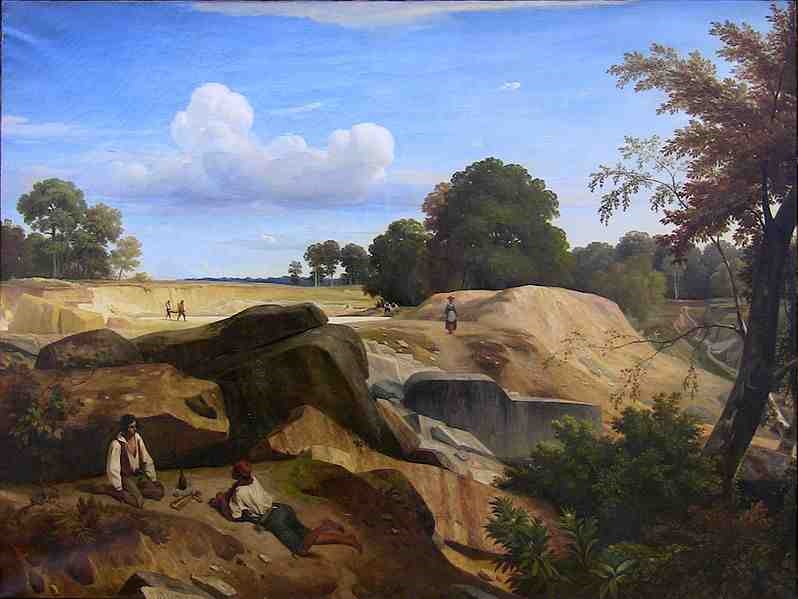

Barye (Antoine-Louis; 1795-1875):
In 1818 Barye was admitted at the École des Beaux-Arts. He debuted at the Salon of 1827. Barye had been merely known as a sculptor. In his lifetime he never exhibited his oil paintings. After his death in 1875 around 300 paintings and watercolours were exhibited at the École des Beaux-Arts and later auctioned. 70 of them depicted Barbizon and its surroundings. He had many contacts with Aligny, Corot, Decamps, Diaz, Dupré, Huet and Rousseau. In 1847 he had taken an initiative for a Salon Indépendant. Daumier, Decamps, Dupré, Jacque, Jeanron and Scheffer joined the initiative, that was supported by Delaroche, Delacroix and Vernet. In 1867 he was appointed as member of the Académie and in 1869 he was part of the jury of the Salon. (R290,p132;iR1)
Sources:
Bonheur, Rosa (1822-99):
Born in Bordeaux. Is mainly seen as a Realist landscapist. Received at the Salon a 3rd class medal in 1845 and a 1st class medal in 1849 (iR3;M1*). At the Salon in 1853 she had success with the Horse fair (iR3). By special decision (1853/07/27), having obtained all the medals that can be awarded to artists, will in future enjoy the privileges to which their outstanding talent entitles them; their works will be exhibited without being submitted to the jury for examination. (R231-9)
At the Exposition Universelle in 1855 she received a 1st class medal for Haymaking (which was purchased by the state for 20.000fr) (iR3;iR23;M1); and in 1867 a 2nd class medal.
She was appointed in the Légion d’Honneur as Chevalier in 1865 and as Officier in 1894.
Note*: the Salon database indicates that Bonheur received in 1848 a 1st class medal (for landscape and animales) (iR1) and that in 1849 she was ‘exempté’ for concurring for a medal (iR1).
Note: more info will follow.
1900/05/30 – 06/02: Auction sale Atelier Rosa Bonheur at Georges Petit, Tome I, tableaux; preface M.L. Roger-Milès. (DPF catalogue: ia600907.us.archive.org; =iR19)
1900/06/05-08: Auction sale Atelier Rosa Bonheur at Georges Petit, Tome II, aquarelles et dessins. Paris, 1900. (DPF catalogue: ia803204.us.archive.org; =iR19)
Sources: info (iR3); pictures (iR6).
Bonvin, François (1817-87):
Pupil at the Académie Suisse. Genre painter. Examened the light, in that sence he was a Pré-Impressionist. Influenced Manet. (R16,p13).
Sources:
Brascassat, (Jacques-)Raymond (1804-67):
Brascassat had several connections with the Barbizon painters. In 1846 he became member of L’Institut and in that sense he is seen as an Academic painter.
Cabat, (Nicolas-)Louis (1812-1893):
Cabat was namely a pre-impressionist and a forerunner of the Barbizon painters. From 1867-1893 he was member of L’Institut; he also was professor at the École des Beaux-Arts in Paris and Rome. See seperate page.
Chauvel, Théophile (1831-1909):
Pupil of Picot, Bellel and d’Alligny↑. Dwelled with others around d’Alligny in Marlotte 1849 onwards. Made several works depicting the forest of Fontainebleau. Exhibited at the Salon from 1855-66. 1867 onwards he made many etchings. Many of his works are not dated.
Sources: R9,p172;iR1;iR132;.
Chintreuil (Antoine; 1814-1873):
Linked to the School of Barbizon. See seperate page.
Corot (Jean-Baptiste-Camille) (1796-1875):
Linked to the School of Barbizon. Corot was the teacher of many ‘impressionists‘, see seperate page.
Courbet, Gustave (1819-77):
Important Realist. See separate page.
Daubigny (Charles-François) (1817-1878):
Linked to the School of Barbizon. See seperate page.
Daumier, Honoré (1808-79):
Is mainly seen as a Realist, see link.
Daumier is seen as a representative of Realism (R13,p599;R173,p80).
Cartoons in ‘Les maîtres humoristes’ (1908) (iR19,ia903408);
Sources: R16,p34/5.


Decamps (Alexandre-Gabriel) (1803-60):
Decamps be seen as a Barbizon painter and as a pre-impressionist. But, he was just partly a landscapist and depicted a variety of themes. You will find more information on the page on meta-impressionists.
Diaz (Narcisse Diaz de la Peña, 1807-1876):
Linked to the School of Barbizon. See seperate page.
Dubourg, Louis-Alexandre (1821-91):
He was the first curator of the Museum in Honfleur, his hometown. Promoted the painting en-plein-air. Connections with Boudin. Part of the School of Honfleur. (R16,p131).
Sources:
Dupré (Jules; 1811-1889):
Linked to the School of Barbizon. See seperate page.
Dutilleux, Constant (1807-65):
Pupil of Hersent. Influenced by Delacroix and Corot. Debut at the Salon of 1849. Often depicted the forest of Fontainebleau. He also depicted landscapes in Normandy and seascapes at the Normandy coast. Also made portraits, nudes, still-lifes. Born in Douai, founded there the ‘Société artésienne des Amis des Arts’ in 1859. He had his own art workshop and had a large number of pupils.
Sources: R9,p266; iR3;
catalogue posthumous sale at Hôtel Drouot 1874/03/26, included many works of Barbizon painters (iR19,ia601600).
Flers (Camille; 1802-68):
Is seen as one of the forerunners of the Barbizon painters and is said to be one of the first who discovered the forest of Fontainebleau (R290,p10+162). He also would paint frequently in Normandy, the Auvergne en Picardy. In the early 1840s he made a trip to Switserland and in 1845 to Holland. He was the teacher of Cabat and had contacts with Diaz, Dupré and Decamps, who called him a ‘naturalist romanticist’ (R290,p162). In 1853 he joined the ‘groupe de Marlotte’, including Aligny, Barye, Brascassat and Decamps. After being rejected in 1827 he frequently exhibited at the Salon since 1831. In 1849 he was appointed Chevalier de la Légion d’Honneur. In 1855 he exhibited at the Exposition Universelle. (Main sources: R290,p162+48)
Sources:
Français (François-Louis) (1814-97):
Français was namely a pre-impressionist and a forerunner of the Barbizon painters. He was a most awarded artist. From 1890-1897 he was member of L’Institut. See seperate page.
Gudin, Jean-Antoine-Théodore (1802-80):
Pupil of Girodet-Trioson. Received a 2nd class medal at the Salon in 1824 (Marine) and a 1st class in 1848. At the Exposition Universelle of 1855 he exhibited no less than 25 paintings, many of the titles depicted locations and atmospherical indications; he received a 1st class medal. Made many marines (including war scenes), exhibited 13 of them at the Salon of 1846. Received several public commissions.
Sources: iR1; R9,p351.
Guigou, Paul-Camille (1834-1871):
Influenced by Courbet. Exhibited at all the Salons from 1863-71. Depicted landscapes in the Provence. (R16,p158).
Sources:
Guys, Constantin (1802-92):
Frenchman born in Holland. Connections with Manet. Painted everyday life in Paris. Used large surfaces in his paintings in which he depicted the light. (R16,p163)
Sources:
Harpignies (Henri-Joseph; 1819-1916):
Harpignies was influenced by Cabat. 1854 onwards in painted in Marlotte and its surroundings. He had contacts with Corot and other Barbizon painters and stood at the cradel of their school.
Harpignies made his debut at the Salon of 1853. He exhibited at the Salon des Refusés of 1863. At the Salon he received medals in 1866 + 1868 + 1869. In 1897 he received a Medaille d’Honneur. At the Exposition Universelle of 1867 he exhibited 2 paintings; in 1878 5 paintings and more than 6 watercolours; in 1889 10 paintings. At the Centennale of 1889 he exhibited 3 paintings and 2 watercolours and in 1900 at least 1 painting. At the decennial exhibition in 1900 he received a Grand Prix. He was appointed in the Légion d’Honneur as Chevalier in 1875 and as Officier in 1883. He also was known for his watercolours. He was member of the Société des Aquarellistes Français since 1887 (iR19) and exhibited at their 2nd Salon in 1888 (iR19).
Sources: iR1;R231;R290,p163;R9,p364;R16,p40.
Hervier (Adolphe; 1818-79):
Hervier regularly painted in Barbizon and surroundings. He had contacts with Corot, Decamps and Jacque. He made his debut at the Salon in 1849 after being refused several times. (R290,p164/5)
Sources:
Huet (Paul; 1803-1869):
Pupil of Guérin and Gros. Paul Huet received a 2nd class medal at the Salon of 1833 and a 1st class medal in 1848. From 1866 till 1868 he exhibited hors concours. At the Exposition Universelle of 1855 he exhibited 9 works, including 6 paintings. He received a 1st class medal. In 1867 he exhibited 8 paintings, in 1878 there were 14 works exhibited including 3 paintings, at the Centennale of 1889 24 works including 7 paintings at in 1900 at least 2 paintings. (iR1;R231) In 1869, the year of his death, there was a retrospective held at the Salon (R88II,p393). He was appointed Chevalier de la Légion d’Honneur 1841/06/22.
Paul Huet was influenced by the English landscapists. He was befriended with Bonington, met him in 1820 and painted with him in Normandie (R60,p66;R290,p166). First started painting in Fontainebleau in the mid-1820s (R59,p8). He often painted here with Corot (and also in Honfleur) (R60,p66). He stayed at the Ganne inn in Barbizon and at café Le Cheval Blanc (in Paris), where he met Barye, Decamps, Diaz, Dupré and Rousseau (R290,p166). He also often worked with Delacroix (in the 1850s). He also was acquinted with Troyon. He made travels to Italy (in 1841), the south of France, Belgium and Holland (in 1864) (R290,p166).
Huet was a pre-impressionist. He painted en-plein-air since 1815, especially landscapes full of movement and harassment (R60,p66). His brushstroke sometimes was quite lively. His skies could be melancholic and treathening (R290,p166). He often depicted undergrowth (R290,p166/7).
Sources: R290,p166/7;iR1;R231;R16,p44; more info; more pictures.
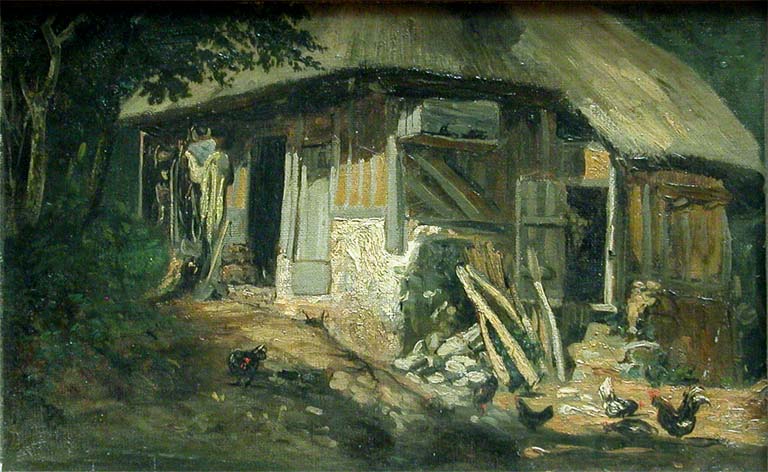


Jacque (Charles-Emile; 1813-94):
Linked to the School of Barbizon. See seperate page.
Jongkind, Johan Barthold (1819-91):
One of the most important Pre-Impressionists. See separate page.
Lapito (Auguste; 1803-74):
Lapito is seen as a forerunner of the Barbizon painters. He was acknowledged at the Salon of 1827 and received a 1st class medal in 1835. He made several travels and also exhibited in Holland and Belgium. He is criticised for idealizing nature. (R290,p171)
Sources:
Lavielle (Eugène-Antoine; 1820-1889):
In 1841 Lavielle was (the favorite) pupil of Corot. He regularly stayed at the Ganne inn in Barbizon and in 1852 moved into a house in the Grande Rue. He had contacts with Aligny, Anastasi, Brascassat, Chintreuil, Daubigny, Diaz, (Léon) Fleury, Millet and Rousseau. He often depicted gloomy winter landscapes and evening moods.
Sources:
Michel (Georges; 1763-1843):
Georges Michel is seen as one of the forerunners of the Barbizon painters. Others remark that is work only became known to the Barbizon painters in the 1840s and that he was not so remarkable and profetic as some have said (R290,p10+32). He was influenced by the 17th century Dutch landscapists. He was admired, by Dupré and Jacque, for his powerful and free brushstroke. He had no contacts with the Barbizon painters, but (after his death in 1843) collected his work. He often depicted heavy clouds and clair-obscure. (R290,p173-175)
Sources:
Millet (Jean-Francois) (1814-1875):
Linked to the School of Barbizon. See seperate page.
Ribot, Théodule (1823-91):
1861 debut at the Salon; refused in 1869. Used clair-obscure effects. Contacts with ‘impressionists’, namely Boudin (starting in 1861) and Monet. Ribot was involved in initiatives for (more) independant exhibitions. In 1859 there was an exposition of refused at the atelier of Bonvin↑, with works of Legros, (Courbet?), Ribot, Whistler and Fatin-Latour (R88). Probably this is the same as the ‘Champs de Mars Salon’ founded by Théodule Ribot (1823-91) (iR69). In 1873 Ribot signed a petition to the Minister of Fine Arts requesting to render the right to vote for the election of the jury to all the artists that exhibited the year before (at the Salon). (R9,p618)
Sources:
Rochenoire, Jules de la (1825-99):
Born as Charles Julien de la Rochenoire in Le Havre. Pupil of Cogniet, Corot, Gleyre and Troyon. Friend of Daubigny and Manet. In London in 1870/71 contacts with Daubigny, Monet and Pissarro. Exhibited very regularly at the Salon from 1857 till at least 1886. In 1870 he took part in a campain to include Corot, Courbet, Daubigny, Daumier, Manet and others in the jury of the Salon. Made many landscapes in Normandy, Calvados and Bléville.
Sources: R9,p441; iR1. More info and pictures: .
Note: also listed as La Rochenoire.
Rousseau (Theodore; 1812-1867):
Linked to the School of Barbizon. See seperate page.
Trouillebert (Paul Désiré; 1829-1900):
Trouillebert made his debut at the Salon in 1865. First he painted genre pieces, portraits and nudes. Later on he made landscapes, namely grey river banks. His style is compared and confused with Corot. One can seen him as a post-bloom of the School of Barbizon.
Sources: R290,p189.
Troyon, Constant (1810-1865):
Linked to the School of Barbizon. See seperate page.
Véron (Alexandre René) (1826-97):
Véron was a teacher of Henri Rouart. 7 of his landscapes were in the posthumous sale of Léopold Levert. He belonged to the Barbizon School.
Sources: R92,p16; iR1; iR40;
Ziem (Félix) (1821-1911):
Born in Beaune (Côte-d’Or). Around 1846 Ziem was a pupil of Isabey, where he would meet Jongkind. Made his debut at the Salon in 1849 and would exhibit regularly. Received at the Salon a 3rd class medal in 1851 and a 1st class medal in 1852. Received at the Exposition Universelle of 1855 a bronze medal. Was appointed in the Légion d’Honneur as Chevalier in 1857 and as Officier in 1878.
Ziem regularly worked together with Rousseau in Barbizon (R290,p99). In 1866 Ziem bought a house in Barbizon (R290,p99). Ziem painted often in Venice and also in Holland (R290,p99). One cirtic in 1855 wrote about ‘a chaos of colourful and brilliant colours’. Made thousands of paintings.
Sources: R290,p65;R16,p58;R231-3; R337/1901.
Sources:
My main sources are Moffett (1886=R2), Walther (2013=R3), Denvir (1993=R5), Schurr & Cabanne (2008=R9), Adams (1994=R59), Monneret (1978-81=R88), Boime (R287), Sillevis (1985=R290) and also the catalogues on the Expositions Universelle (R231) and the ‘Explication des Salons’ (R337). See the link for other general References (=Rx) and to the internet references (=iRx).
Recommanded citation: “Pre-Impressionism: pre-impressionists, predecessors. Last modified 2025/11/25. https://www.impressionism.nl/pre-impressionists/”
Note: additional info and pictures will follow.
Note: this page is under construction.
Please be reluctant when you site from this page, for the information is incomplete and maybe incorrect.