Meta-Impressionism
other art-movements
Neo-Impressionism
pointillism / divisionism / scientific impressionism


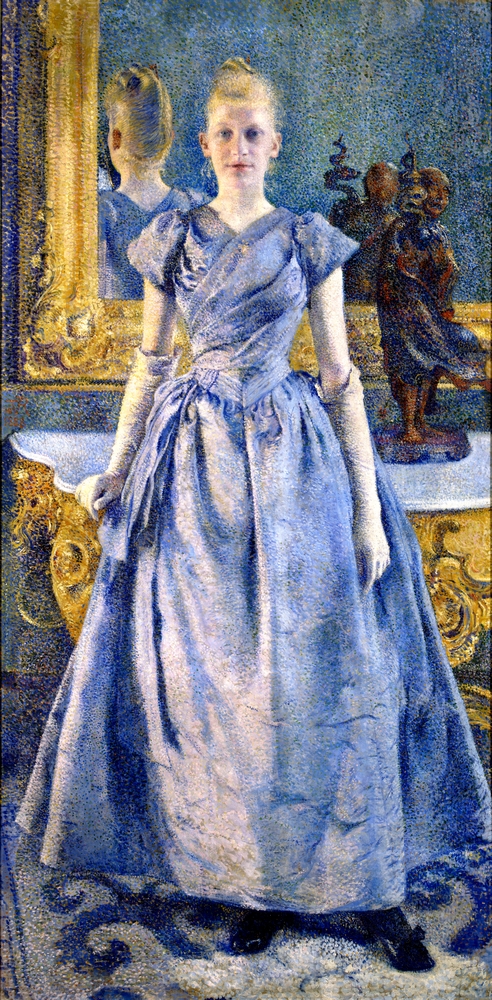
Neo-impressionism:
Neo-Impressionism is an art-movement that has it’s roots in Impressionism.
It is also called Pointillism and Divisionism.
This page pays attention to the start by Seurat, his followers (namely Signac) and the difference between the used terms.
See also the list with neo-impressionist painters.
See seperate pages on Seurat, Signac, Camille Pissarro, Lucien Pissarro, Schuffenecker, Cross, Luce.
See 3 pages with paintings:
pointillist paintings;
divisionist paintings;
neo-impressionist paintings (in a wider sense).
The start with Seurat (Pointillism):
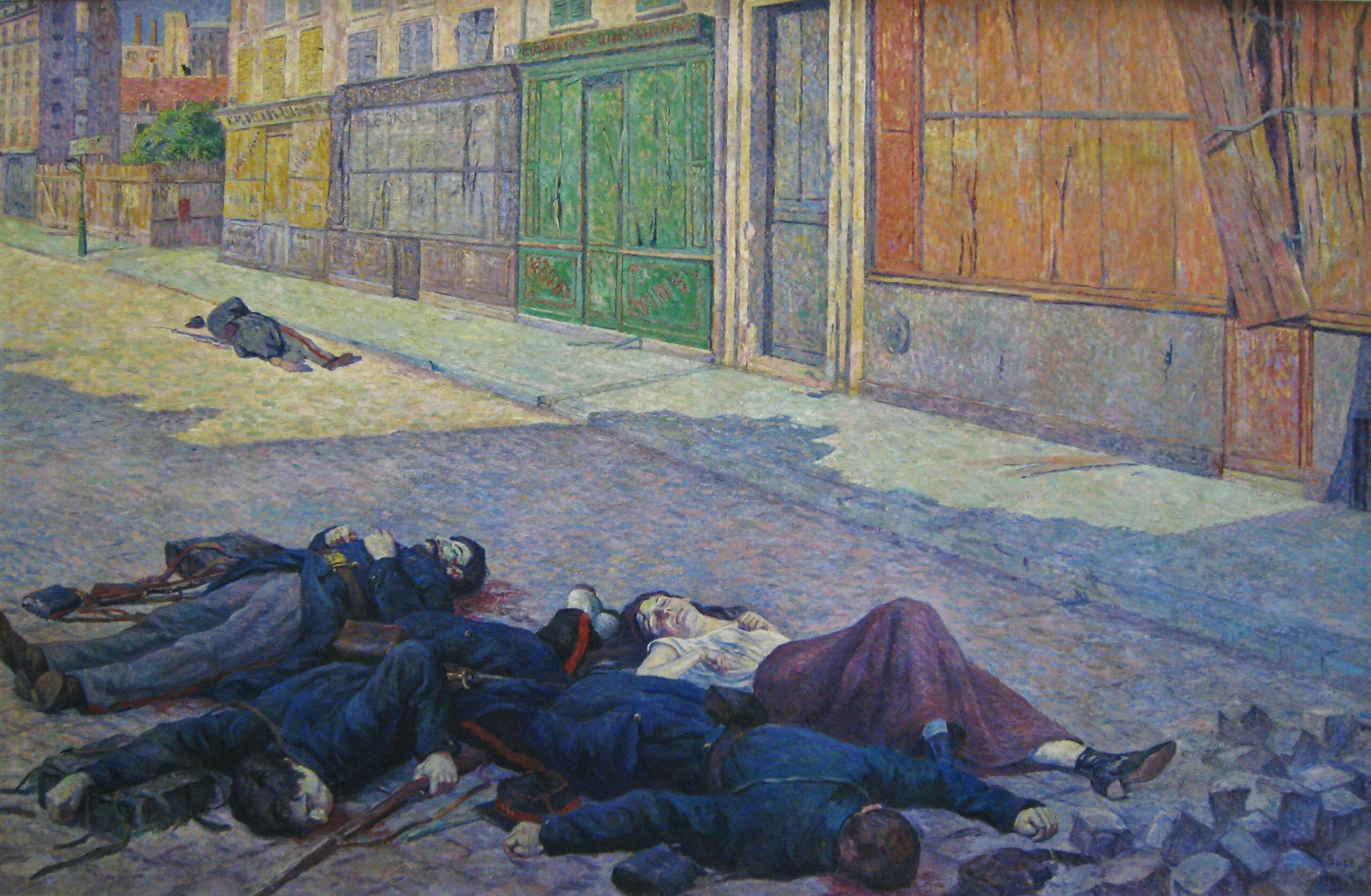
After a systhematic (almost scientifique) study, Georges Seurat started in the summer of 1885 to use points of pure colour which he juxtaposed on the canvas. His most famous example is ‘a Sunday afternoon on the island of Grande Jatte‘, which he showed at the 8th ‘impressionist’ exposition in 1886. In reviews the pointillist technique was described. By Fénéon: ‘Take two steps backward, and all of those multicoloured drops dissolve into flowing luminous masses’. (R40,p44+52;R90I,p444). And by Darzens: ‘every dot has it’s own colour and it’s the juxtaposition of these colours that gives, with a few meters distance, an intense and unified effect of light.’ (R90I,p438).
Still, it was not the ‘point’ that was crucial to Seurat, but the division of pure tones, giving simultaneous contrasts. He first preferred the term ‘Divisionism‘. Later on (1887/07) he called himself a ‘Luminarist’ and his style ‘chromo-luminarism’. (R40,44). Others called it ‘Confetti-ism’, ’tachism’. Fénéon (1886/09/19) called it ‘scientific Impressionism’ in contrast with the ‘romantic Impressionism’ of the traditional Impressionists. (R40,p44) A term that fits the systhematique approach that used.
Seurat quite consequently used small dots of paint, in that sense Pointillism is an appropriate term, to capture his oeuvre. But, around 1888 he would use more sweeping brushstrokes (R40,p78). Before the summer of 1885 his brushstroke also had more variation. In his many studies Seurat often used more mosaic-like paint strokes.


French followers:
Soon Signac, Camille Pissarro, Lucien Pissarro, Louis Hayet would take over this pointillist technique (R40,p41).
Later on Angrand, Cross, Luce and Schuffenecker.
Though Seurat considered his method to be a personal invention, conceived for him alone to use (R40,p44).
The Salon des Indépendants, that started in 1884, namely in the earlier years, gave room for neo-impressionist painters.
Later on, painters that will be become known as Les Fauves, like Henri Matisse, also would use elements of neo-impressionism in their paintings.


Foreign followers:
And around 1889 (Belgium) artists like Théo van Rysselberghe, Anna Bloch, Jan Toorop, Henry van de Velde and George Lemmen (R40,p78).
The Salons of Les XX in Brussels, that started in 1884, gave room for neo-impressionist painters, namely 1887 onwards.
Later on, also other painters (for a longer or shorter period) would use elements of Neo-Impressionism in their paintings. Among them are Dutch painters like Piet Mondriaan and Jo Koster.
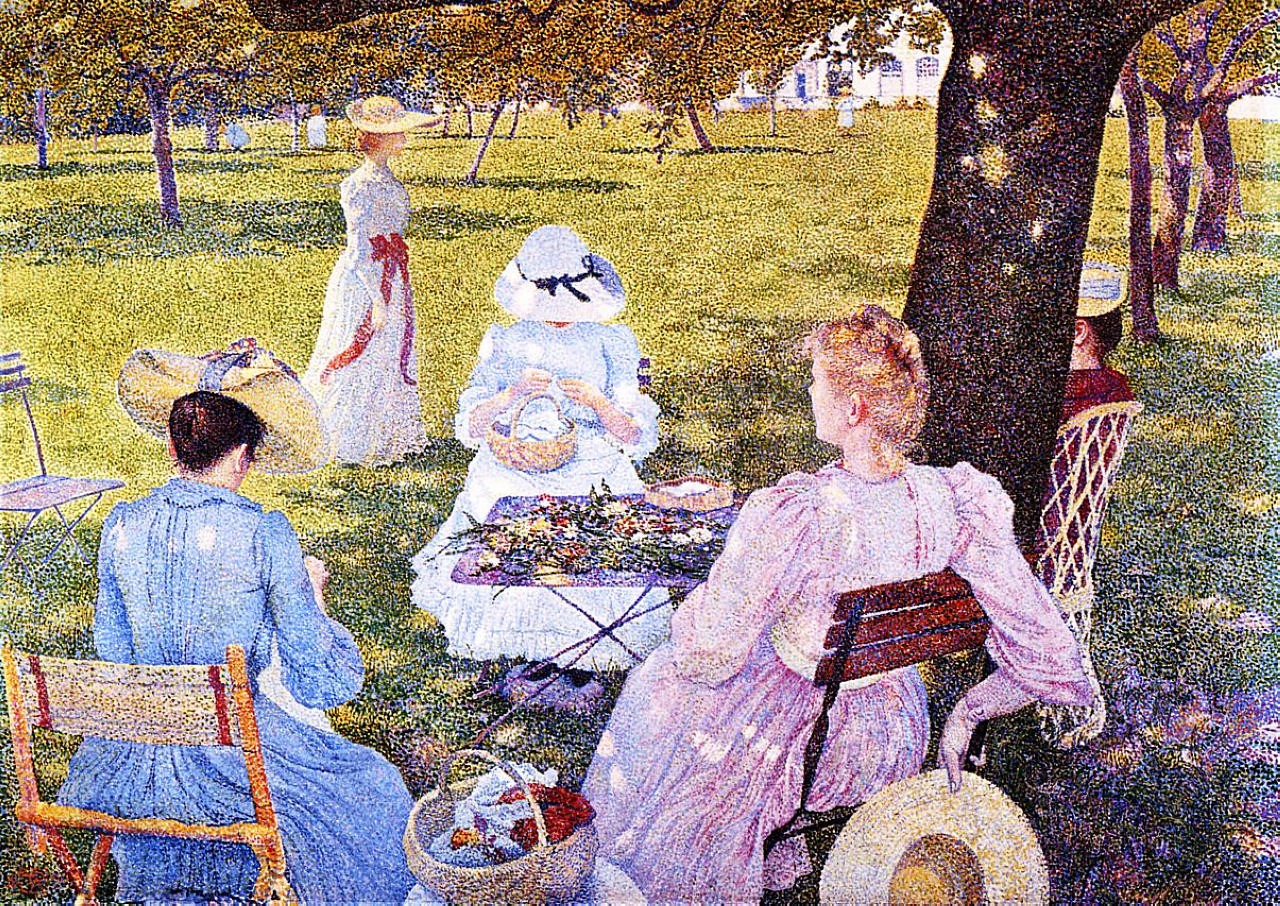
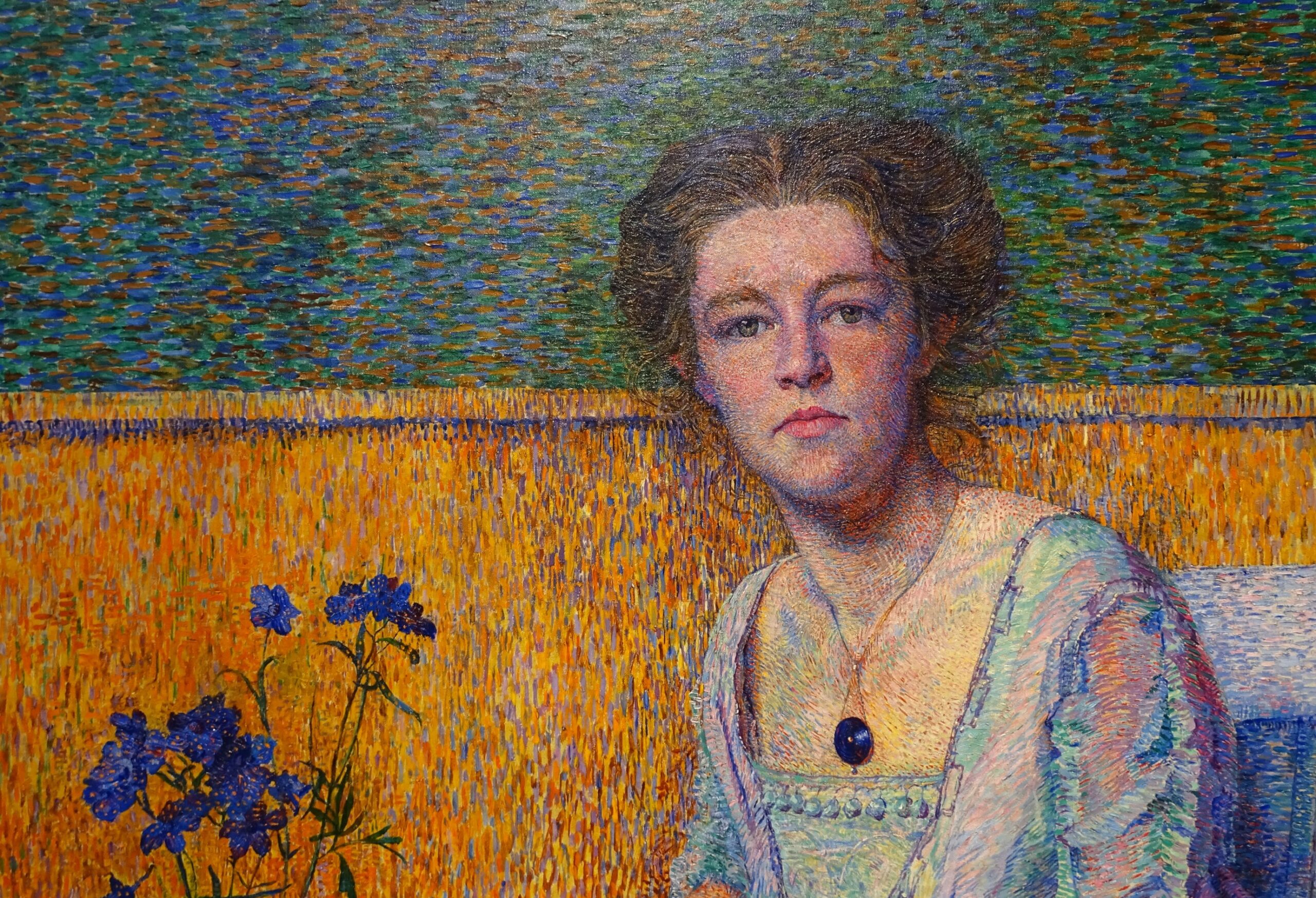
Divisionism:
Unsatisfied with the pointillist technique Signac and Cross around the mid-1890s started to use larger mosaic like pads of paint to obtain a larger liberty and personal expression (R56,p160). The colours intensified. In the earlier years a brownish orange and a greyish blue were dominant colours.
The artist that most consequently used this technique throughout his life was Paul Signac, who wrote in 1899 an essay on this technique (R348=iR19).
Signac was disappointed when his friends later on didn’t stick to a more pure form of Divisionism.
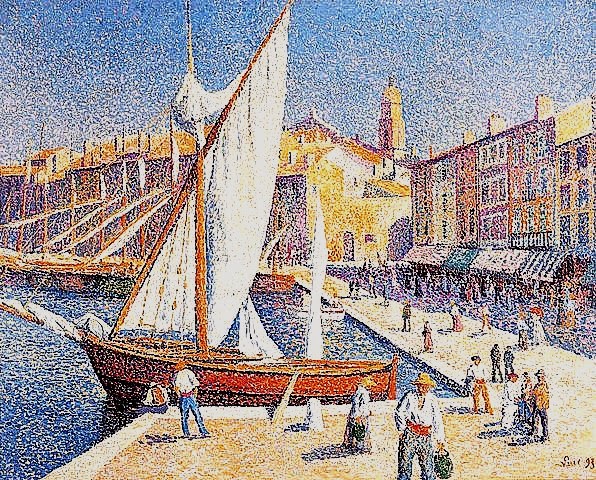

Neo-Impressionists:
The list of neo-impressionists includes namely artists that for a significant period used divisionist techniques.
It includes important representatives like Seurat, Signac, Henri Edmond Cross, Maximilien Luce, Charles Angrand (1854-1926).
And also several artists who just shortly used divisionist techniques, like Camille and Lucien Pissarro.
Many artists for a shorter or longer period used elements of the neo-impressionist painting style and/or the impressionist painting style.
This painting style was also used to depict allegoric or symbolist themes, like Henri Martin and Henri le Sidaner.
In this sense you can speak of a more strict form of Neo-Impressionism, using a more strict pointilist or divisionist style.
And a less strict form, just using elements of neo-impressionism.


Pointillism or divisionism?
Which term is better: Pointillism or Divisionism?
I think Divisionism is a better term, as Seurat preferred this term and it captures the essence of the technique.
The use of sweeping brushstrokes or mosaic like pads of paint are not covered in the term Pointillism.
Still, the consequent use of namely dots of paint, namely by Seurat and Signac, is best captured in the term Pointillism.
When we look at these specific pointillist paintings, we see that they are more stiff and lack movement.
The larger, more varied brushstrokes make the other paintings vibrate more, they are more lively (see divisionist paintings).


Impressionism or Neo-Impressionism?
The use of juxtaposed brushstrokes of pure colour is typical for Neo-Impressionism, but also for the impressionist painting style.
Typical for Neo-Impressionism is the analytic division of colours and the consequent use of complementary colours. And the more systhematic rendering of almost identical brushstroke as typical for Neo-Impressionism. These brushstrokes can be smaller, more dot-like (Pointillism) or larger, more square-like, as a mosaic (Divisionism). Also more sweeping brushstrokes are used, but in a consequent way throughout the whole painting (Neo-Impressionism in a wider sense). When there is more variation of brushstrokes, in size, form and direction and when these brushstrokes are rendered more spontaniously, I would like to call it more Impressionistic*.
You could say that Neo-Impressionism (also called Scientific Impressionism) is a more cerebral way of painting and Impressionism a more emotional way of painting.
Note*: To be a fully impressionist painting, elements like painting en-plein-air and rendering atmospherical influences, also most be present, see impressionist painting style.
We see that namely in the 1890s several artists left the strict divisionist technique behind and started to mix elements of Impressionism and Divisionism (some even used allegoric or symbolist themes). Others were not that strict during the start. (See neo-impressionist paintings.) To discern these painters from the impressionists, I speak of neo-impressionist painters and of Neo-Impressionism as a more overall term. These neo-impressionist artists were mostly of a later generation than the impressionists and were mostly born after 1855.
For both Impressionism as Neo-Impressionism the observable reality remains the starting point. This is left behind in Post-Impressionism.

Sources:
See sources on the bottom of the pages on Seurat, Signac, Luce, Cross.
See links for general references (=R), references to internet sites (=iR), for musea (=M). For other additional references (=aR) see below. See links for practical hints and abbreviations and for the subscription of the paintings.
For further reading:
- Signac, Paul: ‘D’Eugène Delacroix au néo-impressionnisme‘. Paris, 1899 / 1911; (online PDF: ia800404.us.archive.org; =aR1 ==iR19 =R483)
- Widauer, Heinz (ed.): Seurat, Signac, Van Gogh; Ways of Pointillism. Exhibition catalogue. Albertina, Vienna, 2016. (=R496)
- Wardwell Lee, Ellen: Neo-Impressionisten; Seurat tot Struycken. Zwolle, 1988 (=R56)
- Fondation Pierre Arnaud: Divisionism: Mastery of Color? Effusion of color! Exhibition catalogue. Lens / Crans-Montana, 2014. (=R537)
- Sillevis, John, Hans Verbeek & Hans Kraan: Een feest van kleur; Post-impressionisten uit particulier bezit; tentoonstellingscatalogus. ‘s-Hertogenbosch, 1990. (=R227)
- Rausmüller, Urs & Christel Sauer: Luxe, Calme et Volupte; regards sur le Post-Impressionisme; collectionneurs à Winterthur et Baden au début du XXe siècle. Exhibition catalogue. Luxembourg, 1995. (=R516)
- Wiggins, Colin: Post-Impressionisme. Oog op kunst; Baarn, 1994. (=R530)
- Denvir, Bernard: Post-Impressionism. Thames & Hudson world of art, London, 1992. (=R513)
- Barras Hill, Ian: Post Impressionism; painting of the western world. Amsterdam, 1980. (R96)
- House, John & Mary Anne Stevens (eds): Post-Impressionism; cross-currents in European painting. Royal Academy of Arts, London, 1979 (=R55)
- Regenmortel, Charlotte & Benno Tempel: Miracle de la Couleur; impressionisme en post-impressionisme. Tentoonstelling Kunsthal in Rotterdam. Zwolle, 2003. (R280)
additional references (=aRx):
- ia800404.us.archive.org (online PDF version of Paul Signac ‘D’Eugène Delacroix au néo-impressionnisme’, 1911; =iR19 =R483)
- magrasku.de/NA-02 (page in German on Pointillism; =iR59)
Recommanded citation: “Meta-Impressionism: Neo-Impressionism / pointillism / divisionism. Last modified 2026/09/09. https://www.impressionism.nl/neo-impressionism/”
Note: additional info and pictures will be added.