Impressionism, a historical reconstruction:
Claude Monet
(1840-1926)
in Giverny
his garden and the water-lily pond

Intro:
On this page you will find information and pictures on Claude Monet his stay in Giverny from 1883/04 till his death 1926/12/05. This page limits to his estate, his garden and the waterlily pond. During his years in Giverny, Monet made several extended trips and made several series. See link for the paintings he made in Giverny and the surroundings.


His house and his garden:
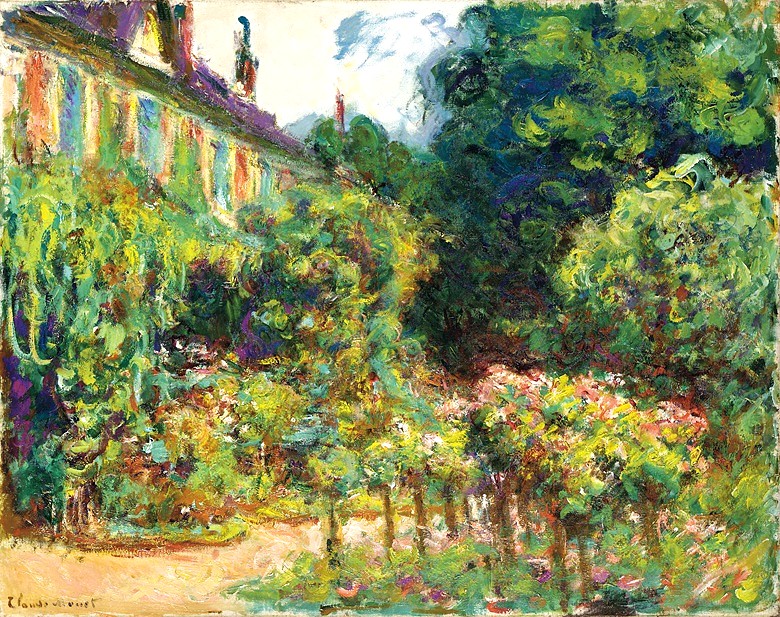
Since April 1883 Monet rents a house in Giverny. This small village lies on the right / north bank of the Seine, about 75km west of Paris. (iR468; iR9; iR3; iR4)
1890/11/17 Monet buys the house and the property for 20.oofr. He starts improvements on the garden and the house. Early 1893 Monet bought extra land across the railroad line, where he established a garden with a water-lily pond. This was enlrged again in 1901 and 1910. In 1904 Monet had 6 full-time gardeners. (R464,p15+16; iR4)
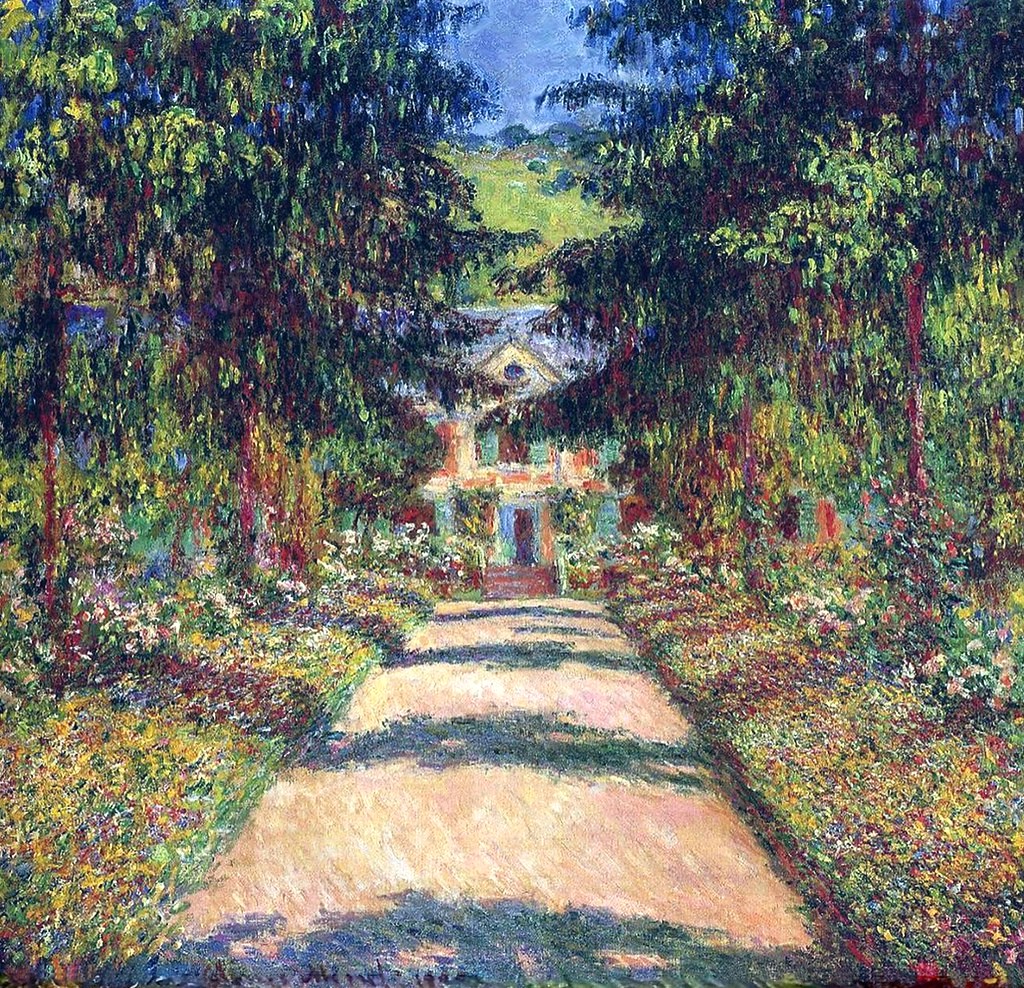
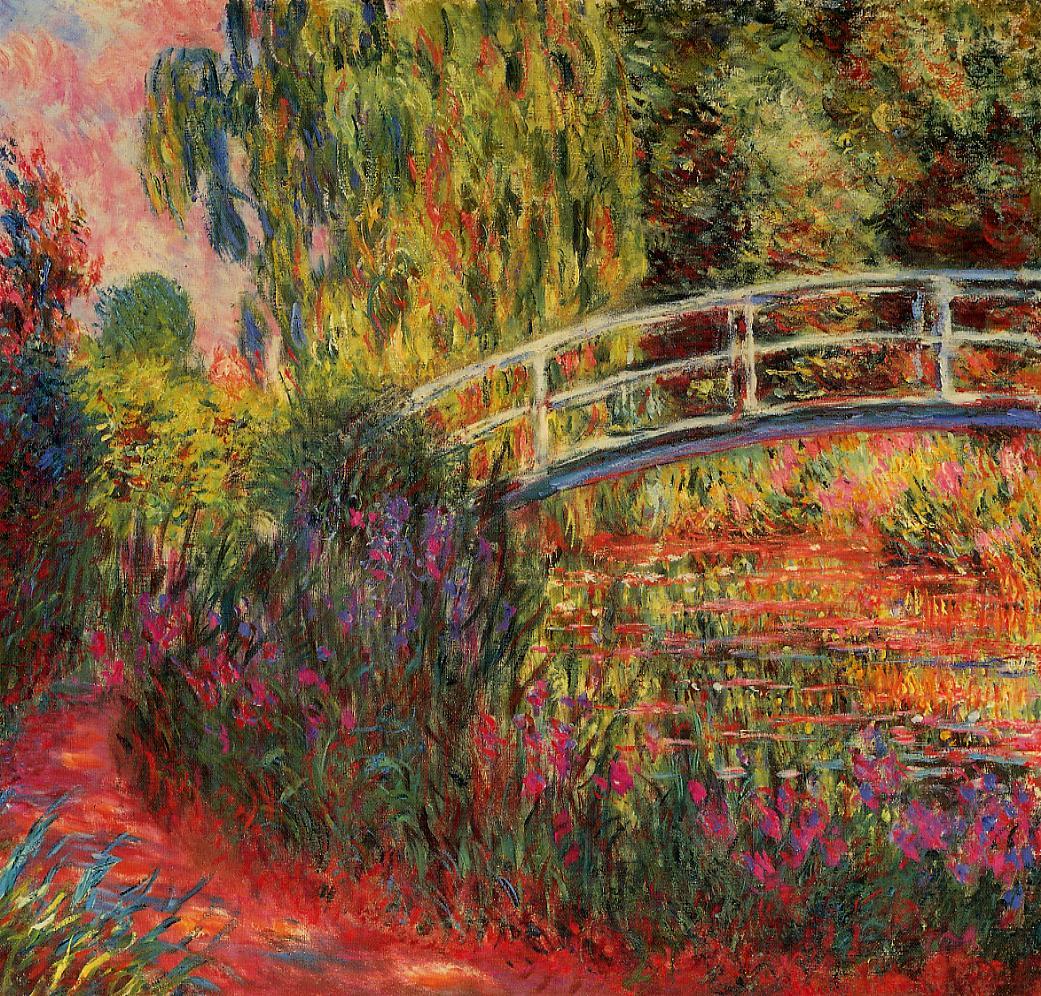
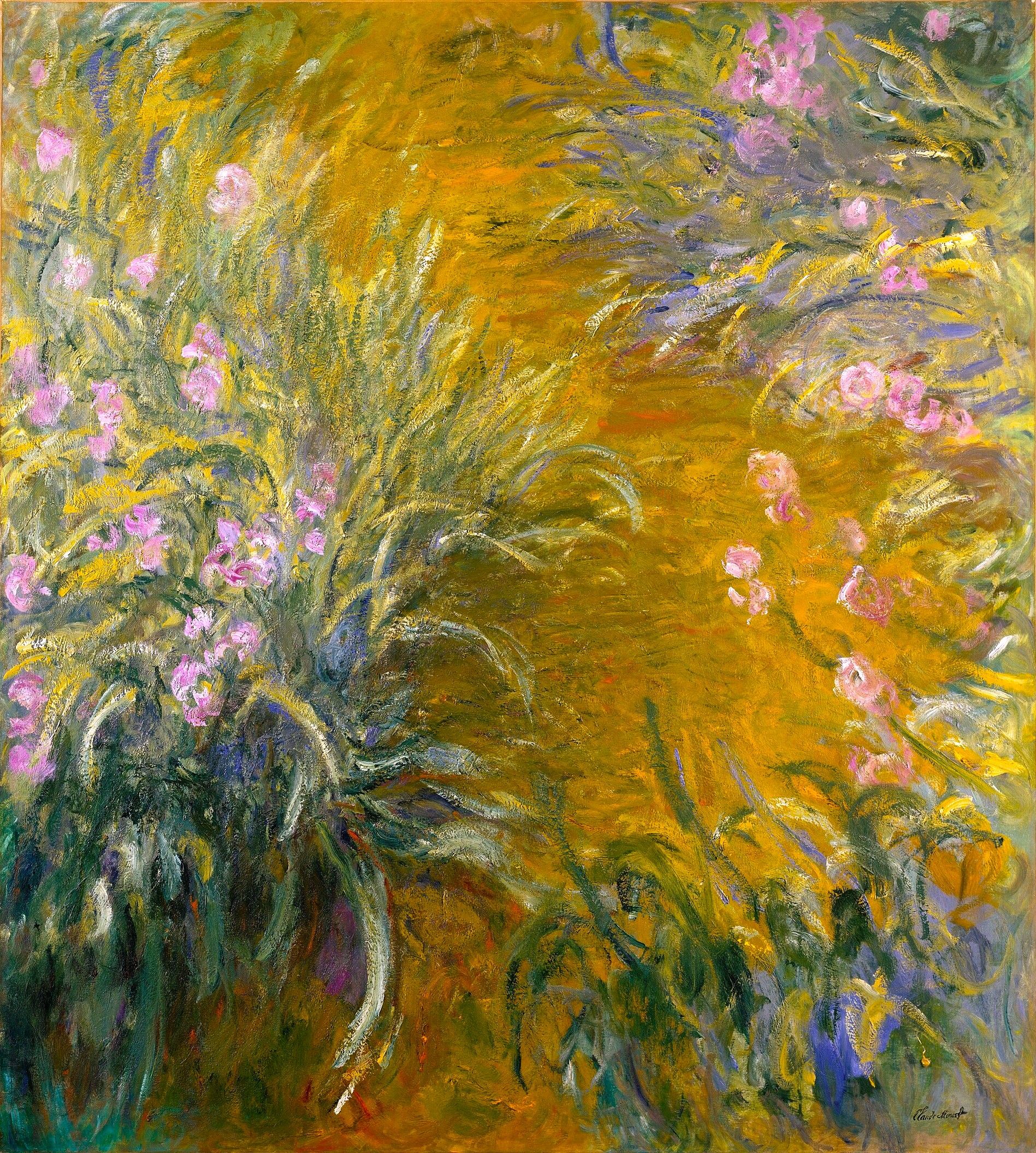
At first the garden consisted mainly of an orchard (R22,no1065; see also CR1634). Later on flowerbeds were created. Monet depicted the main path leading to his house, edged by flowerbeds of irises.
In the years 1918-1922 Monet depict the Allée de rosiers in which pergolas with roses almost form a tunnel; in these paintings his eye-problems↓ (cataract) are clearly visible (R22,no1934): CR1934-1940.Earlier on Monet had already depicted some rose arches, but they didn’t form a tunnel yet (CR1779-1781).
See CR1065 +1066 +1621-1627 +1650-1653 +1777-1781 +1934-1940 +1944-1963.

Monet and his family:
1883/04/29 Claude Monet moved with his two sons* to Giverny. Alice Hoschedé and her 6 children** would follow the next day. Her husband Ernest Hoschedé stayed in Paris. 1891/03/18 Ernest died. 1892/07/16 Claude Monet married Alice.
After the death of Claude 1926/12/05 his son Michel (1878-1966) inhereted the estate and the collection. But, it was Blanche Hoschedé (the widow of Jean Monet), who stayed and lived at the estate. After her death in 1947 the estate was neglected. Michel Monet would mary in 1931, but had no legal offspring (iR4). After his death the Giverny estate was donated to L’Institut de France / the Academie des Beaux-Arts (an opponant of Claude during his life) and the collection to the Musée Marmottan (M2). In 1980 the Fondation Claude Monet opened the estate in Giverny for the public.
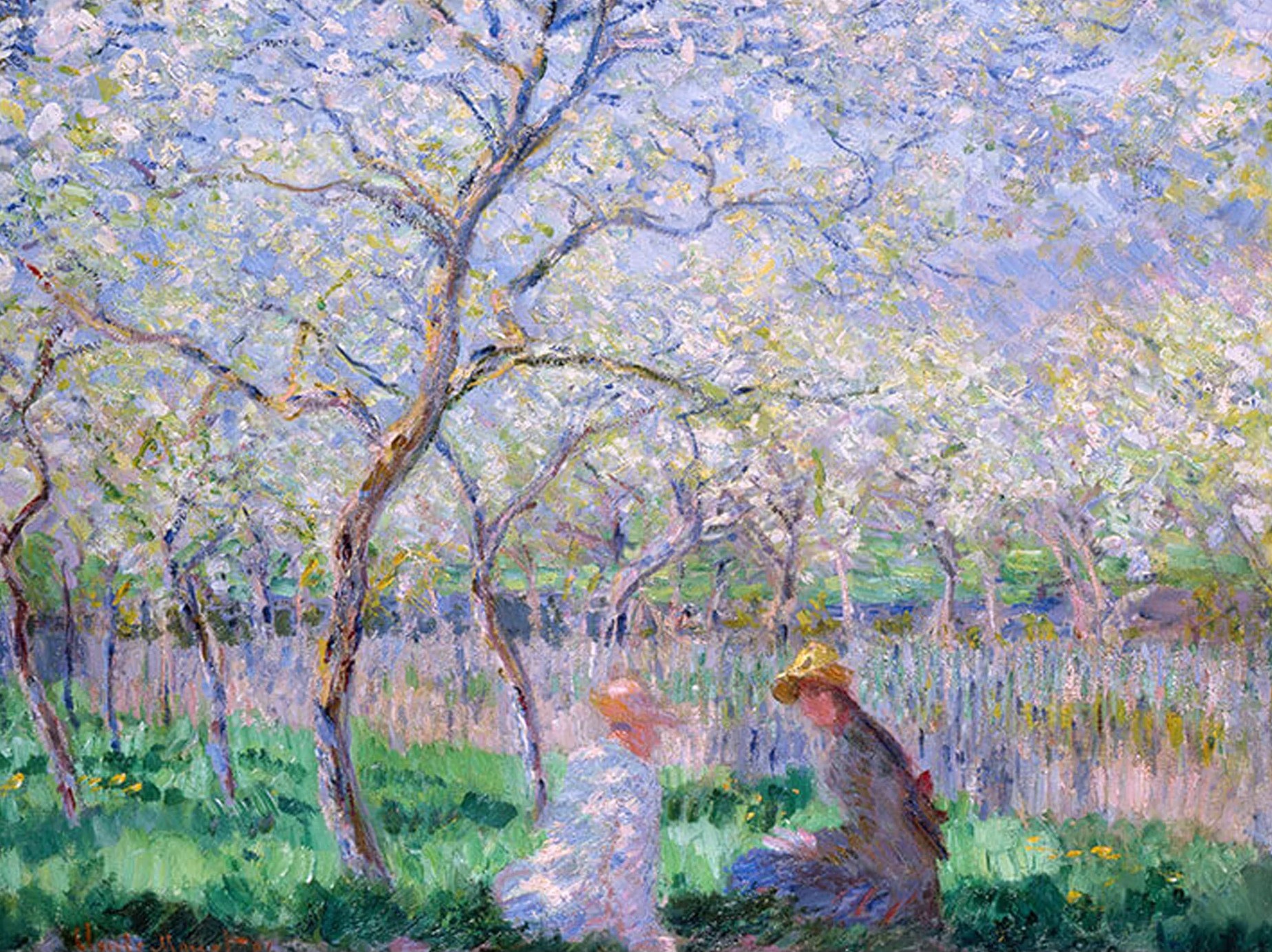
Monet sometimes depicted the members of his extended family in the garden and the surroundings of his estate.
See also Monet and his family.
Note*: His first wife Camille had died 1879/09/05 in Vétheuil. She had given birth to Jean (1867/08/08) and Michel (1878/03/17).
Note**: Marthe (1864-1925), Suzanne (1868-99), Blanche (1865-1947), Germaine (1873-1968, see CR434), Jacques (1873-1968, Jean-Pierre (1877-1961) (iR4).
The water-lily pond and the surrounding garden:
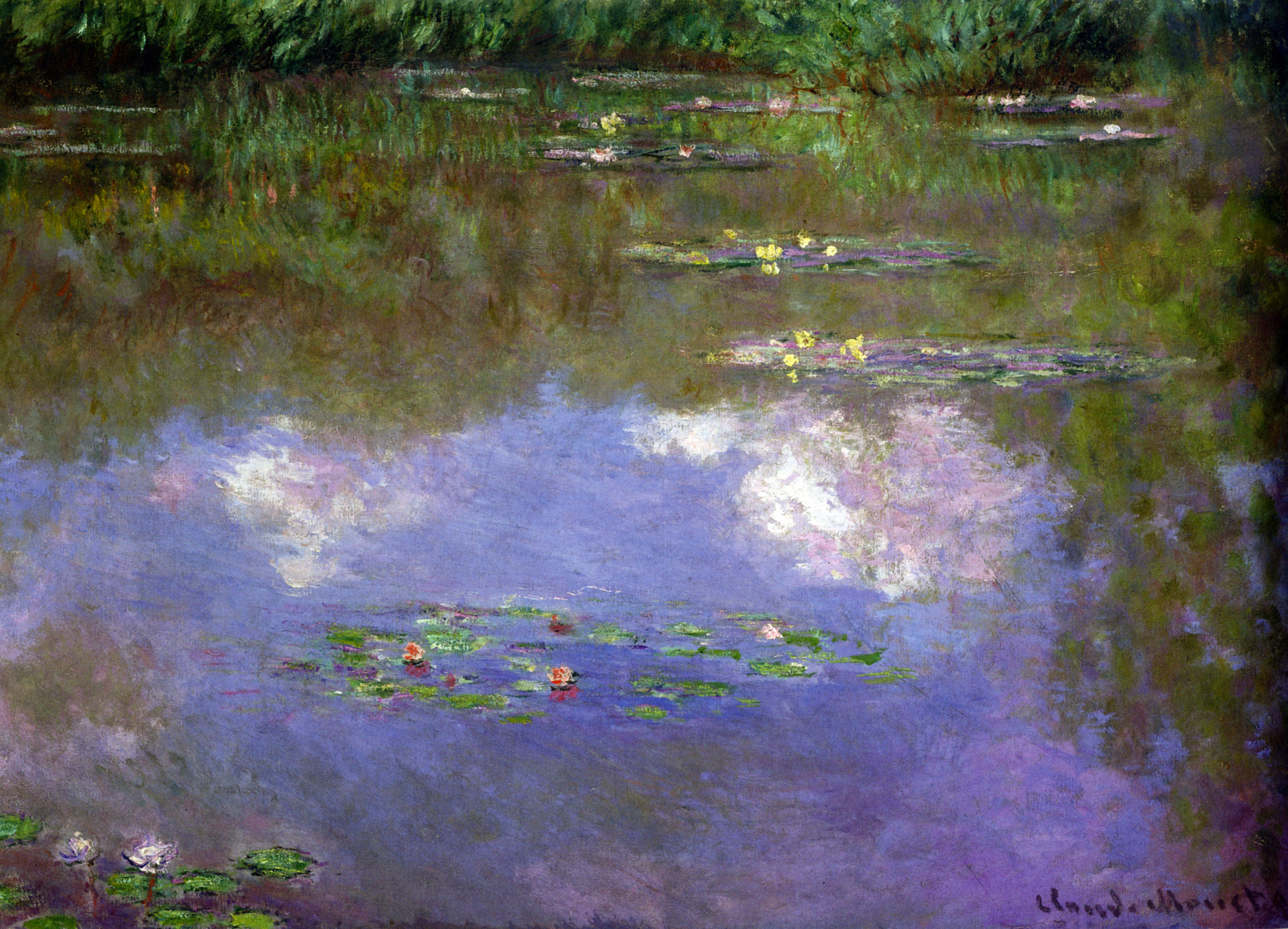
1893/02/05 Claude Monet acquired south of his estate, the land across the railroad line, where he established his famous Water-Lily Pond. The pond was filled with water of the Ru, an adjacent brook and branche of the Epte. Oktober 1893/10/30 Julie Manet witnessed the ‘little pond with the green, Japanese like bridge across it’ (R93,p41). 1901/05/10 Monet buys more land south of the Ru (for 1.200fr), the pond tripled in size (CR1650). After the flood of 1910/01 Monet enlarged his water-lily pond again.
The water-lily pond and the surrounding garden gave Monet many motives that he repeatedly depicted untill his death in 1926.


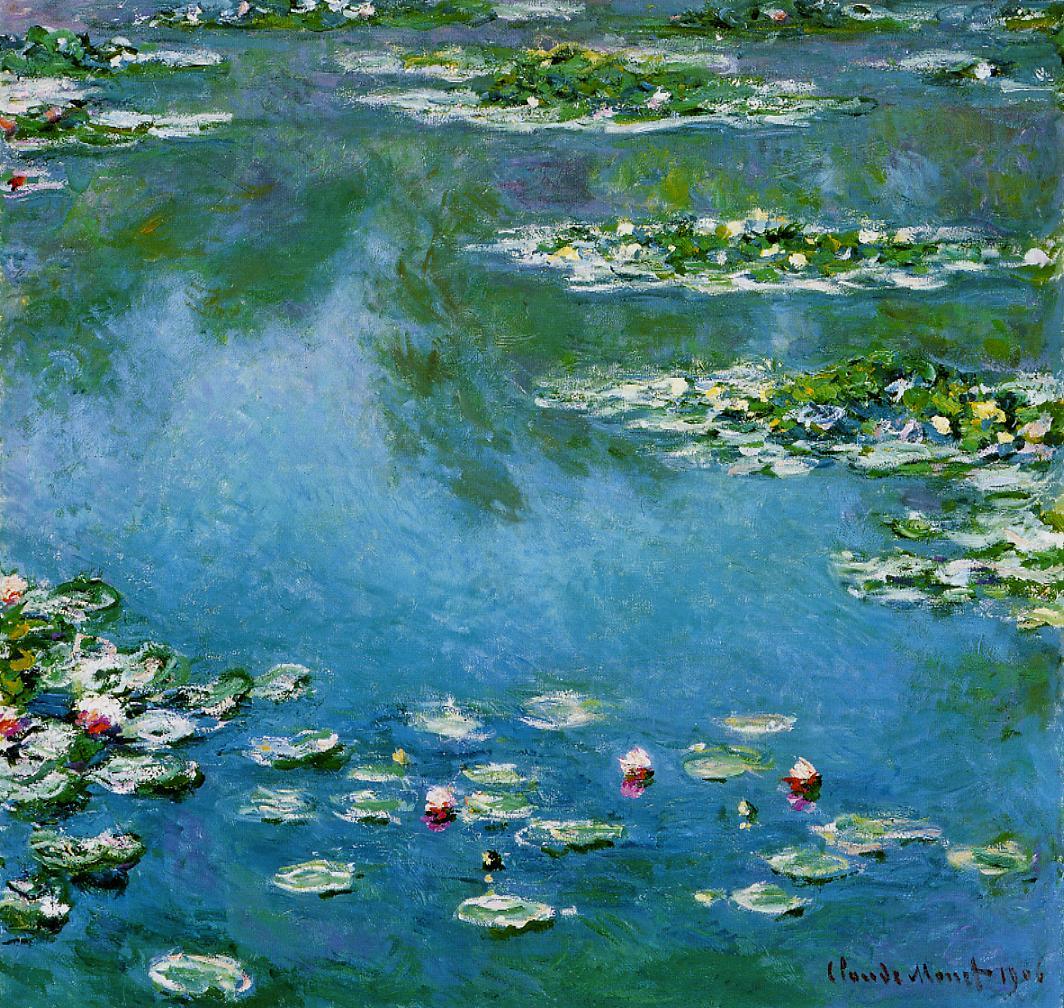
1897-1926, Water-Lilies / Nymphéas:
Claude Monet is famous because of his many paintings of Water-Lilies (Nymphéas in French).
He started to do so around 1897. Between 1897 and 1899 he made 8 paintings; they were not exhibited during his life.
In the winter of 1901/02 Monet had begun to renovate and enlarge and the water-lily pond.
In 1903 Monet again used it as a motif for his paintings. He did so until 1908. (CR1650+CR1654). Almost 50 of them were exhibited at the Durand-Ruel gallery in 1909 (6 May – 5 June) (R22IV,p1020).
After an interruption of some years he again took up this motiv from about 1914-1920. In this period he used larger canvasses. Very few of them are dated and those that are, were dated afterwards at the moment of sale, which makes the dating disputable. None of them were exhibited during his life. In these years his eyesight deteriorated, until he underwent a cataract operation. (R22IV,p839)
In his last years until his death in 1926 he would only work on his Grande Décorations↓.
Monet made also other pictures of his pond in which other water plants or the surrounding trees and other vegetation were more prominent subjects, see the overview of the Catalogue Raisonné.
See the Catalogue Raisonné of Wildenstein: CR1501-1508 +1656-67 +1671-91 +1694-1735 +1782-1817 +1852-65 +1883-1902 (+1964-91↓)(1996=R22IV; iR3; =iR182IV; =iR19vIV).





1895-1924, The Japanese bridge:
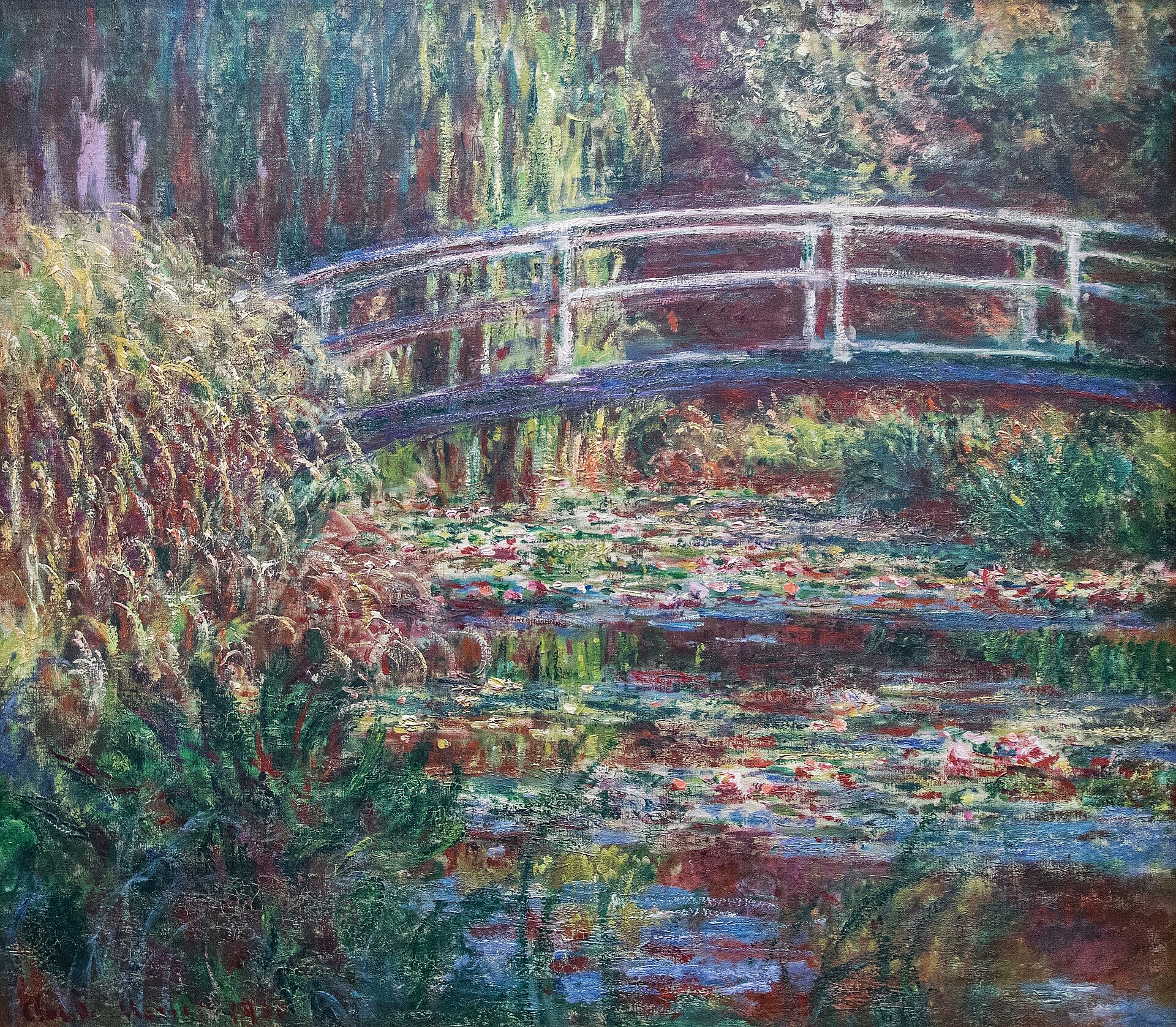
Over the pond Claude Monet constructed the so-called Japanese bridge. Early January 1895 he made his first picture of this bridge (CR1392). In the Summer he made 2 more paintings (CR1419 +1419a). He dated several of these paintings 1899 and showed them at Durand-Ruel in 1900. But, probably he already started with this serie in 1897.
He never depicted the Japanese bridge from exactly the same viewpoint (CR1628).
Monet made a serie from 1918-1924 in the summer and early autumn after lunch (CR1911-1933). These pictures also depict the Wisteria trees. In this serie the signs of distored vision are visible and also of (the partly) recovered sight after the cataract operation 1923/01 and the appropriate glasses. (R22IV,p912)
See the Catalogue Raisonné of Wildenstein: CR1392 +1419+1419a +1509-1520 +1628-1633 +1668-1670 +1911-1933 (1996=R22III+IV; iR3; =iR182IV; =iR19vIV).


Plants bordering the pond:
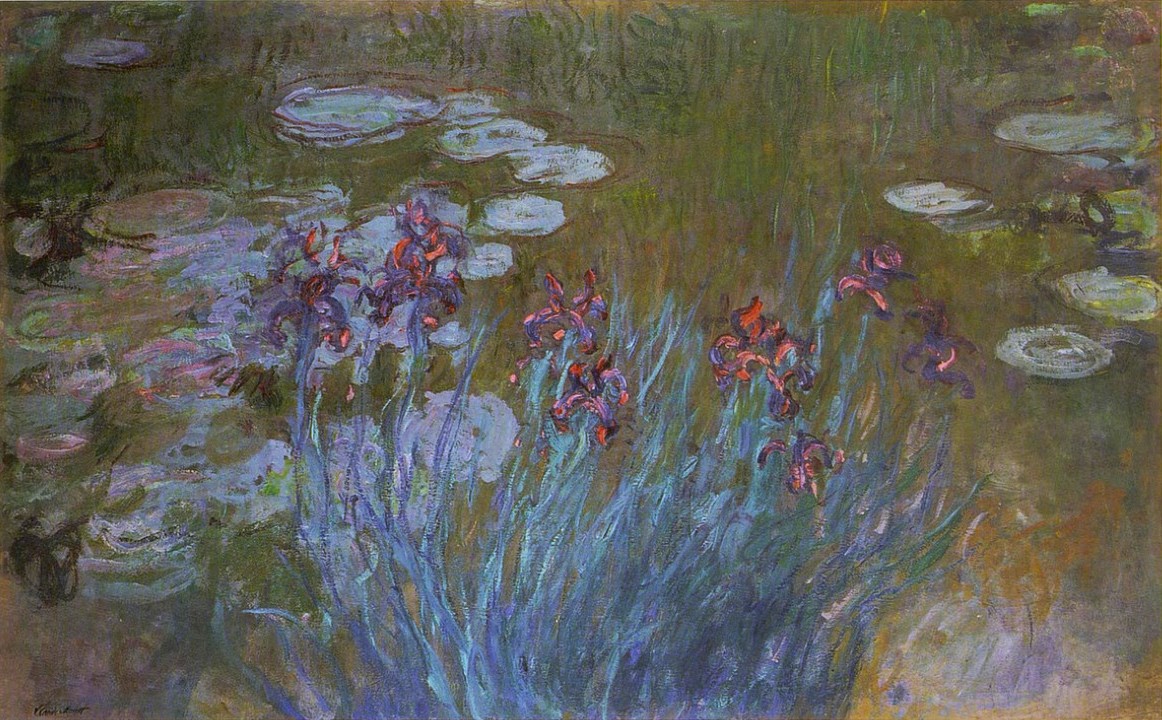
Claude Monet also depicted some plants next to the pond. (CR1818-1842)
Willow trees and Wisteria:
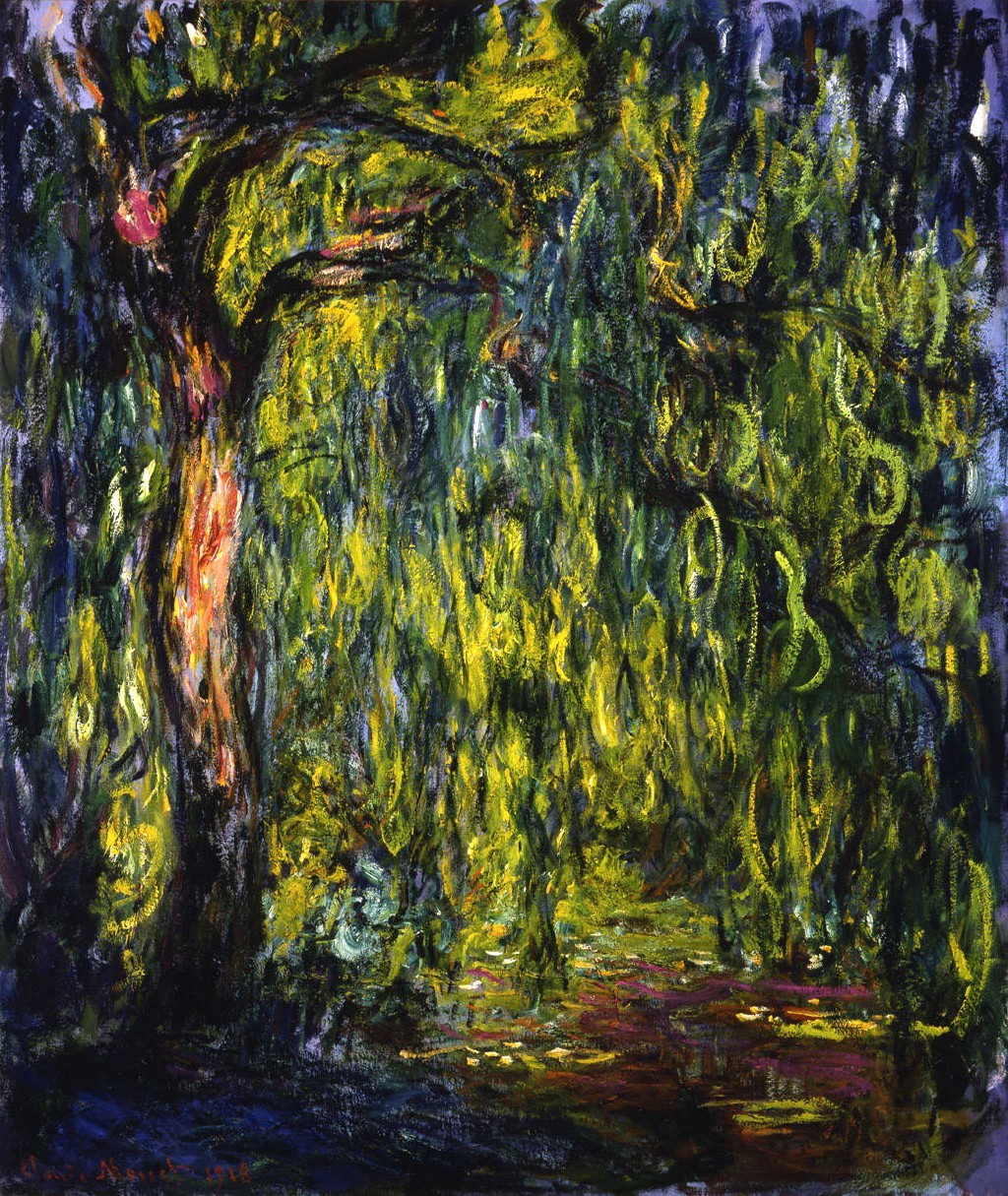
Claude Monet also depicted the willow trees and the Wisteria that stood beside the pond (and were reflected in the pond).
See: CR1848-55 +1866-77 +1903-10 +1941-1943.


Monet his eyesight:
The problems Claude Monet had with his eyesight started in the Summer of 1900, when he had a temporary loss of sight in one eye, due to an accident. In 1908 he again had eye problems. In 1911 his eyesight deteriorates. 1912/07 Monet receives the diagnoses double cataracts (Nl. staar). In some paintings signs of distored vision are visible and also of (the partly) recovered sight after the cataract operation 1923/01 and the appropriate glasses. (R22IV,p912)


1897-1926, Water-Lilies / Nymphéas, Grandes Décorations:
At the end in the years 1920-26 Claude Monet worked on his Grandes Décorations. In 1914/15 he had build an immense 3rd studio in which he could house canvasses of two meter high, for 50.000fr. (R464,p15+16; iR4) Already 1917/11 he worked on 10 panels. In 1920 Arsène Alexandre counted 40. Throughout the years the idea grew to donate a serie to the French state as a hommage to his friend Georges Clemenceau, who had been Président du Conseil from 1906-09 and 1917-20. In the end it was decided that the donation of 8 panels would be given to the Orangerie, where it can be seen up till today (see virtual tour). Other panels were not included and can now be seen on various locations. (R22IV,p945; iR3; iR4; M3)
Note: Monet painted these works in his studio, which is not in line with the impressionist painting style. But, probably his inspiration came from observations en-plein-air.
Did Monet depict atmosperical influences in this serie, in accordance with the impressionist painting style?
When we look at the titles, this limitly seems the case, except: the reflections of clouds (CR1972-74 +1985*); the setting sun (CR1984*) the rendering of morning (CR1987* +CR1989* + CR1991*).
As expected in most pictures blues are dominant (the colour of the pond) and greens (the reflection of the greenery + the depicted willows). Still, Monet renders a variaty of other colours: whites (often reflection of clouds), yellows (probably reflections of sunlight), reds (probably reflections of twilight). So, in that sense Monet depicts atmospheral influences. But, Monet doesn’t seem to render the typical leaves-filtered-light.
Note*: the numbers of the Orangerie paintings are not sequentially numbered in the catalogue raisonné of Wildenstein; I took the liberty to do so and to render them the numbers CR1984-CR1991 (R22IV,p972-979).
See the Catalogue Raisonné of Wildenstein: CR1694-1735 (1996=R22IV; iR3; =iR182IV; =iR19vIV).


Sources:
My main source is the catalogue raisonné of Wildenstein (1996=R22). See also the overview of the Catalogue Raisonné numbers (still in development). Another important source is the biography of Stuckey (R464,p11-16). See for other used sources at the bottom of the main page about Claude Monet. See the link for explanation of the subscriptions.
Further readings:
x
Additional references (=aRx):
- en.wikipedia.org//Giverny_Fondation_Monet_in_Giverny (Fondation Monet in Giverny; =iR)
- x
Recommanded citation: “Impressionism: Claude Monet in Giverny, his garden and the water-lily pond. Last modified 2026/06/22. https://www.impressionism.nl/monet-in-giverny/”
Note: additional info and pictures will be added.