Meta-Impressionism / Other exhibitions
Exposition Universelle
1900
Background information
General info:
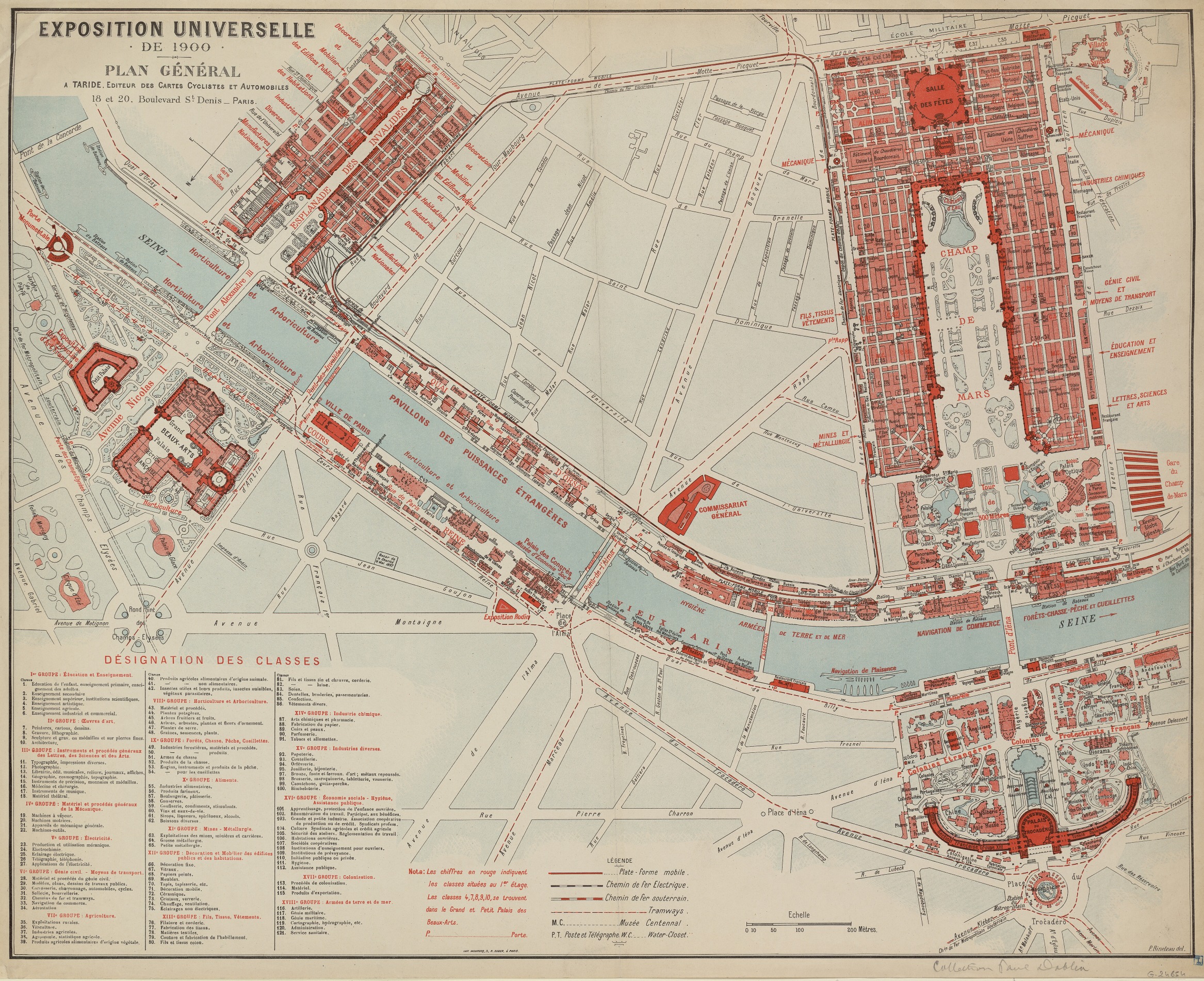
There were several art expositions at the Exposition Universelle in 1900 in Paris. On this page you will find background information on these expositions, namely from the catalogues.
First of the international Decennial exhibition, the Exposition Décennale des Beaux-arts 1889-1900, with more recent works of living artists, (namely) made between 1890-1900 (=EU-1900-D). (see seperate page with namely pictures).
Alongside this official international art exhibition, there were also French, national exhibitions.
You will find background info on the Centennial exhibition, the Exposition Centennale de l’Art Français (1800-1889), which represent the high regarded (French) art-works of the last 100 years (=EU-1900-C). (see seperate pages with an alphabetical and one with a chronological overview with namely pictures).
There also was a retrospective with French sculptures and applied art-works made before 1800 (=EU-1900-R). You will find some information from the catalogue at the bottom of this page and some pictures at the main page on the 1900 exposition.
L’Exposition Decennale (1890-1900):
First you will find background info on the Decennial exhibition of the Exposition Universelle held in 1900.
Hors Concours:
Several French and foreign artists joined ‘hors concours‘. They were (highly) awarded at an earlier Exposition Universelle and / or were part of the jury*. These are the following French partakers: Louis-Émile Adan*; Jean Béraud*; Paul-Albert Besnard*; René Billotte*; Léon Bonnat*; Bouguereau*; Jules Breton*; Charles Busson*; Carolus-Duran*; Eugène Carrière*; Jules Chéret; Raphaël Collin*; Gustave Courtois*; Émile-Charles Dameron*; Pierre-Emmanuel Damoye*; Albert-Pierre Dawant*; Édouard Detaille*; Edouard-Marie-Guillaume Dubufe; Julien Dupré*; Gabriel Ferrier*; François Flameng*; Henry Gervex*; J.B.-Antoine Guillemet*; Ferdinand Humbert*; Jean-Paul Laurens*; Jules-Joseph Lefebvre*; Léon-Augustin Lhermitte*; Albert-Pierre-René Maignan*; Frédéric Montenard*; Émile Renard*; Paul Renouard; J.-André Rixens*; Tony Robert-Fleury*.
The following people were part of the jury for painting, but were not noted as exhibiting ‘hors concours’: Léonce Bénédite; Louis de Fourcaud; Gérôme (president) (didn’t show art-works); Anatole Gruyer; Henry Havard; Gustave Larroumet (rapporteur); Georges Lafanestre; Émile Molinier. Note: it is possible some of them were no artists and maybe membre libres of L’Institut.
‘Impressionists’ at the Decennial exhibition:
8 of the 57 partakers of the ‘impressionist’ expositions exhibited art-works at the Decennial exhibition. They showed (at least) 43 art-works. Astruc showed an aquarelle and a sculpture. Félix Bracquemond exhibited 5 etchings. Colin showed 3 paintings. Desboutin showed 3 oil portraits and 3 engravings. Franc Lamy showed 3 paintings. J.F. Raffaëlli showed 5 paintings, 3 pastels and 5 coloured etchings. Vidal showed 2 pastel studies. Albert Lebourg showed at least 9 paintings in a ‘série Algérienne’ as part of the entries from Alger (=EU-1900-D-Algérie; note: 1 catalogue number maybe contained several studies).
7 of them were awarded with prices. Astruc received a médaille de bronze for sculpture (classe 9) (R231-13,p130;iR5;iR35). The marble version of his plaster statue was already owned by the state and in the Musée de Laval. Félix Bracquemond received a Grande Prix ‘Gravure et lithographie’ (R3,p650;R16,p81;R88;R52,p229). Desboutin also received a Grande Prix for ‘Gravure et lithographie’ and also a médaille de bronze for painting* (R231-13;R3;R9). Franc Lamy received a médaille de bronze for painting*. Lebourg received a médaille d’argent for painting*. J.F. Raffaëlli received a médaille d’or for ‘Gravure et lithographie’ (R231-13,p122). Vidal received a médaille de bronze for his pastels* (R231-13,p117;R88;iR69;R3;R9;iR60;aR2).
Note*: Classe 7 not only included paintings (peintures), but also ‘cartons + dessins’, in fact drawings, pastels and aquarelles.
Note: There was an Alphonse Legros who showed a design for a hospital. The catalogue indicates he was born in Clermont (Oise), a pupil of Bailly and P. Blondel and living 69, Boulevard Saint-Germain in Paris. The Alphonse Legros that joined the ‘impressionist’ exposition in 1876, was born in Dijon (Côte-d’Or); he was an etcher (and no architect) and lived in London (in 1900).
French artists at the Decennial exhibition:
Here below you will find some info on the other French artists at the Decenial exhibition of the Exposition Universelle in 1900.
Of the pre-impressionists only Harpignies was present, he received a Grand Prix. The widow of Charles Jacque had send in 2 paintings and 2 drawings. Note: most had already died.
Of the neo-impressionists just 4 were present. Lebasque and Le Sidaner received a bronze medal, Ménard a golden medal and Henri Martin a Grand Prix. Le Sidaner and Martin often used a neo-impressionist painting style, but rendered often symbolist themes.
Of the post-impressionists only Aman-Jean exhibited and received a golden medal.
Many para-impressionists and meta-impressionists did join.
110 French and foreign artists received a ‘médaille d’or‘ for ‘Peintures, cartons et dessins’. Some of the 45 French artists were: Edmond Aman-Jean; Jacques-Émile Blanche; Paul Chabas; Gaston Latouche; Henry Lerolle; Edmond Petitjean.
Many artists received a ‘médaille d’argent’, even more a ‘médaille de bronze’ and even more a ‘mention honorable’.
Among those who received a ‘médaille d’argent‘ were: xxx.
Among those who received a ‘médaille de bronze‘ were: Henri Lebasque + Henri Le Sidaner + Jean-Jacques Rousseau.
Among those who received a ‘mention honorable‘ were: xxx.
Note: More info will follow later.
Info catalogue Decennial exposition:
The catalogue of the Decennial exposition was part of the Catalogue Générale Officiel (Tome II). It belonged to groupe II, the ‘oeuvres d’art’ and was divided in classe 7 (Peintures – Cartons – Dessins) (=EU-1900-D-cl7); classe 8 (Gravure et lithographie) (=EU-1900-D-cl8); classe 9 (Sculpture et gravure en médailles et sur pierres fines) (=EU-1900-D-cl9); 10. Architecture. It was divided per country. Per country and per classe the numbering started again and again with number 1. (For example indicated as EU-1900-D-CH-cl7-1)
The French section contained the following catalogue numbers: Classe 7 (Peintures, cartons et Dessins) 1-1972; Classe 8 (Gravure et lithographie) 1-479; classe 9 (Sculpture et gravure en médailles et sur pierres fines) 1-640; Classe 10 (Architecture) 1-245.
So, the French section of classe 7 (peintures, cartons et dessins) counted 1972 numbers. A global research makes clear that about 418 landscapes were shown, more than 21% of the total. 190 of them also render in the title a (global) location, 98 an atmospherical indication* and 75 rendered both (which is typical for an impressionist painting style). 392 paintings were portraits, this is almost 20% (including anomynous portraits and excluding figure paintings). 212 paintings depicted classical themes**, this is almost 11%; 66 depicted historical scenes, 38 mythological and allegorical scenes and 108 biblical and/or religious scenes. Just 8 paintings clearly depicted oriental scenes.
Note*: an indication of time of day, season and/or weather conditions.
Note**: mythological, religious or historical themes.
Catalogue: 1900, Paris. Catalogue Génénéral Officiel, tome second groupe II , Oeuvres d’Art, classe 7 à 10; Exposition Décennale des Beaux-arts 1889-1900 (Musée Rodin) (=R231-3).
There also is a catalogue illustré officiel de l’exposition décennale des beaux-arts 1889 à 1900. Starting with about 900 gravures of paintings and sculptures; about 700 of French and 200 of foreign artists. The catalogue is composed per country and just two sections: paintings and sculptures. So, the classes engravings (8) and architecture (10) are left out.
Catalogue: 1900, Paris. Catalogues illustré Exposition Decennale 1889 à 1900 (iR40,bpt6k4328343 ; iR19/ia801209 =R231-4)
The foreign section in the catalogue:
Many countries joined the Decennial exhibition of the Exposition Universelle. Here below they will be noted in the order of the catalogue (with the French names). I will namely render the amount of catalogue numbers of classe 7 ‘Peintures et Dessins’. I will mention all foreign artists that joined ‘hors concours’ (20), all those who received a Grand Prix for painting (17) and those who received a médaille d’or (65). I will also mention some other more well known partakers and indicate if they received silver or bronze medal or a ‘mention honorable’.
The catalogue first rendered the French Colonies (iR3):
Algérie (=Algeria): peintures etc.: 1-135; including Albert Lebourg↑ (59-67).
And also: Congo; Somalis; Dahomey (part of Maroc?); L’Indie Française; Océanie; L’Indo-Chine; Madagascar; Martinique; Mayotte; pavillon de la Réunion; Saint-Pierre et Miquelon; Sénégal; Tunisie (=Tunisia); pavillon du ministère des colonies (including Cormon);
Allemagne (=Germany=DE): Peintures et Dessins: 1-168; ‘hors concours‘: Franz von Defregger + Dill; Grand Prix: Franz von Lenbach + Fritz von Uhde; médaille d’or (gold): Von Gebhardt + Ludwig Herterich + Max Koner + G. Kuehl + Richard Müller + Franz Stuck; ‘mention honorable‘: Max Slevogt;
Autriche (=Austria =AT): Peintures et Dessins: 1-176; ‘hors concours‘: Guillaume Bernatzik + Venceslas de Brozik + Clément de Pausinger; Grand Prix: Gustave Klimt; médaille d’or (gold): Henri de Angeli + Adalbert Hynais + Joseph Mehoffer; ‘medaille d’argent‘: François Kupka + Alponse-Marie Mucha;
Belgique (=Belgium =BE): Peintures et Dessins: 1-117; Grand Prix: Alfred Stevens + Alexandre Struys; médaille d’or (gold): Albert Baertsoen + Émile Claus + Léon-Henri-Marie Frédéric + Théodore Verstraete; ‘medaille d’argent‘: Fernand Knopff + Laermans; ‘médaille de bronze‘: James Ensor; ‘mention honorable‘: William de Gouve de Nuncques;
Bosnie-Herzégovine: Peintures et Dessins: 1-2; Sculpture et gravure en médailles et sur pierres fines: 1-2; including (Alphonse) Mucha.
Bulgarie (=Bulgaria =BG): Peintures et Dessins: 1-25; médaille d’or (gold): J-V. Mrkvitchka;
Danemark (=Denmark =DK): Peintures et Dessins: 1-162; ‘hors concours‘: L. Tuxen; Grand Prix: P-S Kröyer; médaille d’or (gold): Viggo Johansen + Julius Paulsen; ‘medaille d’argent‘: Anna Ancher; ‘médaille de bronze‘: Nielsen;
Équateur (Equador): Peintures et Dessins: 1- 50; Sculpture et gravure en médailles et sur pierres fines: 1-13.
Espagne (=Spain =ES): Peintures et Dessins: 1-106; Sculpture et gravure en médailles et sur pierres fines: 1-57; ‘hors concours‘: Aureliano de Beruete; Grand Prix: Joaquin Sorolla y Bastida; médaille d’or (gold): Ulpiano Checa + José Jimenez Abanda + Daniel Urrabietta Vierge; ‘medaille d’argent‘: Ricardo de los Rios (for engraving);
États-Unis (=USA): Peintures et Dessins: 1-352; ‘hors concours‘: Alexandre Harrison + Francis-D. Millet; Grand Prix: John-S. Sargent + J-Mac-Neil Whistler; médaille d’or (gold): Edwin-A. Abbey + John-W. Alexander +Mlle Cécilia Beaux + George de Forest Brush + William-M. Chase + Winslow Homer + Abbott-H. Thayer; ‘medaille d’argent‘: Childe Hassam; ‘médaille de bronze‘: Mme Mary Mac-Monniès (USA); ‘mention honorable‘: Willard-L. Metcalf.
The entries from Cuba were exhibited in the Trocadero and mentioned per classe after the entries of the États-Unis .
Grande-Bretagne (=Great-Britain =GB): Peintures, Aquarelles et Dessins: 1-276; ‘hors concours‘: H-W-B Davis; Grand Prix: Lawrence Alma-Tadema + W-Q Orchardson; (William-)Hamo Thornycroft (for sculpture); médaille d’or (gold): George Clausen + Stanhope-Alexander Forbes + E-J. Gregory + J-H. Lorimer + George Reid + John-M. Swan; ‘medaille d’argent‘: La Thangue;
The entries from the colonies of Grande-Bretagne were exhibited in the Trocadero and mentioned per classe after the entries of Grande-Bretagne.
Grèce (=Greece =EL): Peintures: 1-5; Sculptures: 1-26; ‘hors concours‘: Théodore Ralli; médaille d’or (gold): Georges Jacobidès;
The most entries from Greece were shown in the ‘Pavillon spécial, Rue des Nations’.
Hongrie (=Hungary =HU): Peintures et Dessins: 1-147; Grand Prix: Jules de Benczur; médaille d’or (gold): Étienne Csók + Philippe László;
The entries from Croatie-Slavonie (Croatia + Slavonia) were mentioned per classe after the entries of Hungary.
Italie (=Italy =IT): Peintures et Dessins: 1-129; Grand Prix: Jean Boldini; médaille d’or (gold): Pie Joris + François-Paul Michetti + Ange Morbelli + Dominique Morelli + Hector Tito;
Japon (=Japan) peintures etc.: 1-193; médaille d’or (gold): Suiséki O-Hashi;
Luxembourg: The in total 4 entries were shown in the ‘Pavillon spécial, Rue des Nations’.
Mexique (=Mexico): Peintures: 1-3.
Principauté de Monaco: The in total 12 entries were shown in the ‘Pavillon spécial, Rue des Nations’.
Nicaragua: Peintures: 1.
Norvège (=Norway =NO): Peintures et Dessins: 1-119; ‘hors concours‘: Grönvold; Grand Prix: Fritz Thaulow; médaille d’or (gold): Eiebakke + Eyolf Soot + Halfdan Ström;
Pays-bas (=the Netherlands =NL): Peintures et Dessins: 1-102; ‘hors concours‘: W. Maris + Willy Martens; Grand Prix: Jozef Israëls; médaille d’or (gold): B-J Blommers + J-H Breitner (hc) + H-W Mesdag + J-H. Weissenbruch; ‘medaille d’argent‘: J. Toorop (for painting and for engraving); ‘médaille de bronze‘: Albert Roelofs; ‘mention honorable‘: F. Hart-Nibbrig + W-E Roelofs Jr.;
Pérou (=Peru) Peintures: 1-21; médaille d’or (gold): Albert Lynch;
Portugal (=PT): Peintures et Dessins: 1-123; ‘hors concours‘: José-Julio de Sousa Pinto;
médaille d’or (gold): Columbano Bordallo-Pinheiro + José-Velloso Salgado. See for the complete entry aR7↓.
Roumanie (=Romania): Peintures et Dessins: 1-71; Sculpture: 1-21.
Russie (=Russia =RU): Peintures et Dessins: 1-283; Sculpture: 1-137; ‘hors concours‘: Albert Edelfeldt* + Élie Répine; Grand Prix: Valentin Sérov; Prince Paolo Troubetzkoj (for sculpture); médaille d’or (gold): Axel Gallen + Eero Jaernefelt + Constantin Korovine + Philippe Maliavine; ‘médaille de bronze‘: Elin Danielson-Gambogi*; Kiriak Konstandi;
Note*: This included the entries of the artists from Finland.
République de Saint-Marin: The in total 10 entries were shown in the ‘Pavillon spécial, Jardins du Champ-de-Mars)
San Salvador: The 2 entries were shown in the Pavillon du Mexique at the Quai d’Orsay.
Serbie (=Serbia): Peintures: 1-46; médaille d’or (gold): Paul Yovanovitch;
Suède (=Sweden =SE): Peintures: 1-85; ‘hors concours‘: August Hagborg; Grand Prix: Anders Zorn; médaille d’or (gold): Nils Forsberg + Carl Larson + Alfred Wahlberg; ‘medaille d’argent‘: Wilhelmson;
Suisse (=Switzerland =CH): Peintures et Dessins: 1-198; ‘hors concours‘: Charles Giron + Hans Sandreuter; médaille d’or (gold): Eugène Burnand + Mlle Louise-Catherine Breslau + Eugène Burnand + Ferdinand Hodler + Carlos Schwabe;
Turquie (=Turkey =TR): Peintures: 1-14; médaille d’or (gold): Zaccharian;
Section internationale: Peintures: 1-19; sculpture: 1-3.
L’Exposition Centennale (1800-1889):
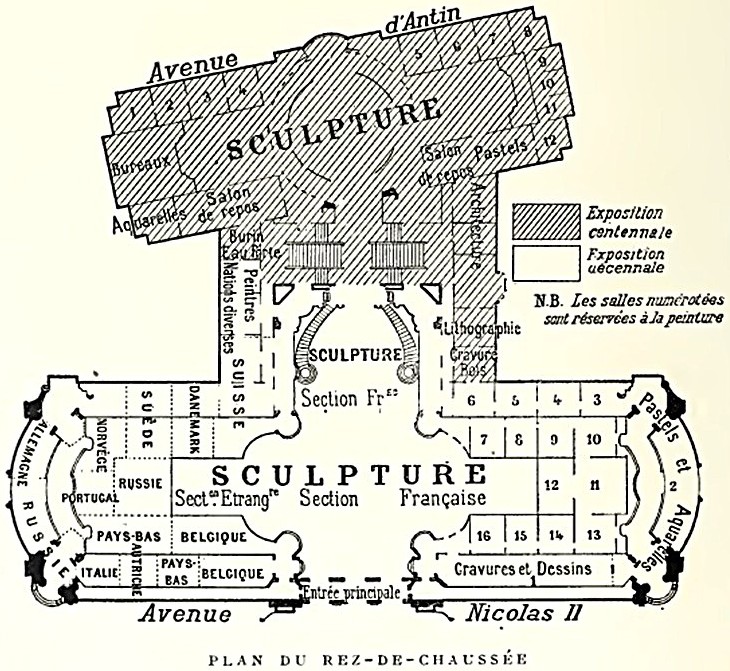
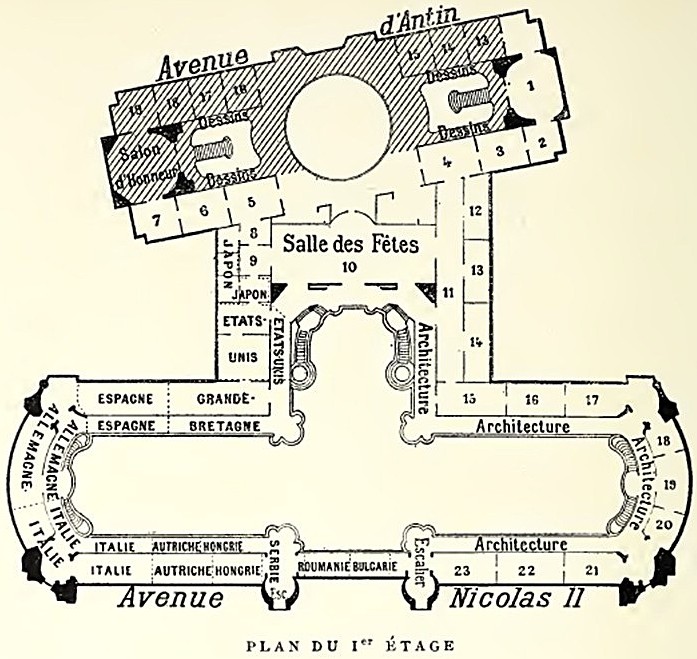
Here below you will find background information on the the Centennial exhibition, the Exposition Centennale de l’Art Français (1800-1889), which was organised alongside the Exposition Universelle of 1900. It did represent the most high regarded (French) art-works of the last 100 years (=EU-1900-C). See seperate pages with an alphabetical and one with a chronological overview with namely pictures. See the main page on the 1900 exposition for a tour along the rooms of the Grand Palais and for additional info on the so-called ‘impressionist room’.
The Centennial exhibition, general info:
The Centennial exhibition (1800-1889) at the Exposition Universelle represent high regarded art-works of the last centennial* (=EU-1900-C). In total there were about 672 oil paintings exhibited, 686 drawings (+pastels + watercolours), 734 sorts of sculptures, 526 sorts of engravings and 448 other art-works. See seperate page for exhibited art-works.
There were 272 painters of which more precise 682** paintings were shown, this makes an average of 2,5 paintings per artist. Of just 11 painters more than 10 paintings were shown: Corot (25), Daumier (18), Ingres (17), Delacroix (16), Monet (14), Daubigny (13), Manet (13), Renoir (11), David (10+4?), Dupré (10), Prud’hon (10). Of 19 more 5 till 9 paintings were shown: Chasériau (9), Rousseau (9), Courbet (8), Diaz (8), Pissarro (8), Ricard (8), Sisley (8), Gros (7), Bastien-Lepage (6), Baudry (6), Fantin-Latour (6), (Louis-Eugène) Lami (6), (J.F.) Millet (6), Monticelli (6), Tassaert (6), Chintreuil (5), Drölling (5), Géricault (5), Moreau (5). So, we see that Impressionists and related painters are more extensively represented than classical painters. In total 28 of the 57 partakers of the ‘impressionist’ expositions showed 73 paintings (almost 11%!) and 40 other art-works.
Arsène Alexandre talked about a a dazzling venue of Impressionists (Le Figaro 1900/05/01), see for more information on the general page. Mellerio writes about 1 small room, mentioning the names of Monet, Pissarro, Renoir, Guillaumin and also Sisley, Degas, Cézanne, Morisot and Boudin. But, he specifies just a few works. He also wrote ’they received their well-deserved coronation’ (R380,p15+19+21). Another source mentions there were two rooms especially for ‘impressionists’.
The Centennial exhibition was one of the retrospective exhibitions of fine arts and decorative arts held alongside the Exposition Universelle in 1900. Already in 1894 a committee started with the preparations. Among the members were government officials, members of L’Institut, art-collectors, art-critics and curators of French musea. Among the members were: Roger-Ballu (inspecteur des Beaux-Arts); Léonce Bénédite (conservateur du Musée national des Beaux-Arts); Henri Béraldi (art-collector); Blot (art-collector); Bonnat; Cahen (art-collector); Léo Claretie (publicist); Ephrussi (Charles) (art-collector); Gustave Geffroy (art-critic); Gérôme; Hayem (art-collector); Roger Marx (inspecteur général des Musées des départements; Moreau-Nélaton (art-collector); Pellerin (art-collector); Antonin Proust (commissaire spécial des Beaux-Arts Exposition Universelle de 1889); Alexis Rouart (art-collector); Henri Rouart (art-collector); Armand Silvestre (inspecteur des Beaux-Arts); Tavernier (art-collector).
Note*: officially from 1800-1889, but in fact since 1780ca.
Note**: the catalogue renders 672 numbers of paintings, but some numbers are left out and some number have a ‘bis’ or even a ’ter’ version. Some numbers included more than one paintings (often several studies), I count them as 1 painting.
Info catalogue Centennial exposition:
The catalogue is divided in 13 catagories:
I: Peintures, nos. 1-672 =672.
II: Dessins, nos. 673 – 1358 = 686.
III: Miniatures, nos. 1359-1410 = 52.
IV: Sculptures, nos. 1411 – 1830 = 420
V: Médailles, nos. 1831-2051 = 221.
+ Monnaies du siècle, nos. 2052-2092 = 41
Note: It is indicated who signed these coins.
VI: Architectures, nos. 2093-2255 = 163.
VII: Gravure au burin et à l’eau-forte, nos. 2256-2451 = 196.
VIII: Lithographie, nos. 2452-2674 = 223.
IX: Gravure sur bois, nos. 2675-2781 = 107.
X: Objets d’art, nos. 2782-2918 = 137.
Note: this included 19 porcelain objects, 7 pieces of furniture and 37 pieces of glassware made by Émile Gallé.
Gauguin showed 4 art objects and Alfred Meyer 2 enamel art objects.
XI: Mobilier*, nos. 2919-3003 = 85.
XII: Bronzes d’ameublement*, nos. 3004-3047 = 44.
XII: Céramique (Sèvres et Limoges)*, nos. 3048-3066 = 19.
Note*: most of these works are anonymous.
So, in total there were about 672 oil paintings exhibited, 686 drawings (+pastels + watercolours), 734 sorts of sculptures, 526 sorts of engravings and 448 other art-works.
Of the more precise 682 paintings, 208 were figure paintings and portraits, 208 landscapes (both 30,5%), 161 classical themes* (23,6%), 105 other and unidentified themes (15,4%).
Note*: mythological, religious or historical themes.
Catalogue: 1900, Paris. Catalogue général officiel; oeuvres d’art (All 3066 catalogue numbers of the Centennale expo). (iR19//ia601309; =R231-1)
Info illustrated catalogue Centennial exposition:
The illustrated catalogue of the Centennial exposition renders a more accurate list of the exhibited paintings (no.1-672). A global research makes clear that about 185 landscapes were shown, more than 27% of the total. 82 of them also render in the title a (global) location, 22 an atmospherical indication* and 12 rendered both (which is typical for an impressionist painting style). 136 paintings were portraits, this is almost 20% (including anomynous portraits and exluding figure paintings). 131 paintings depicted classical themes**, this is more than 19%; 59 depicted historical scenes, 47 mythological and allegorical scenes and 25 biblical and/or religious scenes. Just 12 paintings depicted oriental scenes.
The illustrated catalogue renders 147 gravures of the about 672 exhibited paintings (about 22%), 35 of the exhibited sculptures and 8 of other art-works. 61 of the paintings represent classical themes** (41,5%), 56 represent figure paintings and portraits (38,1%), 17 represent landscapes (11,6%) and 13 other themes (8,8%). So, the landscapes are underrepresented in the gravures and the classical paintings overrepresented. Of the 28 partakers of the ‘impressionist’ expositions, who showed 73 paintings and 40 other art-works, just 13 engravings were presented.
The following artists their paintings were represented more often: Ingres (5 of 17); Corot (4 of 24); Prud’hon (4 of 10); Chassériau (3 of 9); Daumier (3 of 18 + 1 drawing); David (3+2 of 10+5); Greuze (3 of 4); Manet (3 of 13); Puvis de Chavannes (3 of 4); Schewach (3 of 4); Bazille (2 of 2!); Chaplin (2 of 3); Courbet (2 of 8); Court (2 of 3); Daubigny (2 of 13); Degas (2 of 2 + 1 of 5 pastels); Delacroix (2 of 16); Falguière (2 of 2! + 1 sculpture); Fantin-Latour (2 of 6 + 1 dessin); Mll Gérard (2 of 3); Géricault (2 of 5); Gros (2 of); Mme Lebrun (2 of 2!); Legros (2 of 2!); Maignan (2 of 2!); JF Millet (2 of 6); Monet (2 of 14); Régamey (2 of 2!); Renoir (2 of 11); Tassaert (2 of 6); Trutat (2 of 4); Vernet (2+1 of 2+1!).
The illustrated catalogue also renders the titles of the sculptures (no.1411 – 1830), but not of the other 9 catagories.
Note*: an indication of time of day, season and/or weather conditions.
Note**: mythological, religious or historical themes.
Catalogue: 1900, Paris. Catalogues illustré Exposition Centennale (link to gallica.bnf.fr/bpt6k432833q; and gallica.bnf.fr/bpt6k62110164=iR40=R231-2).
L’Exposition Rétrospective (before 1800):
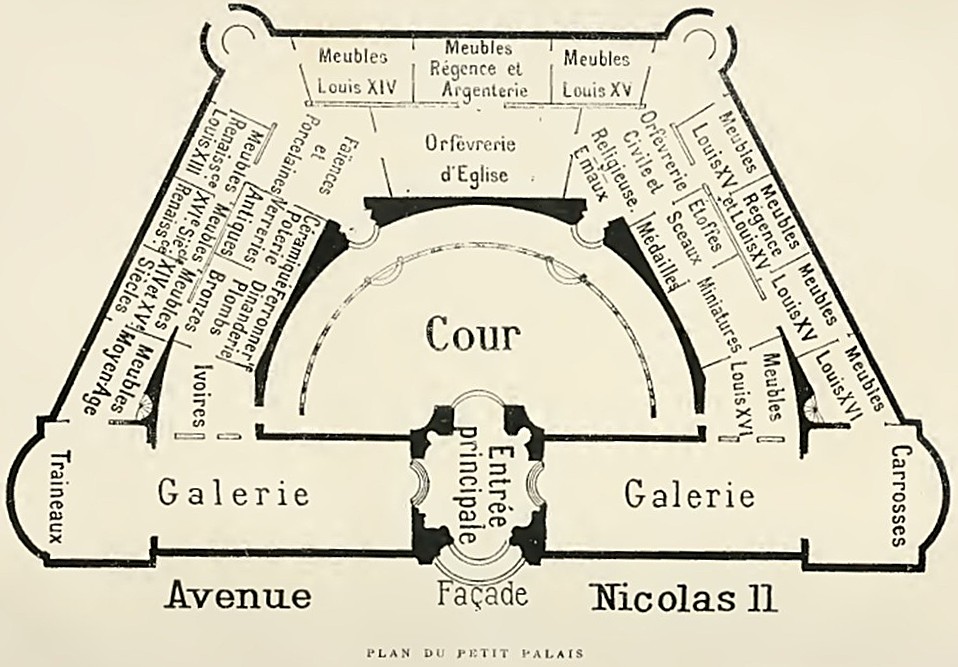
The catalogue of the Retrospective exposition with 4774 numbers is divided in several catagories:
It renders mostly objects of art made from a diversity of materials and just a limited amount of fine arts, namely painting (69x) and sculpture (132x).
I: Ivory, nos. 1-224 =224x
II: Bronze, brassware, lead, pewter, nos. 225-454 = 230x
Including sculptures with classical themes.
III: Iron, weapons, locksmithing, cutlery, nos. 455-627 = 173x
Including bookstands, swords, knifes, locks.
IV: Ceramics, nos. 628-1573 =946x!
Note: 946! objects, including many vases, kitchenware and porcelain from several collections and factories.
V: Goldsmithing / silverware, nos. 1574-1851 = 278
Inclusing crosses, relics, chalices,
VI: Jewellery, fine jewellery, clocks, nos. 1852-2404 =553!
Including fibulae, rings, watches.
VII: Champlevé enamels, nos. 2405-2617 = 213x.
Including crosses, relics, incense burners,
VIII: Painted enamels, nos. 2618 – 2797 = 180x.
Including cups, plates. Many religious themes.
IX: Furniture, nos. 2798 – 3029 = 231
Including, tables, chairs, chests (of drawers), clocks.
X: (objects of) Wood, nos. 3029bis – 3163 = 135
Including sculptures with religious themes.
XI: Tapistry, nos. 3164-3247 = 84x
Many depicting religious scenes.
XII: Fabrics, embroidery, nos. 3248-3290 =43x
Including shrouds, ornaments.
XIII: Leather, bookbinding, nos. 3291 – 3311 = 21x
Including many boxes.
XIV: Manuscripts and illuminated manuscripts, nos. 3312 – 3390 = 79x.
XV: Miniatures and fans, nos. 3391 – 3402 = 12x.
XVI: Coins, nos. 3403 – 3949 = 547x! (not specified)
XVII: Medals, nos. 3950 – 4221 = 272x (not specified)
XVIII: French sigillography, nos. 4222 – 4540 = 319x.
Namely stamps.
XIX: Painting, nos. 4541 – 4609 = 69.
Many portraits, many from the 18th century.
XX: Sculpture, nos. 4610 – 4741 = 132x.
Including capitals. Many religious themes and portraits. Made of several materials.
XXI: Glaswork, nos. 4742-1474 = 33x (not specified)
Catalogue: Paris, 1900. Catalogue officiel illustré de l’exposition rétrospective de l’art français des origines à 1800 (iR19//ia801304 = R231=aR5).
Recommanded citation: “Meta-Impressionism / other expositions: Exposition Universelle 1900 background info (from the catalogues). Last modified 2025/11/11. https://www.impressionism.nl/exposition-universelle-1900-info/”