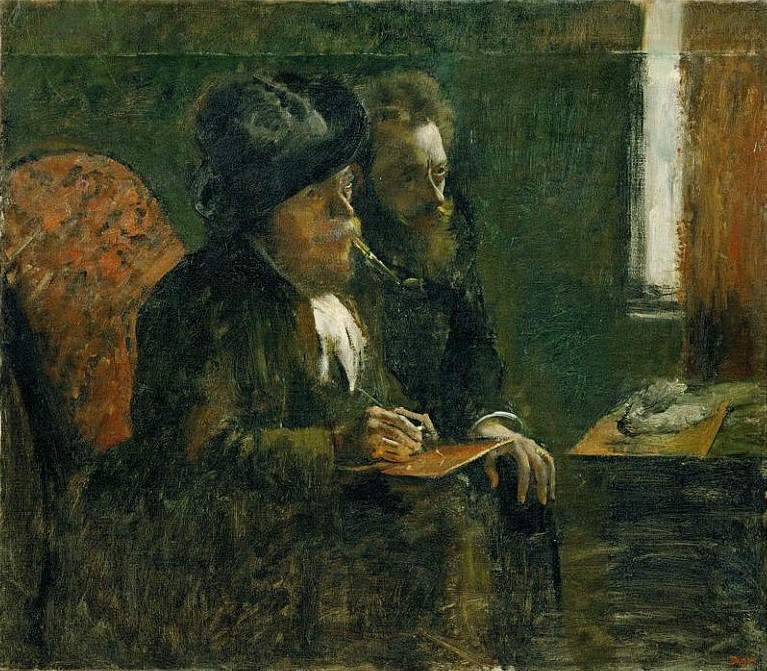
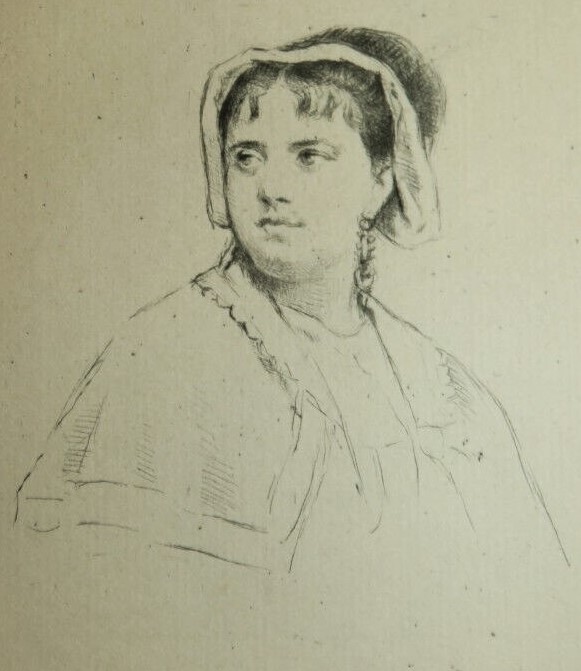
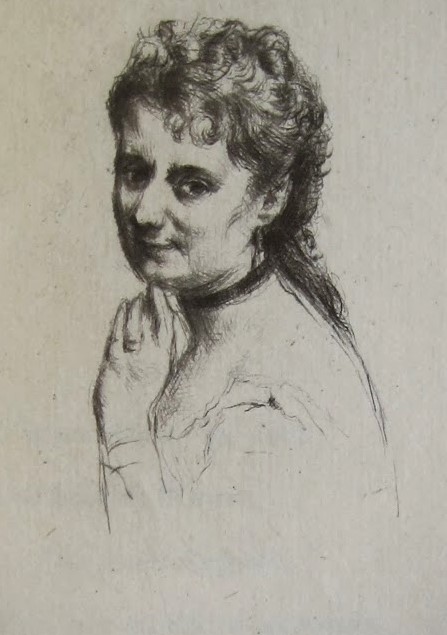
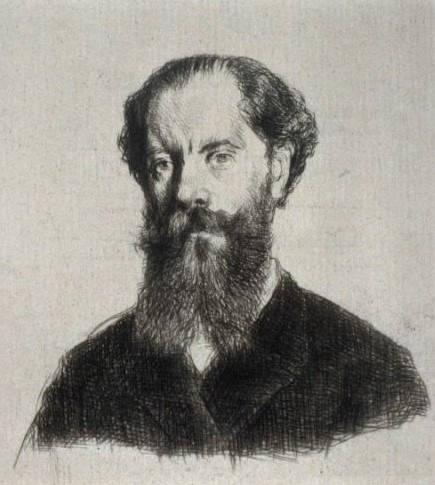
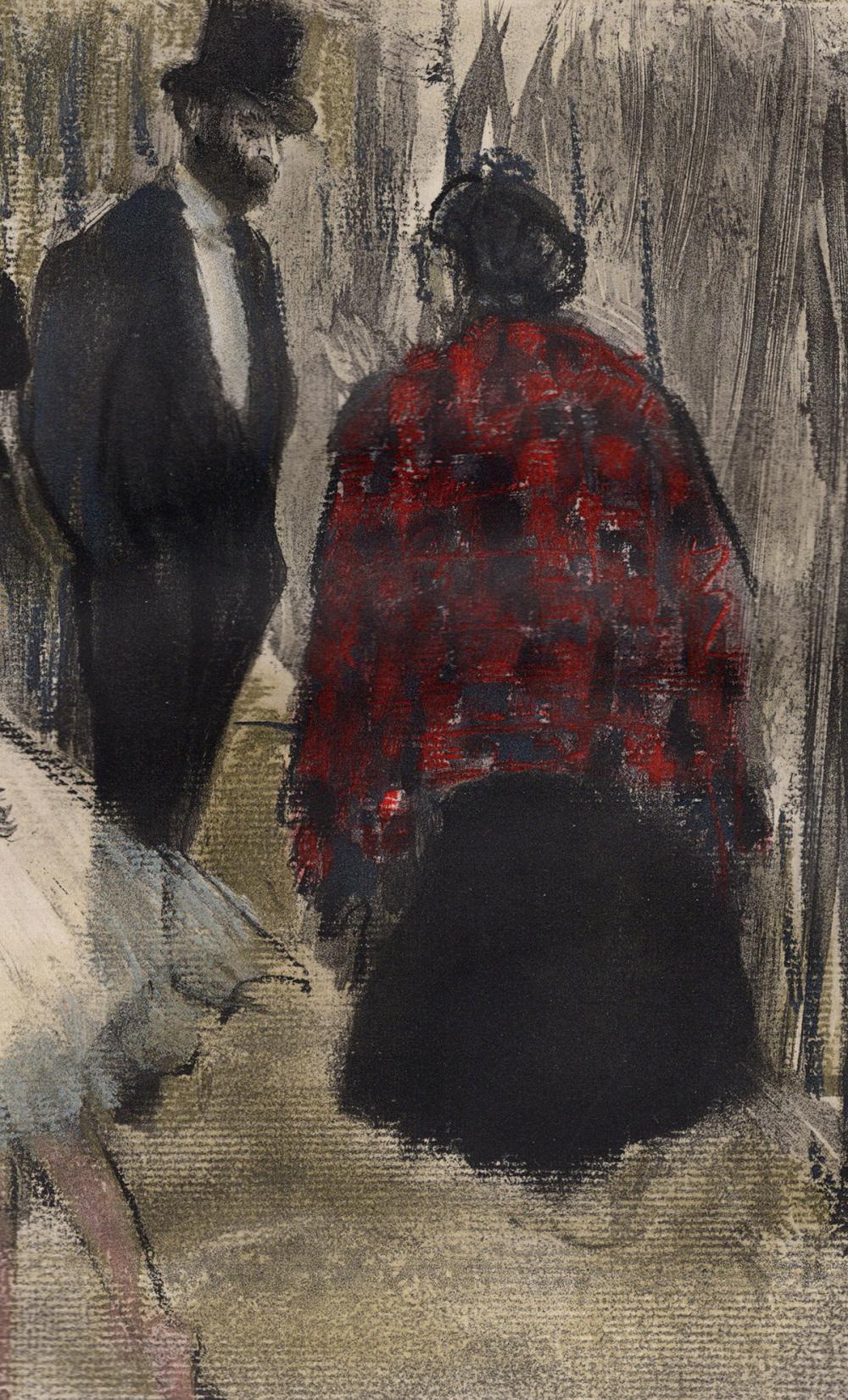
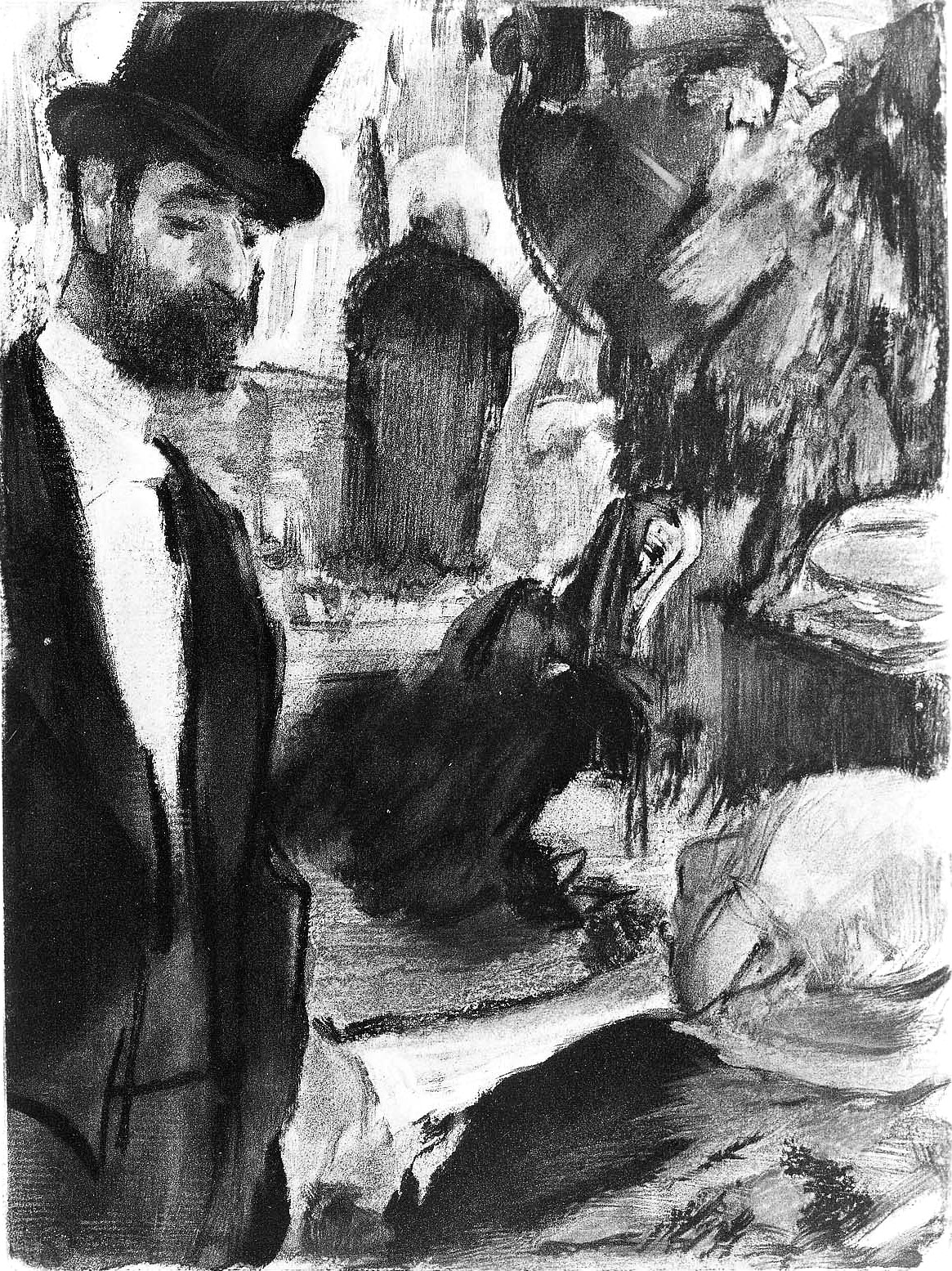
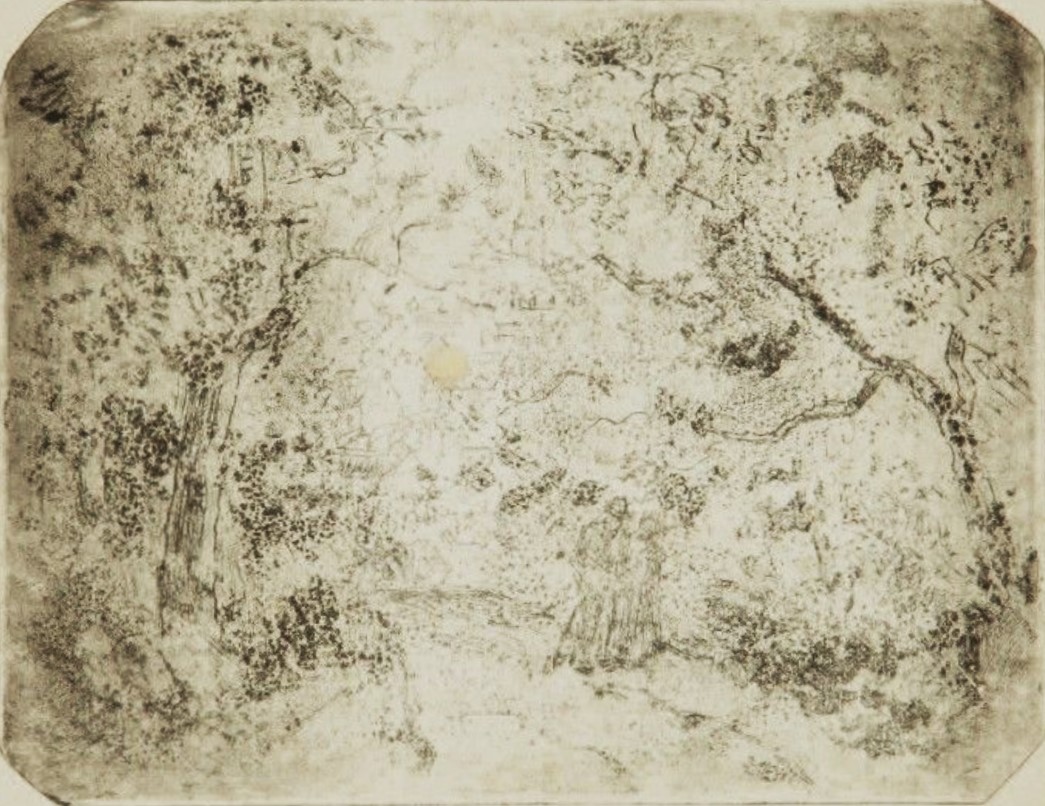
Edgar Degas: 18xx, Portrait du graveur Desboutin et du graveur Lepic, xx, Orsay or MM Nice (iR10;iR155;iR127;R88;M1;M206)
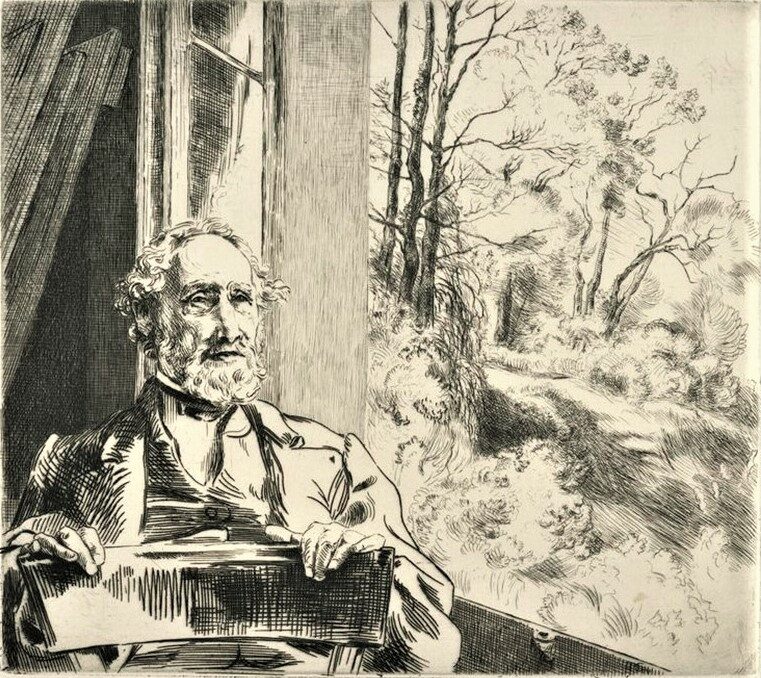
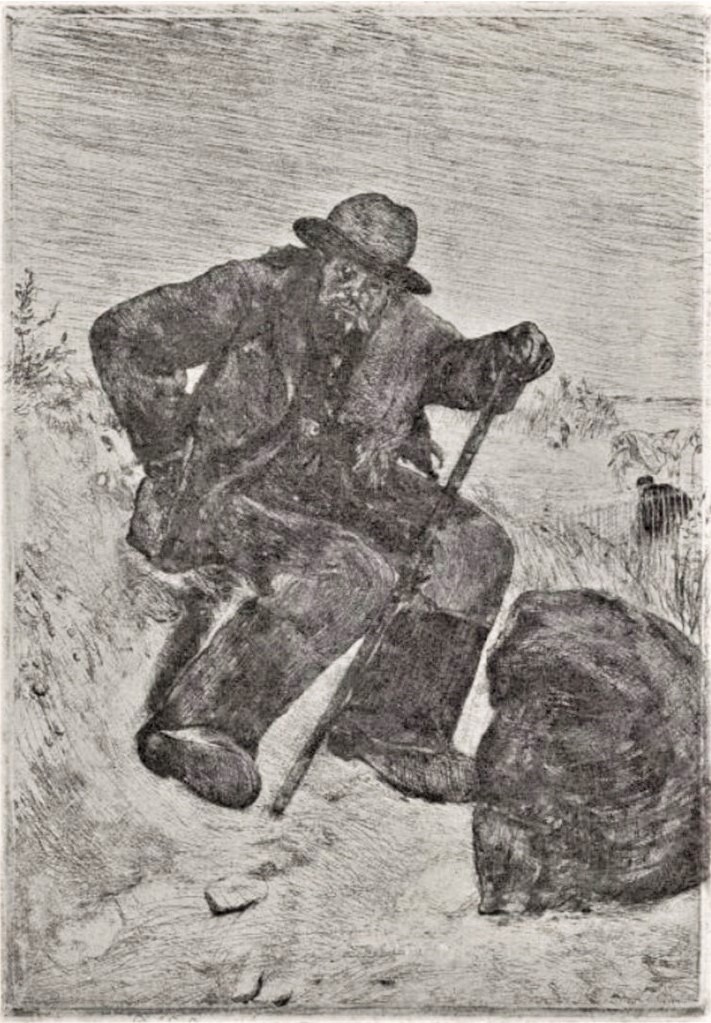
Ferdinand Hodler (1853-1918): 1888ca, The engraver (Desboutin; detail), 41×32, A2016/12/05 (iR15)
Which engravings were shown at the ‘impressionist’ expositions? At the 8 ‘impressionist’ expositions held from 1874-1886 in Paris there were about 209 engravings exhibited, about 10% of the total amount of about 2053 exhibited art-works. In total they were indicated by just 60 catalogue numbers. But in reality many catalogue numbers contained several engravings. Most engravings were shown by Félix Bracquemond, namely 61. Per year the amount of exhibited engravings varied very much.
At several expositions Degas showed monotypes. Often he reworked them with pastel, than I render them on the page with mixed techniques. Lepic also made monotypes. Lucien Pissarro also made woodcuts, which he exhibited in 1886. Mostly the engravings were done on a copper plate. More info on the techniques of engraving you will find lower at this page. More below you will find an overview of the number of engravings exhibited and an account per year.
Note: If you double click on the first picture and then click on full screen, you can create a slideshow. On a smartphone or laptop you can also zoom in. Enjoy!
Félix Bracquemond: 1IE-1874-24-1, Portrait de M. Robert = 1873, SDbl, B94-4, Portrait of Louis Robert, administrateur de Sèvres, etch, 34×24, Metropolitan (iR6;iR284;R2,p119;R90II,p15;R85III,no94;M23) =!? SNBA-1907-171-81, Portrait de Louis Robert, adminstrateur de la Manufacture de Sèvres.
Félix Bracquemond: 1IE-1874-24-2, Portrait de M. Meyer Heine = 1872, B80-2, Meyer-Heine, chef émailleur de la manufacture de Sèvres, etch, 35×26, New York PL (iR61;R2,p119;R90II,p15+3;R85III,no80;R2,p119)
Félix Bracquemond: 1IE-1874-24-3, Portrait de M. Hoschedé =1871, B63-2, Hoschedé, d’après nature, etch 2of2, 30×20, New York PL (iR61;iR10;iR284;R90II,p15;R2,p119;R85III,no63) =SNBA-1907-171-91b.
Félix Bracquemond: 1IE-1874-24-4, Portrait de M Edwards = 1872, B38, Edwin Edwards, etch, 16×15, BNF Paris (iR6;iR284;R73,p45;R2,p119;R90II,p15;R85III,no38) =!? SNBA-1907-93c.
Félix Bracquemond: 1IE-1874-24-5, Portrait de M Aug Comte =!? 1851, B22, Portrait of Auguste Comte, founder of the religion of humanity (1798-1857), etch, 19×14, New York PL (iR10;iR19;R52,p138-9;R85III,no22;R90II,p16+3;R2,p19) =SNBA-1907-171-85
Félix Bracquemond: 1IE-1874-24-6, Portrait de M. Ch. Kean = 1871, B66, Charles Kean, etch, 23×17, in Gazette des Beaux-Arts (1884) + L’Artiste (1891/04) (iR6;iR48;iR284;R2,p119;R90II,p16;R85III,no66) =!? SNBA-1907-171, 94a, Portrait de Charles Keen.
Félix Bracquemond: 1IE-1874-24-7, Portrait de M A Legros. Option 2: 1861, B73-1, Alphonse Legros, etch, 32×22, NSW Sydney (iR61;iR6;iR10;R85,no73;R90II,p16;R2,p119;R85III,no73;M121)
Félix Bracquemond: 1853, B77, Charles Meryon, graveur, etch, 20×15, BNF Paris (iR61;iR1;iR26;R52,p35;R2,p119;R90II,p16;R85III,no77) Option 1 for: 1IE-1874-24-8, Portrait de M Meryon; EU-C-1889-VII-60, Portrait de Méryon, d’après nature, eau-forte.
Félix Bracquemond: 1857, B49, Théophile Gautier (after Nadar), etch, 16×12, BM London (iR6;iR61;iR1;R52,p171;R2,p119;R90II,p16;R87,p231;R85III,no49;M147) =S1859-3529, Portrait de M. Th. Gauthier; eau-forte; =1IE-1874-24-9, portrait de Th. Gautier; =SNBA-1907-171-90.
Félix Bracquemond: 1IE-1874-24-10, Portrait de M. Th. Gautier (le Tombeau) =1873, B50, Le tombeau de Théophile Gautier, etch 4of4, 35×26, New York PL (iR61;iR10;R85III,no50;R90II,p16+4;R2,p119)
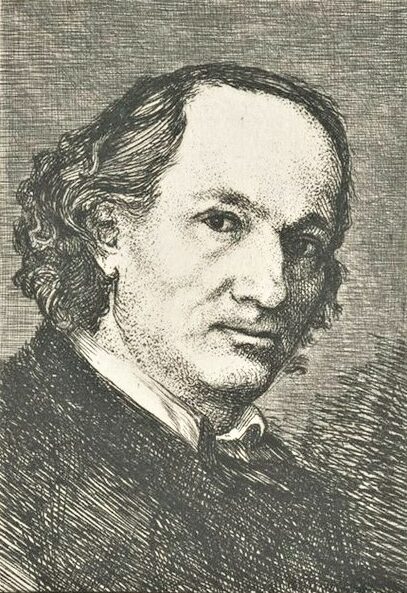
Félix Bracquemond: 1IE-1874-24-11, Portrait de M Baudelaire =!? 1861, B10, Charles Baudelaire (after his own drawing), etch, 35×26, New York PL (iR61;R87,p232;R2,p119;R90II,p17+4;R85III,no10)
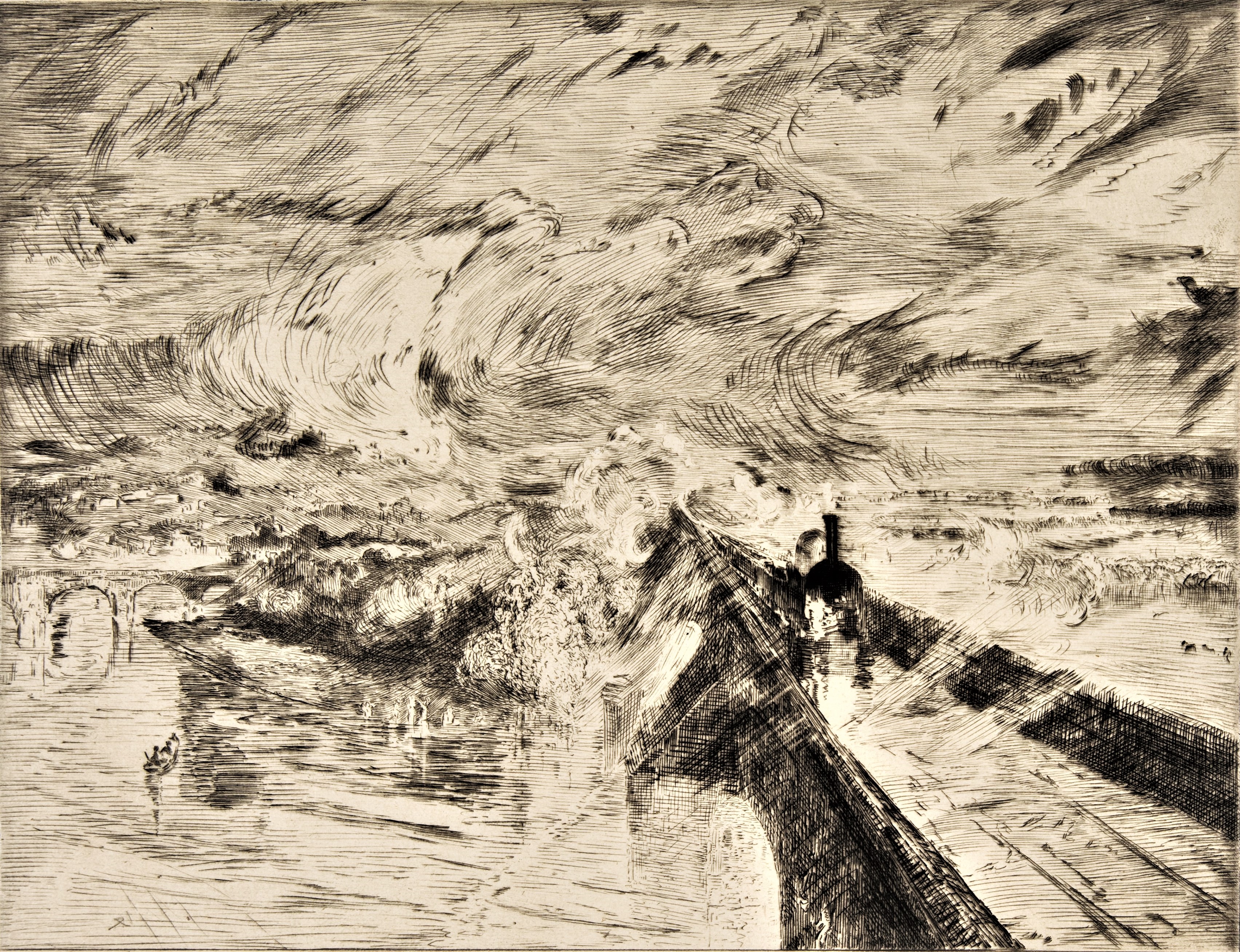
Félix Bracquemond: 1IE-1874-25-1, La Locomotive = 1873, B336, Rain steam and speed (after Turner), etch, 22×26, Metropolitan (iR6;iR19;R2,p119;R90II,p17;R85III,no336;M23) =? SNBA-1907-171-111, Étude d’après un tableau de Turner “La Locomotive”, appartient à M. Jacquin
Félix Bracquemond: 1IE-1874-25-2, Le Lièvre = 1872, B277, The Hare a Misty Morning (after A. de Balleroy), etch, 16×25, BNF Paris (iR10;iR19;R73,p39;R2,p119;R90II,p17;R85III,no277) = SNBA-1907-171-113, Le lièvre, d’après Balleroy, (appartient à M. Jacquin).
Félix Bracquemond: 1IE-1874-25-3, Le Divan = 1863, B279, Young woman reclining, in Spanish costume (as a transvestite) (after Manet), etch, 30×42, New York PL (iR61;iR10;iR284;R88;R2,p119;R90II,p17;R87,p232;R85III,no279) =!? SNBA-1907-171-109, Jeune femme en costume espagnol, d’après Manet.
Félix Bracquemond: 1IE-1874-25-4 Le Tournoi, d’après Rubens = 1862-64, B274, A tournament (after Rubens), etch, 34×44, BM London (iR10;iR105;iR1;iR19;R2,p119;R90II,p17;R85III,no274;M147) =SdR-1863-658, Le tournoi d’après Rubens (eau-forte); S1864-2850, Le Tournoi, d’après le tableau de Rubens, du Musée du Louvre; eau-forte; =!? SNBA-1907-171-114, Un Tournoi, d’après Rubens.
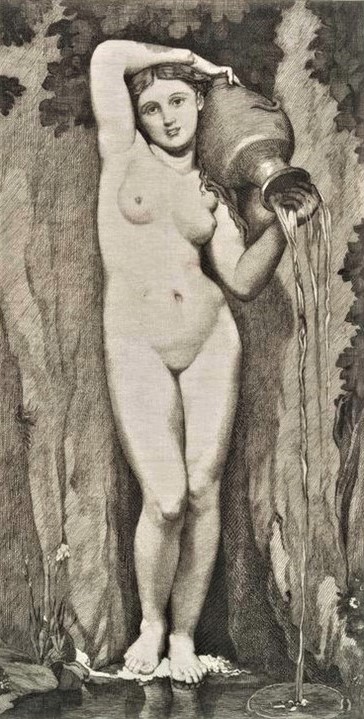
Félix Bracquemond: 1IE-1874-25-5, La Source, d’après Ingres = 1849-70ca, B275, The source (after Ingres), etch, 31×35, NYPL (iR61;iR19;R2,p119;R90II,p18;R85III,no275) =!? SNBA-1907-171-105, La Source, d’après Ingres, appartient à M. Ch. Jacquin.
Félix Bracquemond: 1IE-1874-25-6, La Servante, d’après Leys =? 1868, B280-4-1, The servant (after Leys), etch, 25×15, BM London (iR10;iR61;iR19;R2,p119;R85III,no280;M147) =SNBA-1907-171-110, La Servante, d’après Leys.
Félix Bracquemond: 1IE-1874-26-1, Les Saules =!? 1852-82, B190, The willows of Mottiaux, etch 2of3, 20×30, New York PL (iR61=aR1;R90II,p18+4;R2,p119;R85III,no190)
Félix Bracquemond: 1IE-1874-26-2, Les arbres de la manufacture à Sèvres =!? 1873, B209, Étude de paysage (Study of a landscape), etch 2of3, 14×32, New York PL (iR61;iR10;R73,p46;R90II,p18+4;R2,p119;R85III,no209)
Félix Bracquemond: 1853, B131, Deux gros troncs de charme devant un mur (Two large hornbeam trunks in front of a wall), etch, 34×45, New York PL (iR61;iR10;iR6;R85III,no131;R52,p50;R2,p119) =?? 1IE-1874-26-3, Les Charmes.
Félix Bracquemond: 1IE-1874-26-4, Les Bouleaux =!? 18xx, B170, Les Bouleaux (Birch trees), etch, 21×15, New York PL (R90II,p18+4;R185III,no170;R2,p119)
Félix Bracquemond: 1IE-1874-26-5, La Montée de Bellevue =!? 1873, B210, Le chemin de Bellevue et deux maisons de la rue Brongniar, à Sèvres (The Bellevue road and two houses in the rue Brongniar, in Sèvres), etch, 10×32, Virginia MFA Richmond (iR10;R2,p119;R90II,p18+4;R2,p119;R85III,no210;M220)
Félix Bracquemond: 1IE-1874-26-6, Le Mur = 1868, CR183, La Seine près de Passy, etch ps, 24×31, New York PL (iR61;R73,p43;R2,p119;R90II,p19+4;R85III,no183)
Félix Bracquemond: 1IE-1874-26-7, Les Bachots = 1858ca, B161, Bachots au bord de la Seine (Boats on the banks of the Seine), drypoint etch, 25×35, BNF Paris (iR61;R52,p73;R73,p37;R2,p119;R90II,p18)
Félix Bracquemond: 1IE-1874-27-1, Le Chemin du parc = 18xx, B208, The road in the parc, etch, 22×23, BNF Paris (R90II,p19+5;R85III,no208;R2,p119)
Félix Bracquemond: 1IE-1874-27-2, Frontispice pour les ‘Fleurs du mal’ = 1857, B378-1, frontispiece for Baudelaire’s Les Fleurs du Mal, etch, xx, BNF Paris (R87,p231;iR6;R73,p37;R90II,p19;R2,p119;R85III,no378)
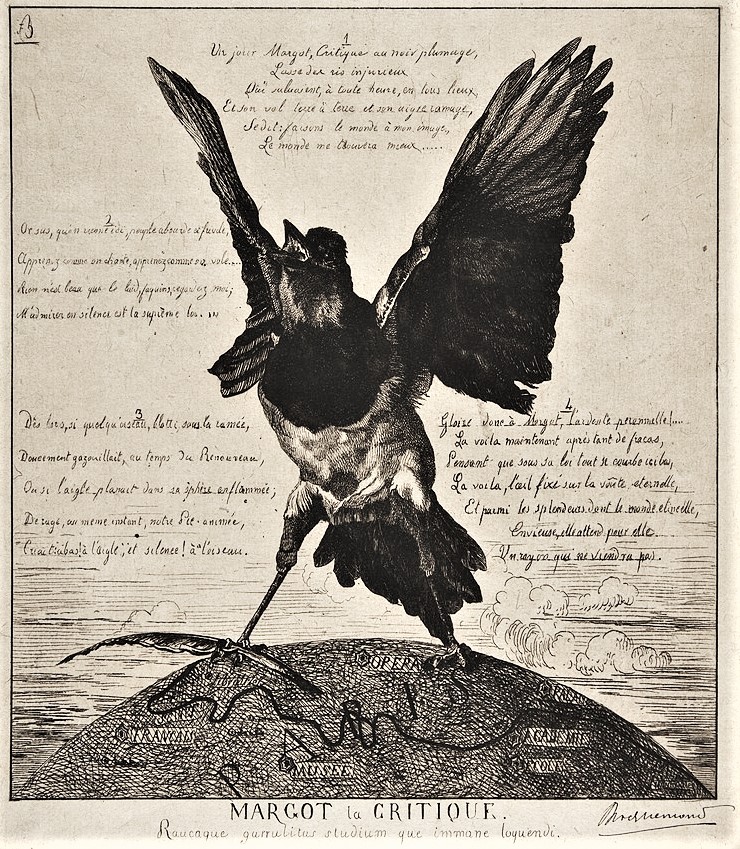
Félix Bracquemond: 1IE-1874-27-3, Margot la critique = 1854, B113, Margot la Critique, etch 1/3, 22×19, Metropolitan (iR6;iR10;iR1;R52,p86-8;R2,p119;R90II,p19;R85III,no113;M23) =EU-1855-4602, Margot la critique; eau-forte; =Lyon-1863-87; =EU-C-1889-VII-64, Margot la critique, eau-forte originale; =SNBA-1907-171-145a, Margot le critique.
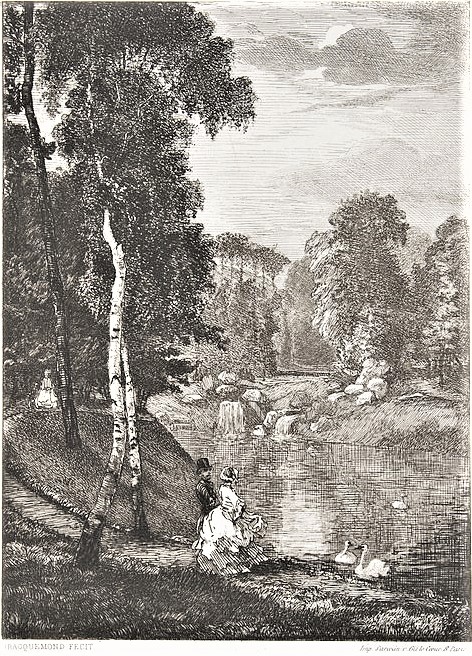
Félix Bracquemond: 1857, B158, Le Bois de Boulogne (les cascades), etch, 16×12 or 55×35, Metropolitan (iR6;iR19;R52,p65;R90II,p19+5;R2,p119;R85III,no158;M23) =!? 1IE-1874-27-4, Bois de Boulogne; SNBA-1907-171-120, Le Rond des chênes, Bois de Boulogne.
Félix Bracquemond: 1IE-1874-27-5, La mort de matamore (Capitaine Fracasse) = 1852-82, B177, The death of Matamore (topic taken from Capitaine Fracasse), etch, 16×23, BNF Paris (iR61;iR26;R2,p119;R90II,p20)
Félix Bracquemond: 1IE-1874-28-1, Portrait d’Erasme (d’après Holbein; premier état) =1863, B39-1, Didier Erasme, etch 1of10, 25×20, New York PL (iR61;iR10;iR48;iR42;iR284;R85III,no39;R2,p119) = SNBA-1907-171-96a, Erasme d’après Holbein; 1er état (iR284).
Giuseppe de Nittis: 1873, B2, The Dancer Holoke-Go-Zen, etch 1/4, 16×19 (22×29), AI Chicago (M20;M26;iR10;iR11;iR23;R85X,no2;R410,p275;aR17=iR437;R2,p122) =? 1IE-1874-118-1, études de femme
Giuseppe de Nittis: 1873, B1, SDbl, Jeune femme assise sur un canapé (femme couchée sur un fauteil, profil à droite), etch 2/4, 22×29, Orsay -> Louvre (HW;iR10;iR127;R85X,no1;R410,p110+275;R2,p122;R422,fig4;M1;M5) former Degas collection; =? 1IE-1874-118-2, études de femme
Giuseppe de Nittis: 1873, B2, SDbl, La danseuse Holoke-Go-Zen, etch 3?/4, 21×28 (26×31), Baltimore MA (M24;iR10;iR11;iR23;R85X,no2;R410,p275;aR17=iR437;R2,p122) =? 1IE-1874-118-3, études de femme
Giuseppe de Nittis: 1873, B2, SDbl, La danseuse Holoke-Go-Zen, etch 4/4, 25×33, MCh Nemours (iR10;iR11;iR23;R85X,no2;R410,p275;aR17=iR437;R2,p122) =? 1IE-1874-118-4, études de femme
Henri Rouart: 1877ca, Sbr, Scene in a park, print in Croquis à L’Eau-Forte 1877, 16×13, NM Warsaw (aR20;M269)
Marcellin Desboutin: 1873, B14=CJ51, La Duchesse Colonna (born d’Affry; 1837-79; surnamed Marcello, sculpteur), etch 2/5, 23×17, BNF Paris (iR40;aR10,no55,R158,no51;R85V,no14;R90I,p71+99;R2,p161;R466,no73;R465,no5) =?? 2IE-1876-69, Portraits et études (gravure à la pointe sec); =!? S1877-4392-9, Portrait de Mme. la duchesse Colonna, gravure à la pointe sèche
Marcellin Desboutin: 1876, B140=CJ193, Mlle Rita Sangalli, danseuse (1850-1909), ps after photo Luckhardt, 12×8, ?? (iR10;aR16;R158,no193;R85V,no140) =?? 2IE-1876-70, Portraits (gravure à la pointe sec)
Marcellin Desboutin: 1876, B134=CJ189, Rosine Bloch (mezzo soprano 1844-91), ps after photo Pierre Petit, 12×8, BNF Paris (iR253;iR10;aR16;R85V,no134;R158,no189+p246;R90I,p71+99;R2,p161) =?? 2IE-1876-70, Portraits (gravure à la pointe sec)
Marcellin Desboutin: 1876, B141=CJ188, Mlle Léotine Beaugrand, ballerina (1842-1925), ps after life, 12×8, ?? (aR16;iR10;R158,no188;R85V,no141) =?? 2IE-1876-70, Portraits (gravure à la pointe sec)
Marcellin Desboutin: 1876, Jules Jacquemart (detail), ps, 14×7 (or 16×12), FAM San Francisco (iR196=M30;iR11;iR105;R90I,p87;R90II,p51+37;R2,p161;R85XIII,no92;R158,no141;aR10,no97) =!? 2IE-1876-71, Portraits (gravure à la pointe sec)
Marcellin Desboutin: 1876, Portrait de Norbert Gœneutte, etch ps, 24×16, Harvard Cambridge (iR6;R90I,p71;R90II,p37+51;R2,p161;R85XIII,no47;aR10,no87;R158,no111;M32) =!? 2IE-1876-71, Portraits (gravure à la pointe sec)
Marcellin Desboutin: 1875, B25=CJ215, Henri Rouart, peintre et collectionneur, etch ps, 27×20, Metropolitan (iR10;M23;R90II,p37+51;R2,p161;R90I,p71;R85V,no25;R158,no215;aR10,no135;R466,no122) =!? S1875-3660-7, Portrait de M. Rouard (sic); =? 2IE-1876-71, Portraits (gravure à la pointe sec)
Marcellin Desboutin: 1875, B63=CJ165, Leroy, imprimeur d’eaux-fortes, etch ps 3rd, 30×21, BNF Paris (iR40;iR10;R85XIII,no63;R158,no165;R90II,p37+51;R2,p161;R90I,p71) =!? 2IE-1876-72, Portraits (gravure à la pointe sec) (le dilettante)
Alphonse Legros, 2IE-1876-81-1, Les baigneuses =!? 1861, CR69, Les baigneuses (the bathers), ps, 34×23, BNF Paris (iR40,btv1b10545519b;iR105;R2,p162;R90II,p37+52)
Alphonse Legros, 2IE-1876-81-2, La procession =!? 1855-65, CR49, Procession dans une église espagnole, etch, 41×68, BNF Paris (iR40,btv1b10545660r;R2,p162;R90II,p37+52)
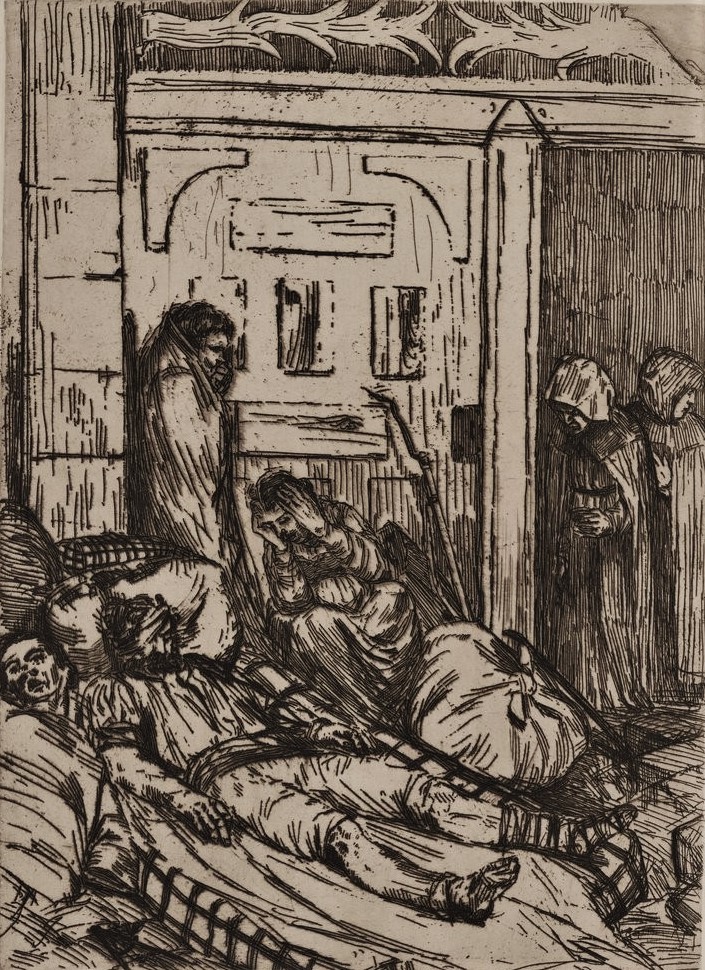
Alphonse Legros, 2IE-1876-81-3, Ambulance =!? 1855-61, CR124, L’ambulance (Scène du coup d’état 1851/12/02), etch, 37×27, BNF Paris (iR40,btv1b525061570;R2,p162;iR105;R2,p162;R90II,p37+52)
Alphonse Legros, 2IE-1876-81-4, Promenade (pointe sèche) =!? 1861ca, CR68, Le Promenade du convalescent, etch ps, 28×20, Cleveland MA (iR19;M27,1945.274;R2,p162;R90II,p37+52)
Alphonse Legros, 2IE-1876-81-5, Tribunal =!? 1874-, CR123, Le Tribunal, etch ps, 21×30, BM London (iR105;M147;iR367;iR282;R2,p162;R90II,p37+52)
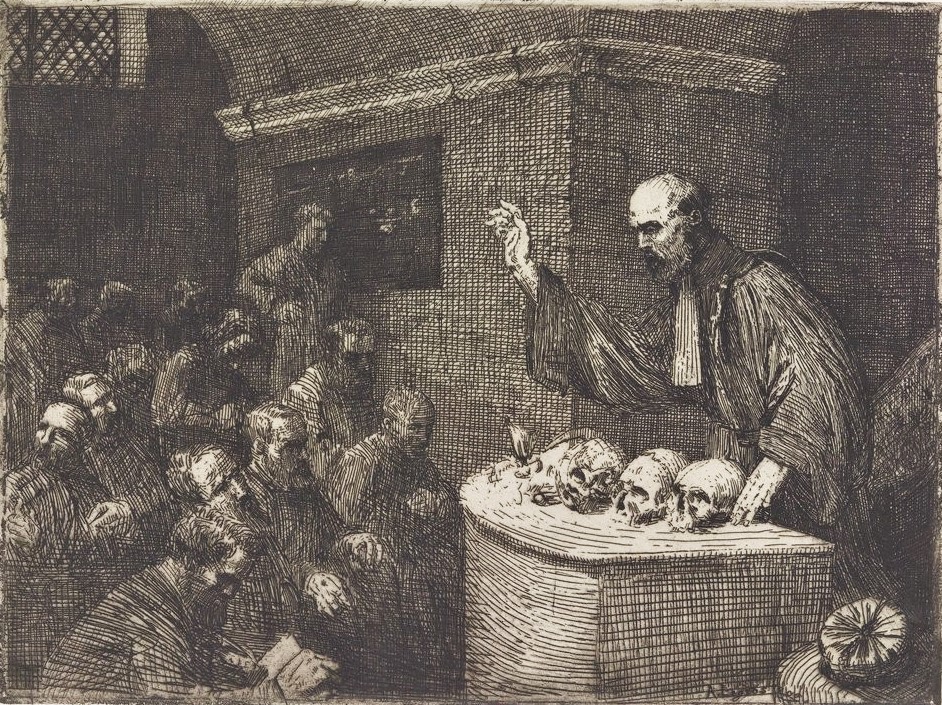
Alphonse Legros, 2IE-1876-81-6, Cours de Médicine =? 1855-65, CR122, Le cours de phrénologie, no.2, etch, 24×32, BNF Paris (iR40,btv1b10545295q;iR105;R2,p162;R90II,p37+52)
Alphonse Legros, 2IE-1876-82, La morte (premier état avant la pointe sèche) =!? 1852-75, CR89, Death of a Vagabond, etch, 55×39, BM London (iR105;M147;iR19;M27;iR40;R2,p162;R90II,p38+53)
Alphonse Legros, 2IE-1876-83-1, Les vagabonds =? 1861, CR71, Les vagabonds de Montrouge (Mendiants aux environs de Paris), etch, 27×37, BNF Paris (iR40,btv1b10545547p;iR105;R2,p162;R90II,p38+53)
Alphonse Legros, 2IE-1876-83-2, La confrérie de la Sainte-Vierge =? 1860, CR50, The choir of a Spanish church, etch, 37×27, BM London (iR105;M147;iR367;iR199;R90II,p38+53;R2,p162). Compare: S1861-3793, Chantres espagnols, gravure
Alphonse Legros, 2IE-1876-83-3, près de la cheminée =!? 1855-61, CR116, Le foyer, etch, 23×16, BNF Paris (iR40,btv1b10545678r;R90II,p38+53;R2,p161)
Alphonse Legros, 2IE-1876-83-4, Paysage (pointe sèche) =? 1852-71, CR103, La ferme au grand arbre, ps, 32×26, BM London (iR105;M147;iR40;R90II,p38+54;R2,p162;aR9,p11) =? S1875-3734, Une eau-forte: La ferme au grand arbre (Appartient à M. P. Malassis)
Alphonse Legros: 2IE-1876-83-5-1, Deux lithographies =!? 1855, CR111, L’expérience d’électricité, litho, 17×29, BNF Paris (iR40,btv1b10545574k;R90II,p38+54;R90I,p71;R2,p162;aR13)
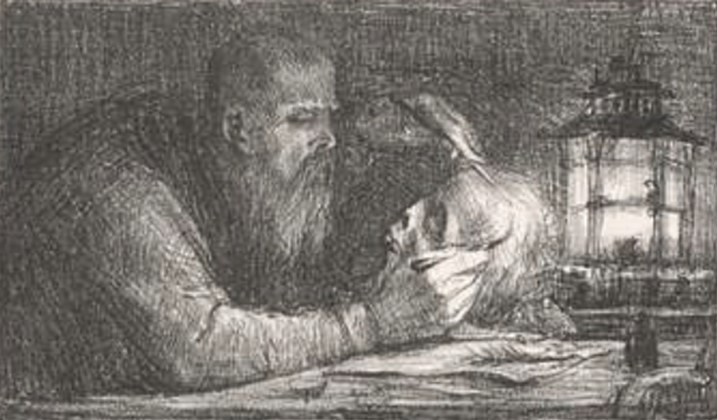
Alphonse Legros: 2IE-1876-83-5-2, Deux lithographies =?? 1877-, CR112, Un anatomiste dissèque une tête humaine, à la lueur d’une lanterne, no.1 of La pièce aux six sujets, litho, 28×24, xx (iR423;aR13=iR40)
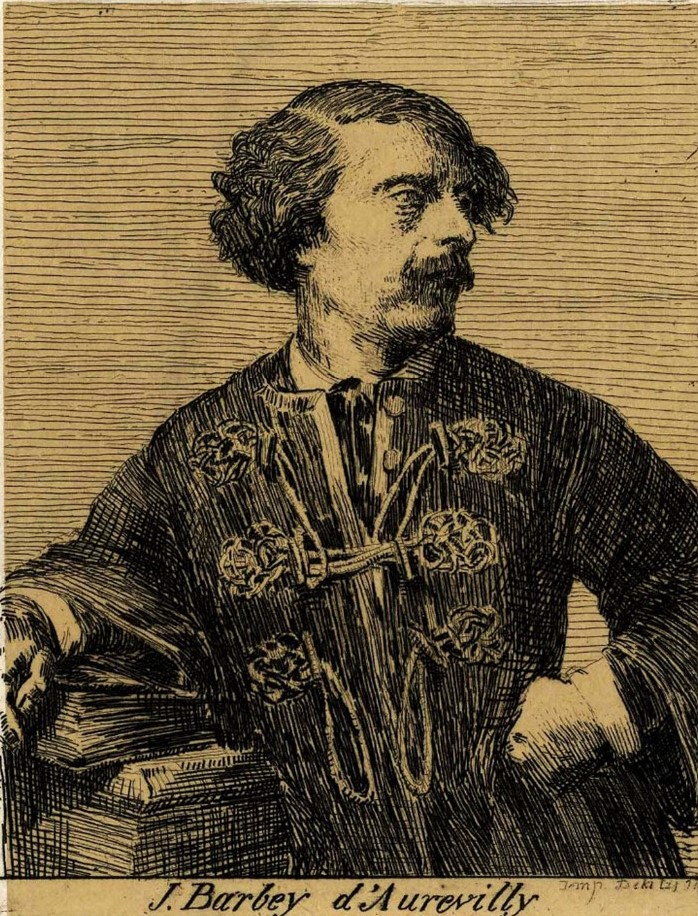
Alphonse Legros, 2IE-1876-83-6, Portrait de M. Barbey d’Aurevilly =!? 1877-, CR10, Portrait de M. J. Barbey d’Aurevilly, etch 2/2, 13×10, BM London (iR105;M147;iR40;R90II,p38+54;R90I,p105;R2,p162)
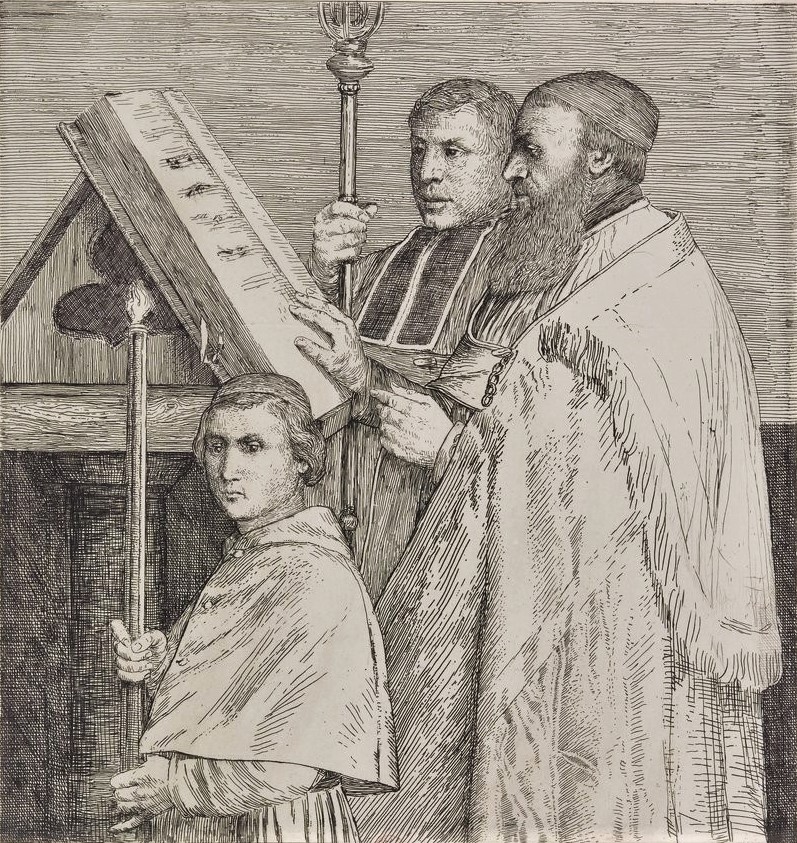
Alphonse Legros, 2IE-1876-84, Lutrin = !? 1852-77, CR62, Le lutrin no.2, etch, 25×24, BNF Paris (iR40,btv1b10545416m;iR105;iR1;R90II,p38+54;R2,p162) Compare: S1863-1155, Le lutrin and: S1868-1525, Un lutrin (Appartient à M. Jonides).
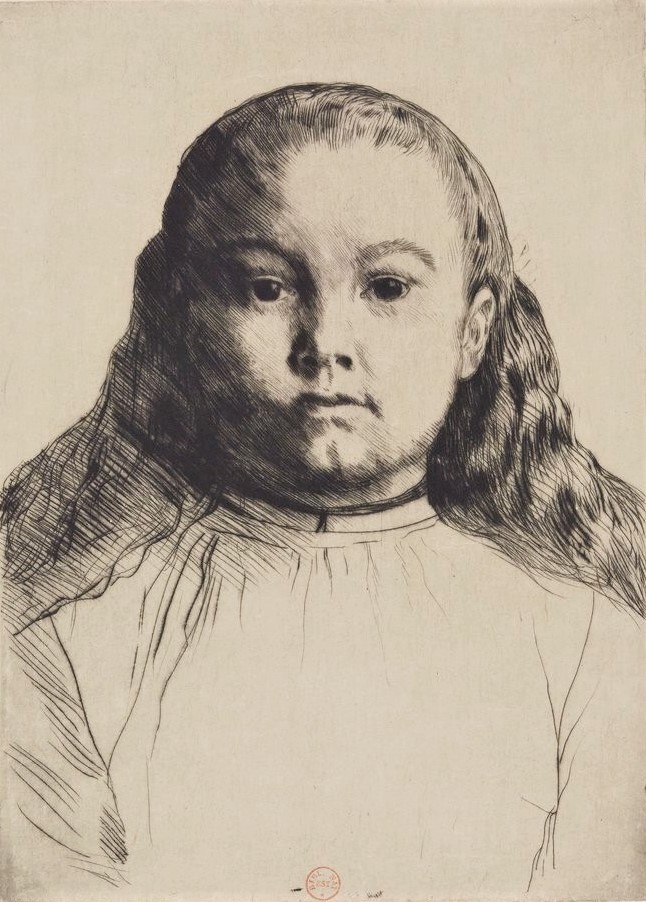
Alphonse Legros: 2IE-1876-85, Portrait de petite fille (pointe sèche) =!? 1875, CR30, La petite Marie (fille de l’artiste), ps, 23×17, BNF Paris (iR40,btv1b105455109;iR105;R2,p162;R90II,p38+54;aR9,p13;R85IX,no30) =!? S1875-3735, Une eau-forte: La petite Marie (Appartient à M. P. Malassis) =!? HD-1897/12/13-132bis-3, Portrait de la petite Marie
Alphonse Legros, 2IE-1876-86, Bonhomme misère. Option 3: 1869, CR140, La mort dans le piorier, etch, 23×15, Cleveland MA (iR19;M27,1921.1416;iR40;iR367;R90II,p38+54;R2,p162)
Alphonse Legros, 2IE-1876-87, Portrait de l’historien Carlysle (premier état). Option 2: 1875-77, CR34, Large Portrait of Thomas Carlyle, etch + aquatint, 44×34, Cleveland MA (iR6;iR40;M27;R90II,p38+55;R2,p162;R89,no21)
Alphonse Legros: 2IE-1876-88-1, Tête de vieillard (pointe sèche) =? 1875-77, CR37, Etude de tête d’homme, de profil, ps, 21×16, BNF Paris (iR40,btv1b10545545s;iR105;R90II,p38+55;R2,p162;aR13,no37)
Alphonse Legros: 2IE-1876-88-2, Femmes de Boulogne =!? 1873, CR80, Peasant woman in the neighbourhood of Boulogne, etch, 23×15, A2022/07/31 (iR17;iR19;M27;iR6;R90II,p39+55;R2,p162;aR13=iR40)
Alphonse Legros, 2IE-1876-89, Grand paysage, coup de vent =!? 1875-77, CR110, Le coup de vent, etch, 57×47, BNF Paris (iR40,btv1b10545317p;iR105;R90II,p38+55;R2,p162;aR9,p14;iR1) Compare: S1875-2482, Le coup de vent (Appartient à M. Malassis) (=drawing; aR9,p11)
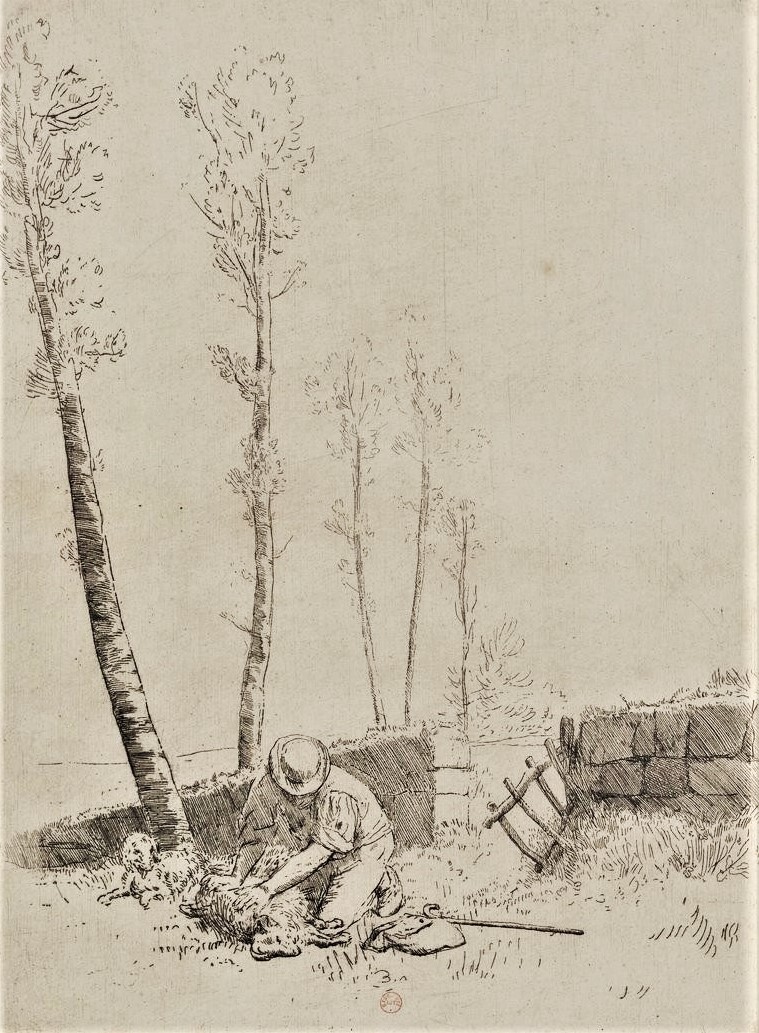
Alphonse Legros, 2IE-1876-90, L’homme au mouton =!? 1855-77, CR86, Le mouton retrouvé, etch, 43×32, BNF Paris (iR40,btv1b10545399w;R90II,p39+55;R2,p162)
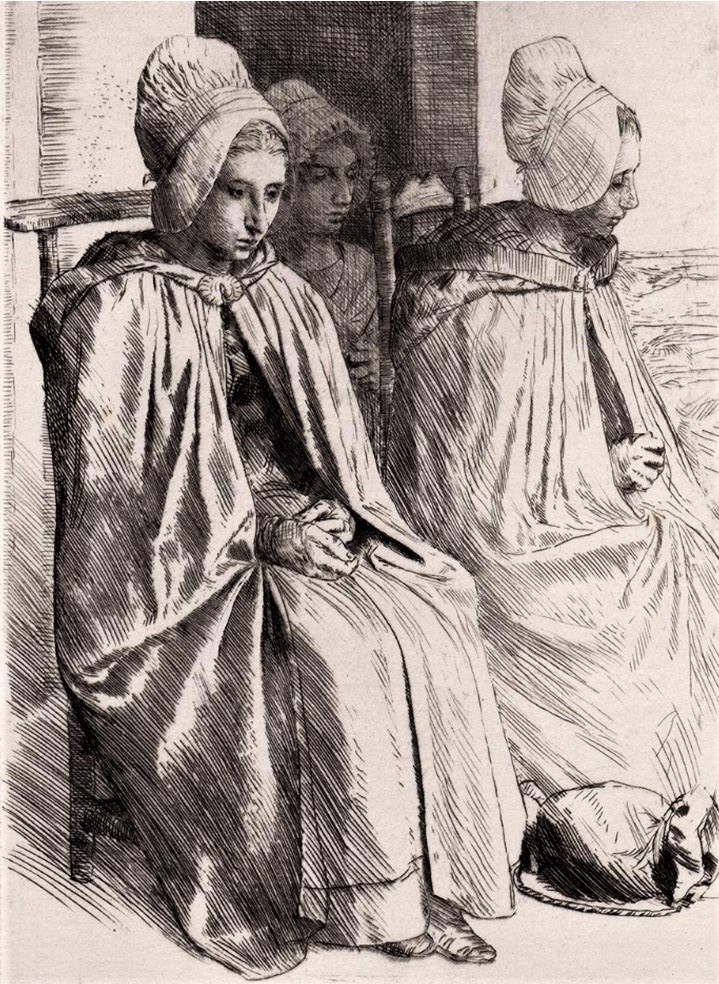
Alphonse Legros, 2IE-1876-91, La communion =!? 1861, CR54, La communion dans l’église Saint-Médard, etch 1st state, 36×27, BNF Paris (iR40,btv1b10545639j;iR105;R90II,p39+55;R2,p126)
Alphonse Legros, 2IE-1876-92, Paysage =? 1870, CR108, Landscape with Strawstacks, etch ps, 20×27, Cleveland MA (iR19;M27,1945.277;iR6;iR40;R90II,p39+92;R2,p162)
Ludovic Lepic: 1870-80, Winter in Holland (daytime), monotype, 32×49, RM Amsterdam (iR6;iR1;R2,p162;R90II,p38;R85IX,p143,no4;M77) Compare: S1870-5260, Neuf gravures à l’eau-forte; même numéro: Vues de Hollande. Compare: 2IE-1876-135, Croquis Hollandais (2 cadres eaux fortes)
Ludovic Lepic: 1870-80, Winter in Holland (sunset), monotype, 32×49, RM Amsterdam (iR6;iR1;R2,p162;R90II,p38;R85IX,p143,no4;M77) Compare: S1870-5260, Neuf gravures à l’eau-forte; même numéro: Vues de Hollande. Compare: 2IE-1876-135, Croquis Hollandais (2 cadres eaux fortes)
Ludovic Lepic: 1876, Sbl, B4, Environs de Dordrecht (L’Illustration nouvelle, Cadart), etch, 16×24, NGA Washington (iR6; iR40,btv1b10315791b; M21;R85IX,p143,no4;M21) Compare: 2IE-1876-135, Croquis Hollandais (2 cadres eaux fortes)
Ludovic Lepic: 1871?, Str, B4, Moonlit landscape with nets in the foreground, hanging from a tree, etch, 40×28, Orsay (iR127;iR1;R90II,p56+40;R2,p162;R85IX,p143,no4;M1;M5) =?? 2IE-1876-136, Canal en Hollande, lever de lune (eau forte).
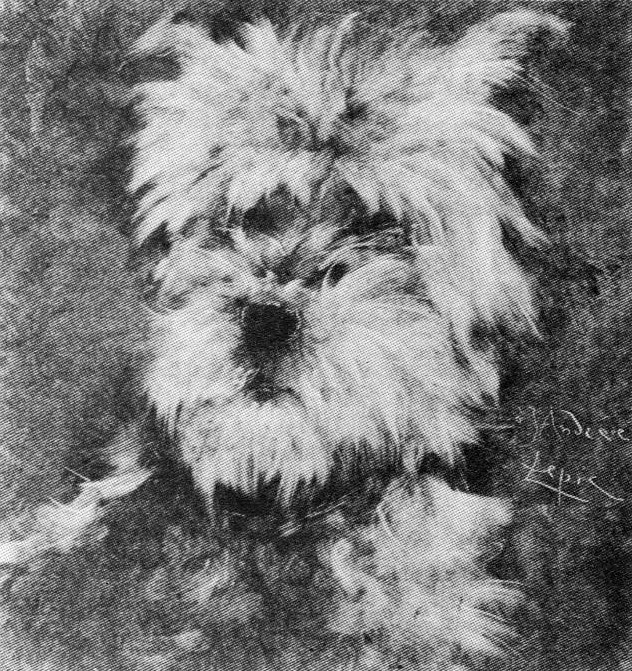
Ludovic Lepic (1839-89): 2IE-1876-137, Tête de chien, épreuve tirée sur plaque sans gravure = 18??, Sbr, Head of a dog (for J. Andrée), monotype, 30×28, Baltimore MA (R90II,p56+40;R2,p162;M24)
Edgar Degas: 3IE-1877-58-1, Dessins faits à l’encre grasse et imprimés =? 1876-77ca, Ludovic Halévy speaking with Madame Cardinal (from Ludovic Halévic: La famille Cardinal), print after pastel on monotype, 27×18, A2023/07/23 (iR17;iR7;iR2;iR15;iR10;aR21;M22;M152;R2,p204;aR21;R90II,p74)
Edgar Degas: 3IE-1877-58-2, Dessins faits à l’encre grasse et imprimés =? 1876-77ca, Ludovic Halévy finds Mme Cardinal in the dressing room (from Ludovic Halévic: La famille Cardinal), print after monotype, 21×16, MFA Boston (M22;M152;aR21;iR10)
Edgar Degas: 3IE-1877-59-1, Dessins faits à l’encre grasse et imprimés =? 1876-77ca, Virginie being admired while the Marquis Cavalcanti looks on (from Ludovic Halévic: La famille Cardinal, p85), monotype + pastel, 16×12, NGA Washington (M21;iR8;iR11;iR10;aR21;R2,p204;R90II,p74)
Edgar Degas: 3IE-1877-59-2, Dessins faits à l’encre grasse et imprimés =? 1876-77ca, Pauline and Virginie Cardinal conversing with admirers (from Ludovic Halévic: La famille Cardinal), monotype, 21×16, Harvard Cambridge (iR10;iR91;iR11;aR21;R2,p204;R90II,p74;M32)
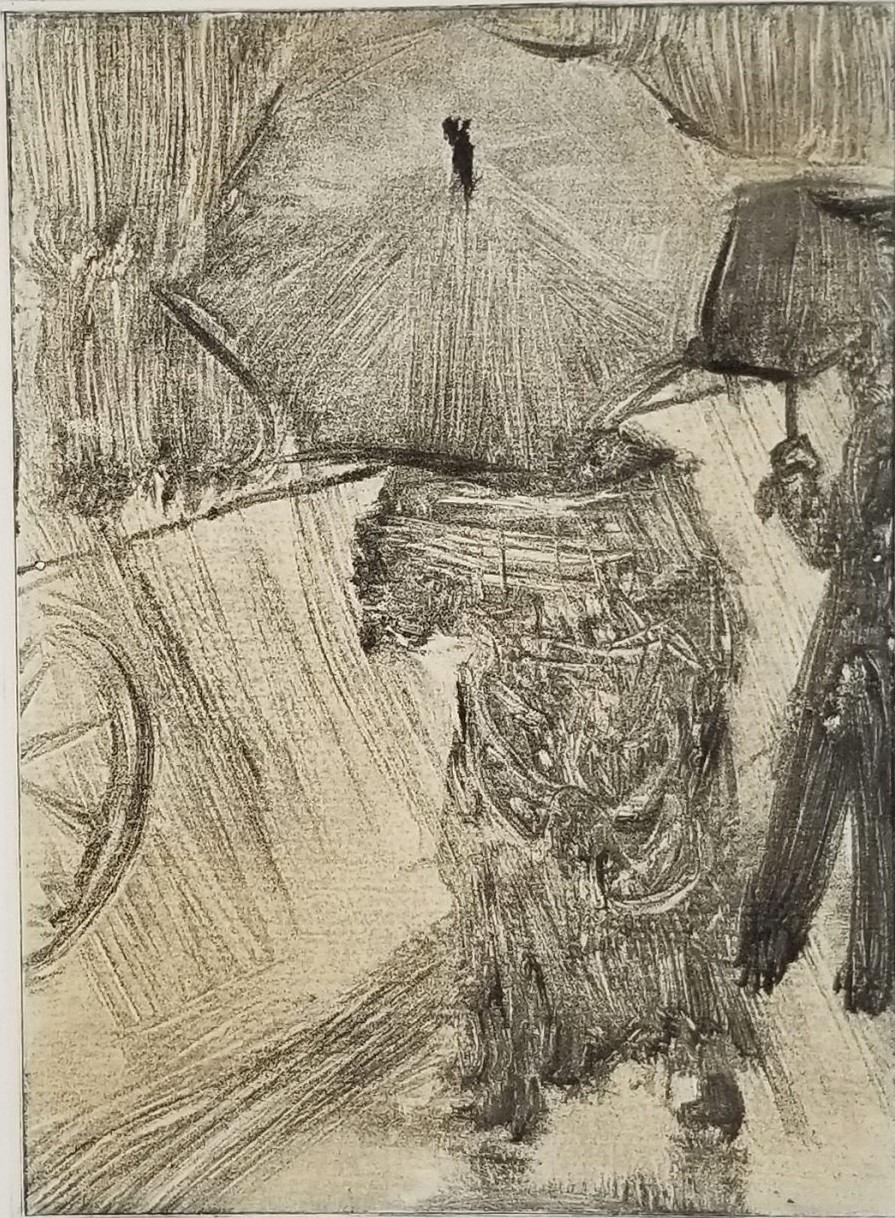
Edgar Degas: 3IE-1877-60-1, Dessins faits à l’encre grasse et imprimés =? 1876-77ca, In the rain (from Ludovic Halévic: La famille Cardinal), print after monotype, 16×11, private (aR21;M22;M152;iR10)
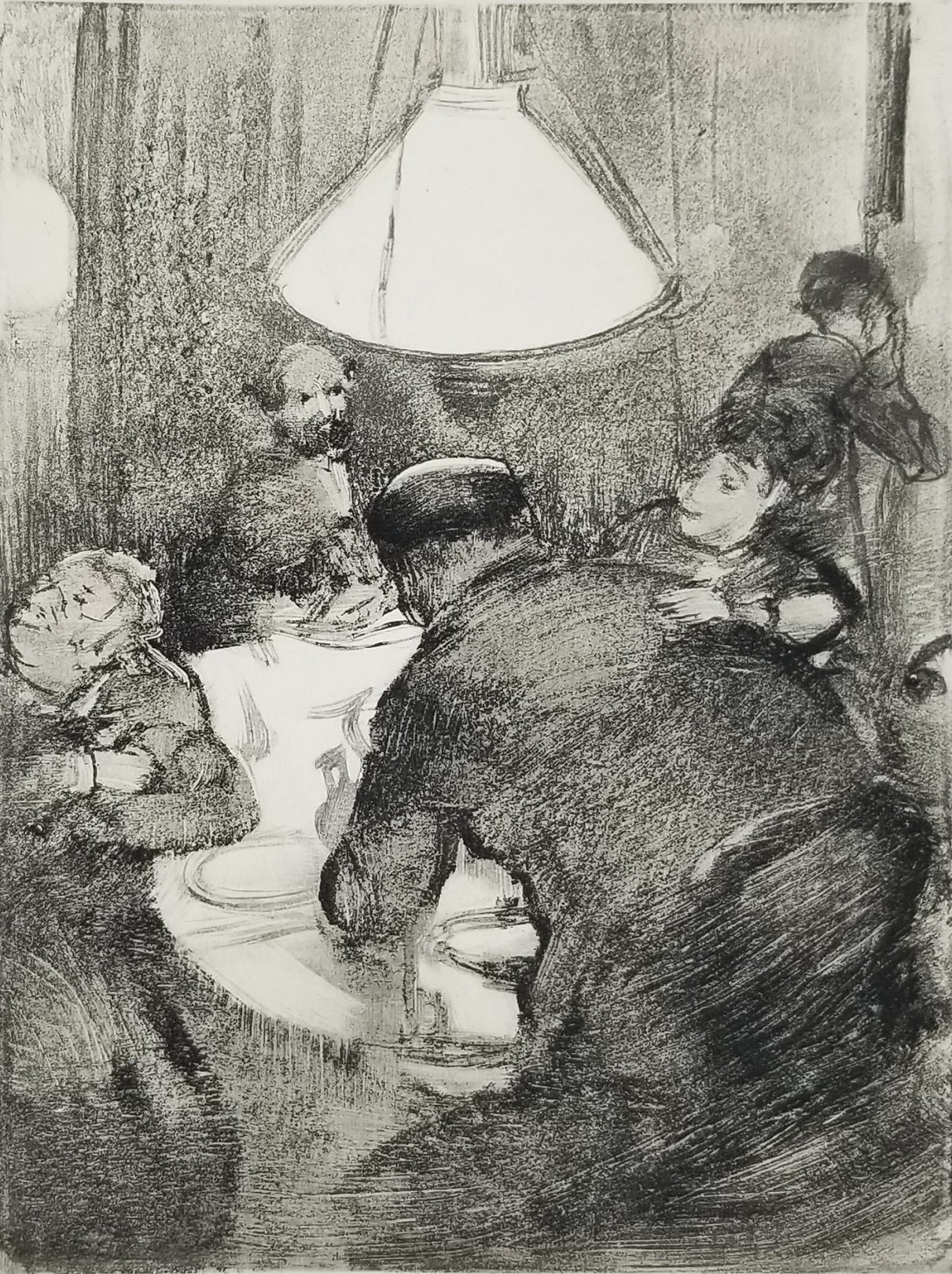
Edgar Degas: 3IE-1877-60-2, Dessins faits à l’encre grasse et imprimés =? 1876-77ca, The famous good friday dinner (from Ludovic Halévic: La famille Cardinal), print after monotype, 21×16, private (aR21;M152;M22;iR10)
Félix Bracquemond: 4IE-1879-3, Au jardin d’acclimatation = 1873, B214, Au Jardin d’Acclimation, etch colour, 21×22, Metropolitan (iR6;iR19;R73,p47;R2,p266;R90II,p121;R85III,no214;M23) =!? SNBA-1907-171-139, Au Jardin d’acclimation (couleur), appartient à M. Jacquin.
Félix Bracquemond: 1882-84, B219, Landscape with approaching thunderstorm and geese in a meadow, etch, 26×35, RM Amsterdam (iR10;iR6;iR19;R73,p49;R90II,p121;R2,p266;R85III,no219;M77) =4IE-1879-4, Une nuée d’orage; =!? SNBA-1907-171-135, La nuée d’orage, appartient à M. Beurdeley.
Félix Bracquemond: 4IE-1879-5, Une terrasse de Sèvres = 1876, B215, Terrace of the Villa Brancas (Marie Bracquemond painting in Sèvres), etch, 23×36, CAI Williamstown (iR6;iR19;R73,p48;R90II,p105+121;R2,p266;R85II,no215;R89,no24;M26) =!? SNBA-1907-171-127, La terrace de la Villa Brancas.
Félix Bracquemond: 4IE-1879-6, Une vue de pont des Saints-Pères) = 1877, B217-3, Vue du Pont des Saints-Pères, etch, 20×25, BNF Paris (iR10;iR19;R73,p48;R90II,p122;R2,p266;R85III,no217) =SNBA-1907-171-130a, Vue du Pont des Saint-Pères.
Henry Somm: 4IE-1879-228, Calendrier de 1878, gravure à la pointe sèche. Compare: 1880, Beraldi 19, Calendrier pour 1881, ps, 38×28, A2016/05/20 (iR241;iR10;iR11;R2,p270;R85XII,no19)
Henry Somm: 4IE-1879-229, Calendrier de 1879, gravure à la pointe sèche =1878, Beraldi 18, Calendar for 1879, etch ps, 31×39, Cabinette des Estampes Paris (iR40;R2,p251;R90II,p141+119;iR26;iR10;R85XII,no.18)
Félix Bracquemond, 5IE-1880-5, Eaux-fortes pour décoration… Probably: 1866, B530, Rousseau no.1, Pheasant and reed, etch, 27×42, BNF Paris (iR40)
Félix Bracquemond, 5IE-1880-5, Eaux-fortes pour décoration… Probably: 1866, B531, Rousseau no.2 (or 5), Large flowers, butterfly, snail, etch, 43×27, BNF Paris (iR40)
Félix Bracquemond, 5IE-1880-5, Eaux-fortes pour décoration… Probably: 1866, B532, Rousseau no.3, Fish, flowers, butterfly, etch, 27×42, BNF Paris (iR40)
Félix Bracquemond, 5IE-1880-5, Eaux-fortes pour décoration… Probably: 1866, B533, Rousseau no.4, Water plants, butterfly, etch, 27×42, BNF Paris (iR40;R73,p13)
Félix Bracquemond, 5IE-1880-5, Eaux-fortes pour décoration… Probably: 1866, B534, Rousseau no.5 (or 2), Large rooster, hen, insects, lizard, plants, etch, 27×43, BNF Paris (iR40)
Félix Bracquemond, 5IE-1880-5, Eaux-fortes pour décoration… Probably: 1866, B535, Rousseau no.6, Large duck, cricket, crab, plants, etch, 27×42, BNF Paris (iR40)
Félix Bracquemond, 5IE-1880-5, Eaux-fortes pour décoration… Probably: 1866, B536, Rousseau no.7, Ducks and water leaves, etch, 28×42, BNF Paris (iR40)
Félix Bracquemond, 5IE-1880-5, Eaux-fortes pour décoration… Probably: 1866, B537, Rousseau no.8, Swallow, rooster, flowers, etch, 28×42, BNF Paris (iR40)
Félix Bracquemond, 5IE-1880-5, Eaux-fortes pour décoration… Probably: 1866, B538, Rousseau no.9, Rooster, pheasant, stingray, plants, etch, 28×43, BNF Paris (iR40;R73,p13)
Félix Bracquemond, 5IE-1880-5, Eaux-fortes pour décoration… Probably: 1866, B539, Rousseau no.10, Lobster, plants, birds and fishes, etch, 43×28, BNF Paris (iR40)
Félix Bracquemond, 5IE-1880-5, Eaux-fortes pour décoration… Probably: 1866, B540, Rousseau no.11, Duck with extended wings, quails, butterfly, dragonfly, snail, grasshopper, flowers, etch, 42×28, BNF Paris (iR40)
Félix Bracquemond, 5IE-1880-5, Eaux-fortes pour décoration… Probably: 1866, B541, Rousseau no.12, Ducks, cocks, fish, etch, 28×43, BNF Paris (iR40;R73,p13)
Félix Bracquemond, 5IE-1880-5, Eaux-fortes pour décoration… Probably: 1866, B547, Rousseau no.18, Pheasant, cock, sparrow, etch, 25×34, BNF Paris (iR40)
Félix Bracquemond, 5IE-1880-5, Eaux-fortes pour décoration… Probably: 1866, B548, Rousseau no.19, Big fish (carp), etch, 25×35, BNF Paris (iR41;R73,p40)
Félix Bracquemond, 5IE-1880-5, Eaux-fortes pour décoration… Probably: 1866, B549, Rousseau no.20, Roosters, ducks, goose, pheasant, etch, 25×35, BNF Paris (iR40)
Félix Bracquemond, 5IE-1880-5, Eaux-fortes pour décoration… Probably: 1866, B550, Rousseau no.21, Lobster, etch, 25×35, BNF Paris (iR61;iR40)
Félix Bracquemond, 5IE-1880-5, Eaux-fortes pour décoration… Probably: 1866, B551, Rousseau no.22 (or 15), flowers and insects, etch, 25×35, BNF Paris (iR40;R73,p40)
Félix Bracquemond, 5IE-1880-5, Eaux-fortes pour décoration… Probably: 1866, B552, Rousseau no.23, flowers and insects, etch, 25×35, BNF Paris (iR40)
Félix Bracquemond, 5IE-1880-5, Eaux-fortes pour décoration… Probably: 1866, B553, Rousseau no.24, Fish, crab, shrimp, shellfish, etch, 35×25, BNF Paris (iR40)
Félix Bracquemond, 5IE-1880-5, Eaux-fortes pour décoration… Probably: 1866, B554, Rousseau no.25, Rooster, bindweed, etch, 25×34, BNF Paris (iR40)
Mary Cassatt, 5IE-1880-25-1, Femme au théâtre, premier état. Compare: 1879-80, CR22, In the Opera Box (no.3), etch 2nd, 21×19, private (R84,p238;iR59;R90II,p147+161;R188,no22;R2,p311). Compare: 4IE-1879-49.
Mary Cassatt: 5IE-1880-25-2, Femme au théâtre, dernier état =!? 1879-80, CR22, In the Opera Box (no.3), etch 4th, 21×19, Metropolitan (R84,p238;iR59;R90II,p147+161;R188,no22;R2,p311). Compare: 4IE-1879-49.
Mary Cassatt: 1883ca, Child seated on a sofa, dr, 22×15, NGA Washington (iR155;iR10;iR373;R2,p311;M21) Compare: 5IE-1880-27-1, Portrait d’enfant, eau forte
Mary Cassatt: 5IE-1880-27-2, Portrait d’enfant, Eau forte, second etat =1883, B49, Mlle Luquet seated on a couch, soft ground etching and aquatint 2of2, 22×14, New York PL (R188,no49;iR6;iR61;iR10;R90II,p147+162;R2,p311)
Mary Cassatt, 5IE-1880-28, Enfant en chapeau, eau-forte =1883, CR48, Mlle Luguet in Coat and Hat, etch, 22×13 (or19), NYPL (R188,no48;iR61;iR10;iR48;R90II,p162;R2,p311). Also exhibited at Durand-Ruel in 1893, no.74.
Mary Cassatt, 5IE-1880-29, Au coin de feu, eau-forte Option 2: 1883, CR65, Before the fireplace (no.2), etch, 16×21, NYPL (R188,no65;R90II,p147+162;R2,p311)
Mary Cassatt, 5IE-1880-30, Homme lisant, eau forte =1883, CR74, Mr. Cassatt reading, etch, 16×12, private (R188,no74;R90II,p147+162;R2,p311)
Mary Cassatt, 5IE-1880-31, Le Soir, eau forte Probably: 1882ca, CR71, Under the lamp, etch, 19×22, A2010/10/26 + NYPL (R188,no71;iR11;iR61;R90II,p147+162;R2,p311)
Mary Cassatt, 5IE-1880-32, Portrait de femme, eau-forte Perhaps: 1879, CR5, The Umbrella, etch, 27×18, Philadelphia MA (R188,no5;R90II,p147;R2,p311)
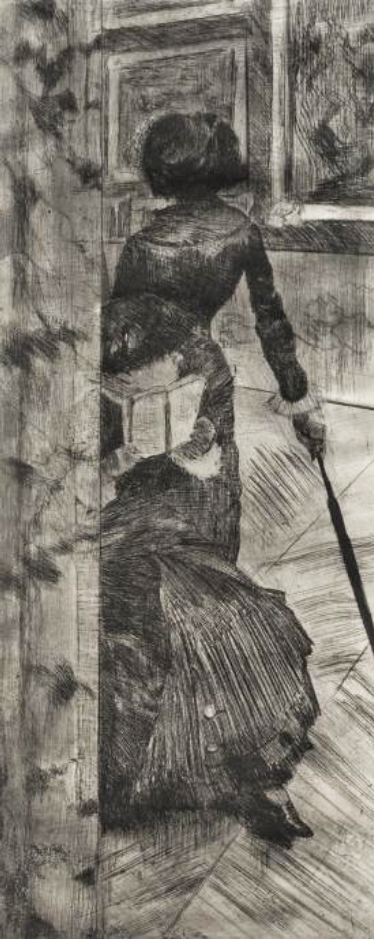
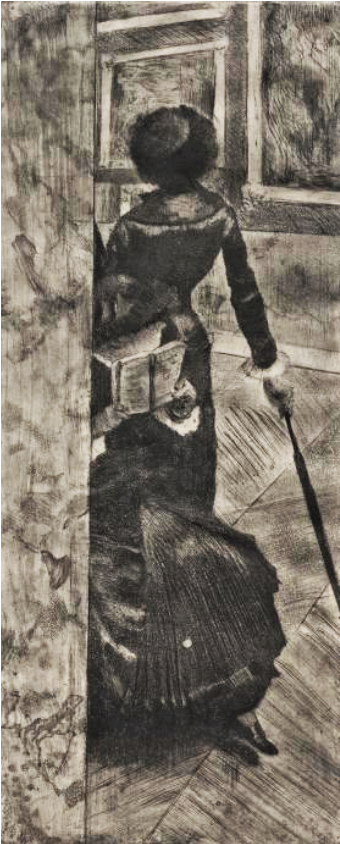
Edgar Degas: 1876-80, Delteil 29, Mary Cassatt at the Louvre, the painting gallery, etch+ps+aquatint 1of20, 30×13, NGA Washington (R138,no29;M21;iR15;R90II,p148;R2,p311) =? 5IE-1880-44-1-1, Eaux-fortes, Essais et états de planches
Edgar Degas: 1876-80, Delteil 29, Mary Cassatt at the Louvre, the painting gallery, etch+ps+aquatint 7of20, 30×13, Cleveland MA (M27;R138,no29;iR15;R90II,p148;R2,p311) =? 5IE-1880-44-1-2, Eaux-fortes, Essais et états de planches
Edgar Degas: 1876-80, Delteil 29, Mary Cassatt at the Louvre, the painting gallery, etch+ps+aquatint 15of20, 30×13, Cleveland MA (M27;R138,no29;iR15;R90II,p148;R2,p311) =? 5IE-1880-44-1-3, Eaux-fortes, Essais et états de planches
Edgar Degas: 1879-80, Delteil 29, Mary Cassatt at the Louvre, the painting gallery, etch+ps+aquatint ?of20, 30×13, NGA Washington (M21;iR15;R90II,p148;R2,p311) =? 5IE-1880-44-1-4, Eaux-fortes, Essais et états de planches
Edgar Degas: 1879ca, Study for Mary Cassatt at the Louvre, wax transfer, 32×24, NGA Washington (iR136;iR59;R90II,p148+164;R2,p311;M21) =? 5IE-1880-44-2-1, Eaux-fortes, Essais et états de planches
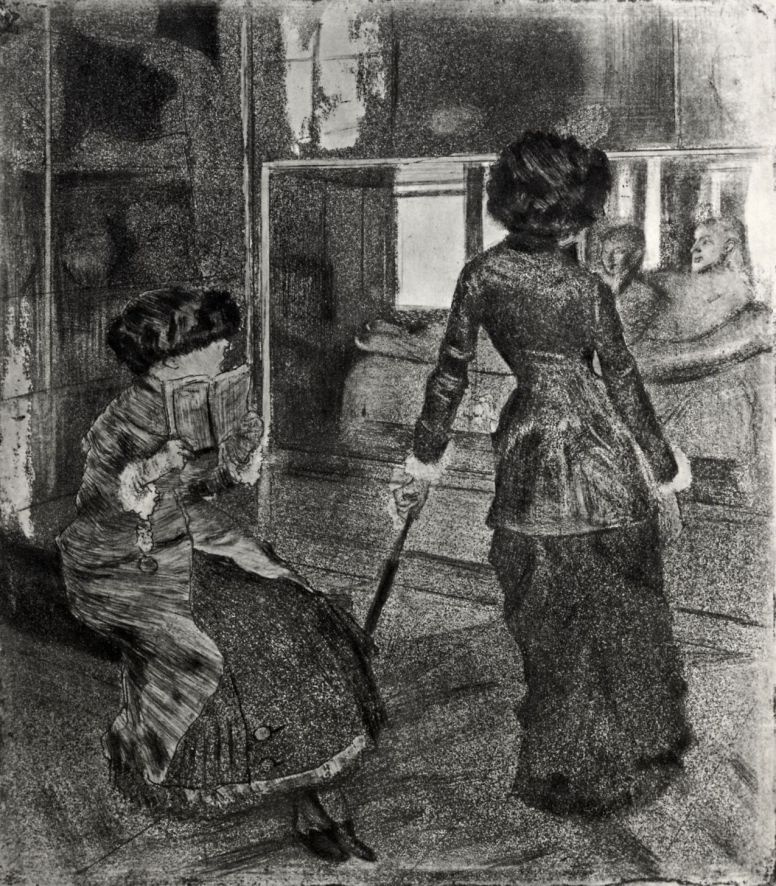
Edgar Degas: 1876-80, Delteil 30, Mary Cassatt at the Louvre, The Etruscan Gallery, etch+aquatint 1of6, 27×23, NGA Washington (M21;R138,no30;R90II,p148+164;R2,p311) =? 5IE-1880-44-2-2, Eaux-fortes, Essais et états de planches
Edgar Degas: 1876-80, Delteil 30, Mary Cassatt at the Louvre, The Etruscan Gallery, etch+aquatint 5of6, 27×23, NGA Washington (M21;iR11;iR23;R138,no30;R90II,p148+164;R2,p311) =? 5IE-1880-44-2-3, Eaux-fortes, Essais et états de planches
Edgar Degas: 1876-80ca, Delteil 30, Mary Cassatt au Louvre, Musée des antiques, ps 6?of6, 27×24, xx (iR10;iR11;iR23;R138,no30;R90II,p148+164;R2,p311) =? 5IE-1880-44-2-4, Eaux-fortes, Essais et états de planches
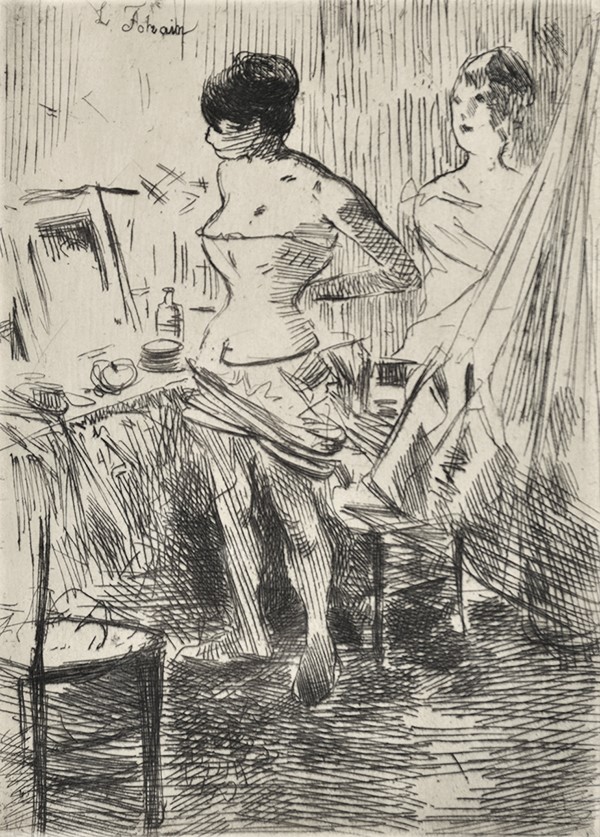
Jean-Louis Forain, 5IE-1880-53, eau-forte. Maybe?: 1876ca, CR7, Dancers in a dressing room (Getting dressed), drypoint, 16×12, NGA Washington (iR1;iR8;aR9,no7;R2,p311)
Jean-Louis Forain: 5IE-1880-54, eau forte =?? 1876 (1876/11/05), CR4, The departure of the star, etch, 18×12, A2015/11/16 (iR11;aR9,no4;R2,p311)
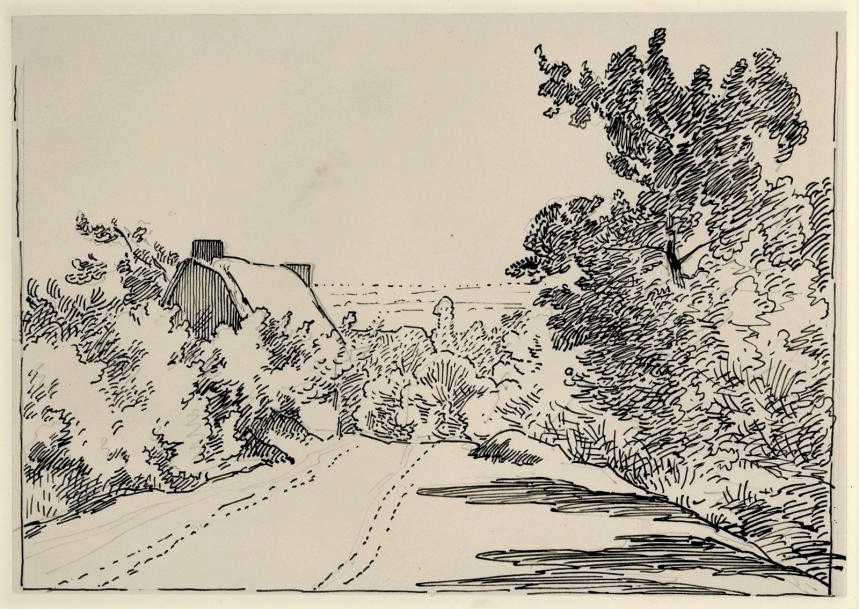
Léopold Levert: 18xx, Paysage, drawing, 14×18, A2017/03/25 (iR10;aR3=iR80;aR2;R2,p162+205) =??? HD1883/02/26-100, Chemin de Noiseau, wc/dr. Compare: 2IE-1876-101, Le chemin vert à Noiseau. Compare: 3IE-1877-82, Route sur le plateau de Fontenay
Léopold Levert: 18xx, Paysage (Sbl: d’ Denis), drawing, 14×18, A2017/03/25 (iR10;aR3=iR80;aR2;R2,p312) =?? HD1883/02/26-64, Bateaux, Ile Saint-Denis. Compare: 2IE-1876-95, Port de Portrieux; Compare: 5IE-1880-112, Cadre d’eaux-fortes.
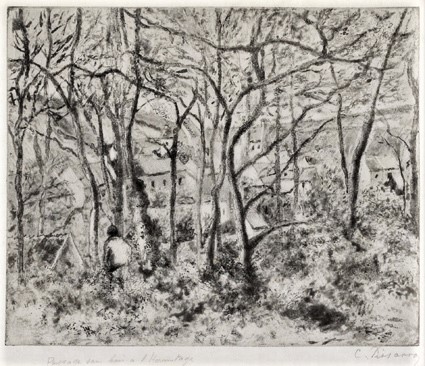
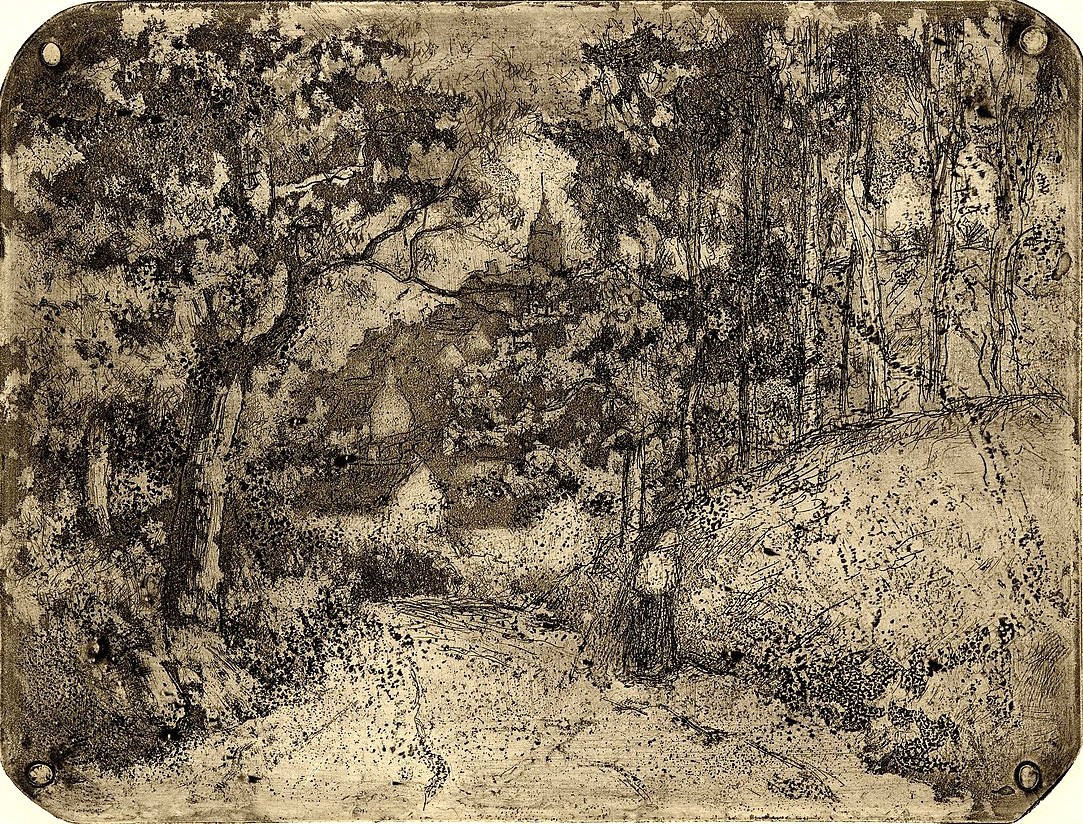
Camille Pissarro, 5IE-1880-139-1, Paysage. Probably: 1879, D16+B18?, Wooded Landscape at l’Hermitage, Pontoise, etch 1st, 22×27, MFA Boston (R84,p242;R138XVII,no16;R85XI,p13;M22)
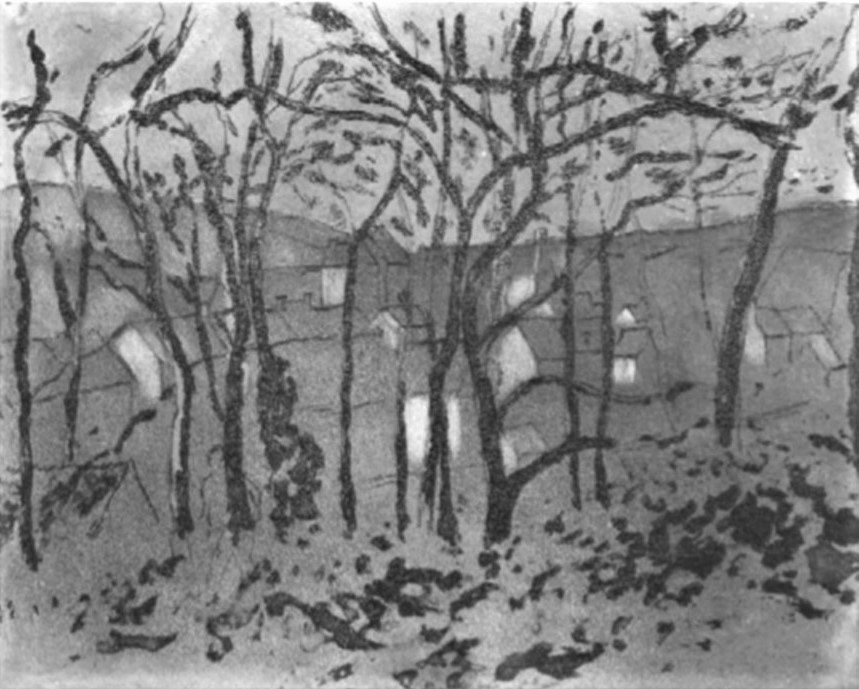
Camille Pissarro, 5IE-1880-139-2, Un cadré, Quatre états du paysage (le jour et la nuit). Perhaps: 1879, D16+B18?, Wooded landscape at L’Hermitage, Pontoise, etch, 22×27, MFA Boston (iR59;R46,p125;R138XVII,no16;R85XI,p13;R90II,p169;M22)
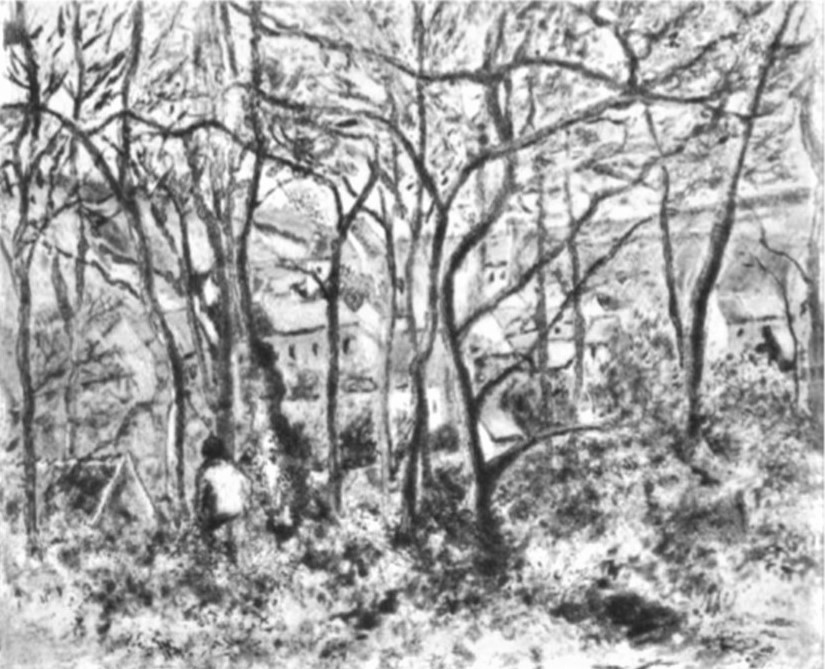
Camille Pissarro, 5IE-1880-139-3, Un cadré, Quatre états du paysage (le jour et la nuit). Probably: 1879, D16+B18?, Wooded Landscape at l’Hermitage, Pontoise, etch 6th, 22×27, MFA Boston (R84,p242;R46,p125;R138XVII,no16;R85XI,p13;R90II,p169;M22)
Camille Pissarro, 5IE-1880-139-4, Un cadré, Quatre états du paysage (le jour et la nuit). Probably: 1879, D16+B18?, Paysage sous bois à l’Hermitage, aquatint, 22×27, A2017/03/29 (iR11;R46,p125;
R90II,p169)
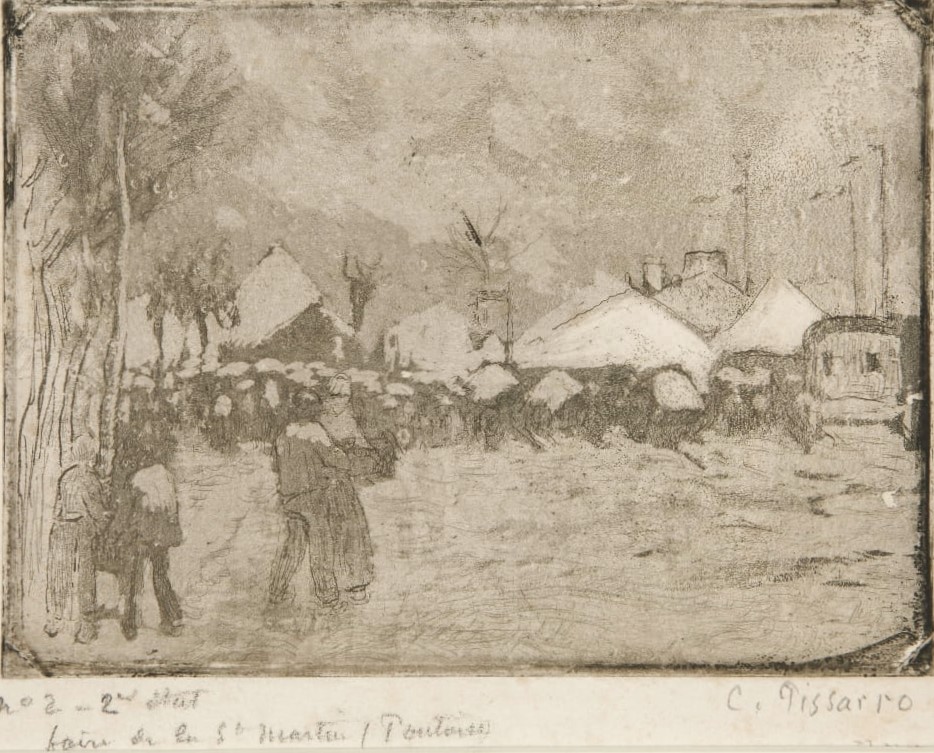
Camille Pissarro: 5IE-1880-140-1, Un cadre: Trois états de la foire de la Saint-Martin. =!? 1879, D21+B11, Foire de Saint-Martin à Pontoise, ps 2of4, 12×16, xx (iR10;iR155;R138XVII,no21;R85XI,no11)
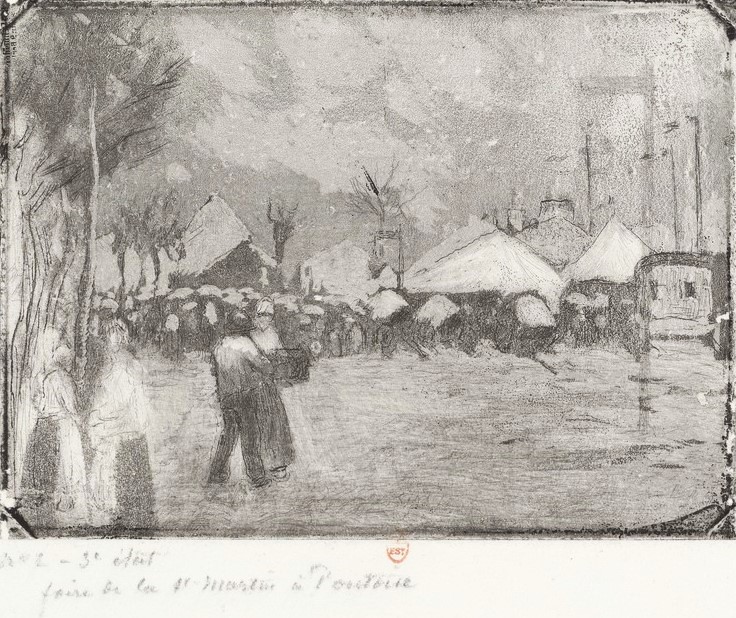
Camille Pissarro: 5IE-1880-140-2, Un cadre: Trois états de la foire de la Saint-Martin =!? 1879, D21+B11, Foire de Saint-Martin à Pontoise, ps 3of4, 12×16, BNF Paris (iR40;iR10;R138XVII,no21;R85XI,no11;R90II,p170)
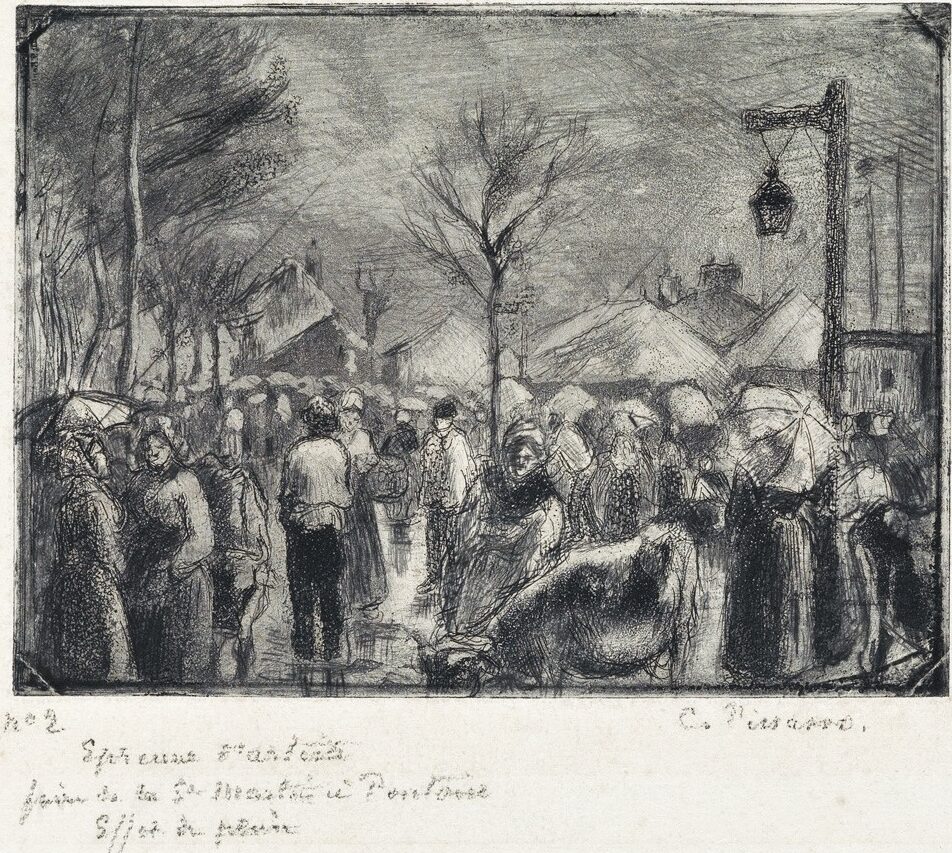
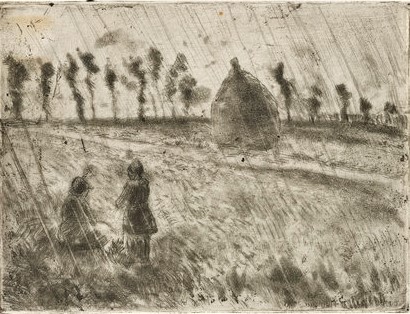
Camille Pissarro: 5IE-1880-140-3, Un cadre: Trois états de la foire de la Saint-Martin =!? 1879, D21+B11, Foire de Saint-Martin à Pontoise, effet de pluie, etch ps 4/4, 12×16, A2016/11/03 (iR11;R2,p313;R138XVII,no21;R85XI,p13;R90II,p170)
Camille Pissarro, 5IE-1880-140-4, Un état, pointe sèche. Marchande des marrons. = 1878, D15+B7, Marchande des marrons (foire de la St.-Martin), etch, 21×16, Metropolitan (iR59;R138XVII,no15;R85XI,no7;R2,p313;R90II,p170;M23)
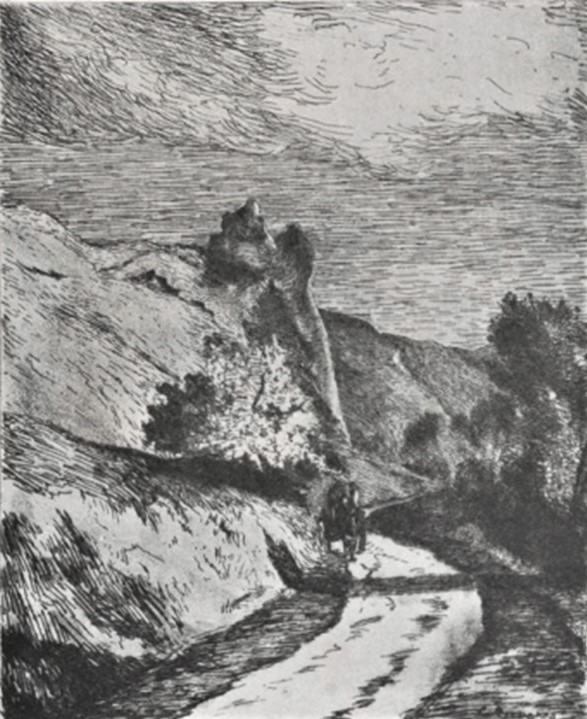
Camille Pissarro, 5IE-1880-141-1, Un cadre: Un état, Paysage, route et côteaux près Laroche-Guyon. Maybe: 1866ca, D5, La Roche-Guyon, etch, 27×22, xx (R138XVII,no5;R90II,p153;R2,p312)
Camile Pissarro, 5IE-1880-141-2, Un état, Effet de pluie. Probably: 1879, D24+B14, Effet de pluie (Rain Effect), dry point, 35×26, Ashmolean Oxford (aR2;iR11;R2,p313;R90II,p153+170;M66)
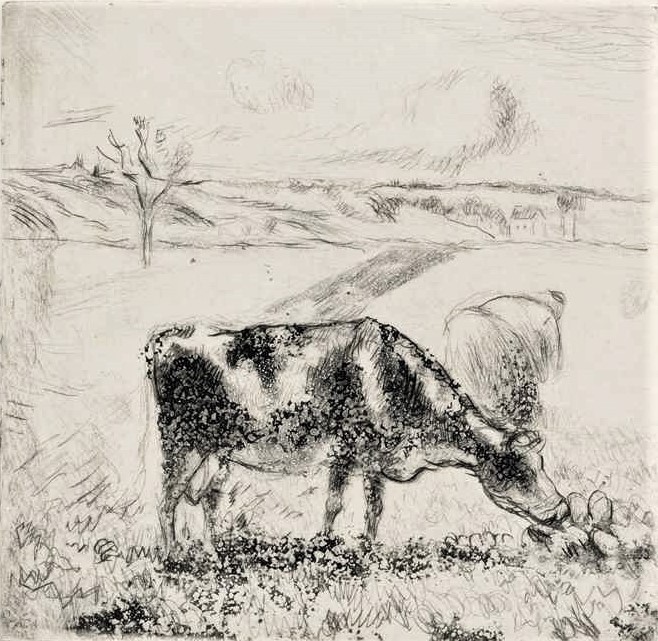
Camille Pissarro, 5IE-1880-141-3, Un état, vache et figure. Compare: 1885, D58, La vache, ps 2nd state, 12×11, A2017/09/19 (iR11;R90II,p170+153;R2,p312;R138XVII,no58;R85XI,no41)
Camille Pissarro, 5IE-1880-141-4, Un état, pointe sèche, côteaux de l’Hermitage, Pontoise. Probably: 1880, D28, Paysage à l’Hermitage, Pontoise, dry point, 11×12, A2017/09/19 (iR11;R2,p313;R90II,p153+170;R138XVII,no28)
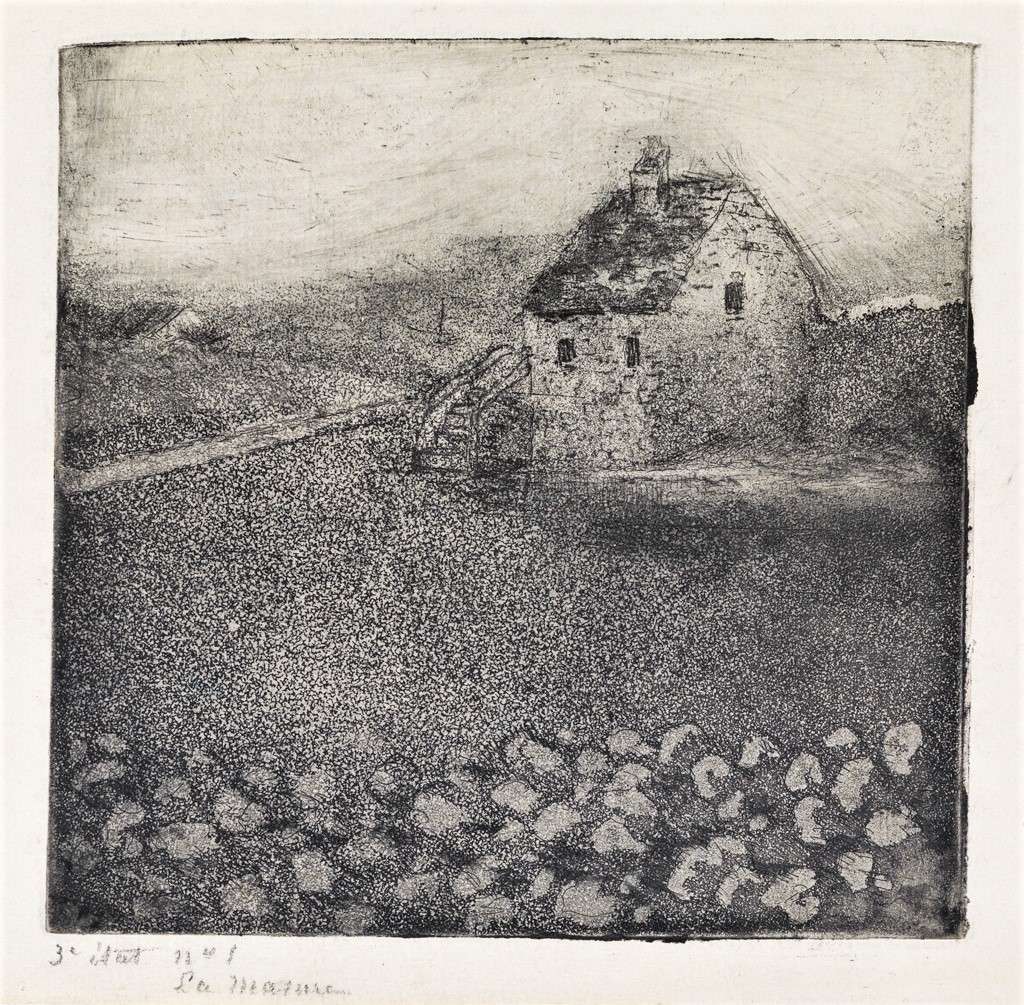
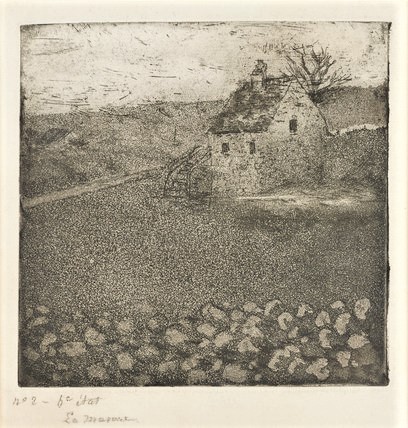
Camille Pissarro, 5IE-1880-142-1, Un cadre: Trois états, paysage, masure. Probably: 1879, D20+B12, La Masure, etch, 3rd state, 16×17, A2016/11/03 (iR11;R2,p313;R90II,p153+171;R138XVII,no20;R85XI,no12)
Camille Pissarro, 5IE-1880-142-2, Un cadre: Trois états, paysage, masure. Probably: 1879, D20+B12, La Masure (The Old Cottage), etch 6th state, 16×17, Ashmolean Oxford (aR2;R2,p313;R90II,p153+171;R138XVII,no20;R85XI,no12;M66)
Camille Pissarro, 5IE-1880-142-3, Trois états, paysage, masure. Probably: 1879, D20+B12, The old cottage, coloured etch, 17×17, Josefowitz collection (R84,p131;R2,p313;R90II,p153+171;R138XVII,no20;R85XI,no12)
Camille Pissarro: 5IE-1880-142-4, Deux états, paysage, arbres et coteaux =!? 1879, D19, Chemin sous-bois à Pontoise, etch 1/6, 16×21, A2016/11/04 (iRx;iR85;iR10;iR6;M147;iR10;R90II,p171+153;R138XVII,no19)
Camille Pissarro: 5IE-1880-142-5, Deux états, paysage, arbres et coteaux =!? 1879, D19, Chemin sous-bois à Pontoise, etch 6/6, 16×21, BM London (iR6;M147;iR10;R90II,p171+153;R138XVII,no19)
Camille Pissarro, 5IE-1880-143, Un cadre: Un état, petit bois à L’Hermitage, Pontoise. Probably: 1879, D17, Paysage en long, etch, 11×38, A2013/09/12 (iR11;R2,p313;R90II,p153+171;R138XVII,no17)
Jean-François Raffaëlli, 5IE-1880-164-1, Eaux-fortes et pointe sèche. Compare: 1882ca, D4, Tête de fille (Femme de Maison), etch, 15×11, Delteil (R138XVI,no4;R85XI,p58;aR7;R2,p313) Part of the painting: La forte chanteuse.
Jean-François Raffaëlli: 5IE-1880-164-2, Eaux-fortes et pointe sèche =?? 1876, D1-2, Mme J.F. Raffaëlli (tête de femme), etch, 12×9, Delteil (R138XVI,no1;R85XI,p58)
Jean-François Raffaëlli: 5IE-1880-164-3, Eaux-fortes et pointe sèche. Compare: 1884, D5, Head of a Ragpicker, ps, 12×9, CAI Williamstown (M26;iR10;iR40;R138XVI,no5;R85XI,p58)
Jean-François Raffaëlli, 5IE-1880-166-1, le marchand de marrons, eau-forte =1880, D137-2, the chestnut merchant, ps, 15×10, A2018/07/26 (iR10;iR94;iR42;iR11;R90II,p172;R138XVI,no137;R85XI,58;aR7) =se-1884-22 (aR14,p8).
Jean-François Raffaëlli, 5IE-1880-166-2, Les remparts du nord de Paris, eau-forte =1880, D138-3, The fortifications in the north of Paris, etch, 15×10, NYPL (iR61;R90II,p172;R138XVI,no138;R85XI,p58)
Jean-François Raffaëlli, 5IE-1880-166-3, La Bièvre, eau-forte =1880, D139-3, La Bièvre, etch, 14×9, Berson (R90II,p172;R138XVI,no139;R85XI,p58)
Jean-François Raffaëlli, 5IE-1880-166-4, Les maigres repas, pointe sèche =1880, D140, Les maigres repas (Les restaurants a bon marché), etch ps, 15×10, A2008/03/06 (iR11;aR7;R90II,p173;R138XVI,no140;R85XI,p58)
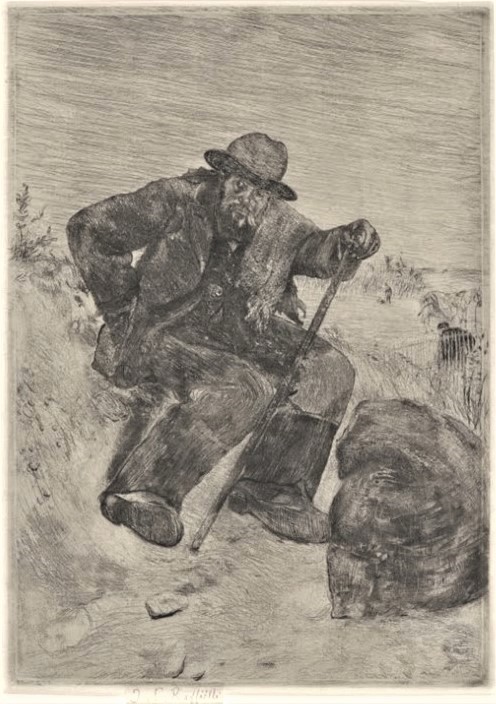
Jean-Marius Raffaëlli, 5IE-1880-180-2, Six eaux-fortes. Maybe: 1880ca, Man playings billiards, etch, xx, Delteil 1923 (iR40;R138XVI,p201;R90II,p173)
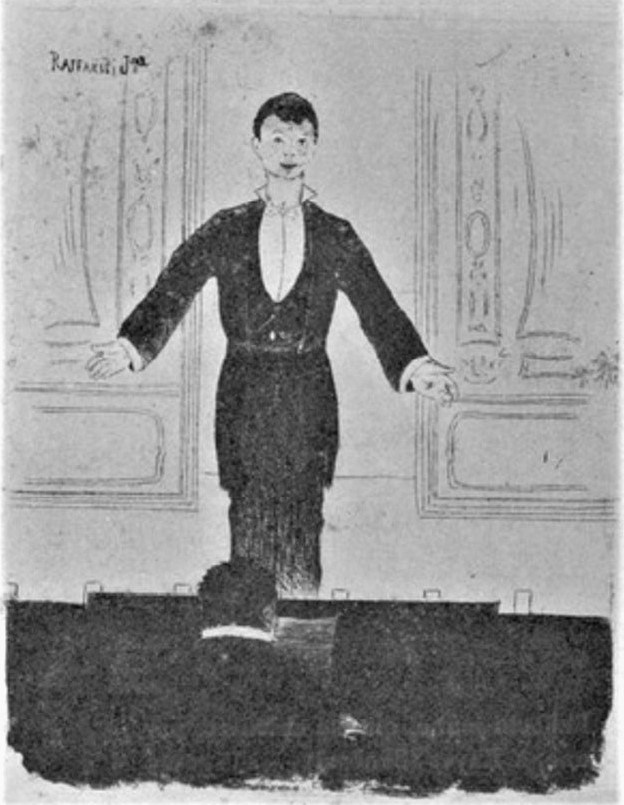
Jean-Marius Raffaëlli, 5IE-1880-180-3, Six eaux fortes. Maybe: 1880ca, actor (or singer) on a stage), etch, xx, Delteil 1923 (iR40;R138XVI,p201;R90II,p174). Note: his older brother Jean-François was also a singer and actor.
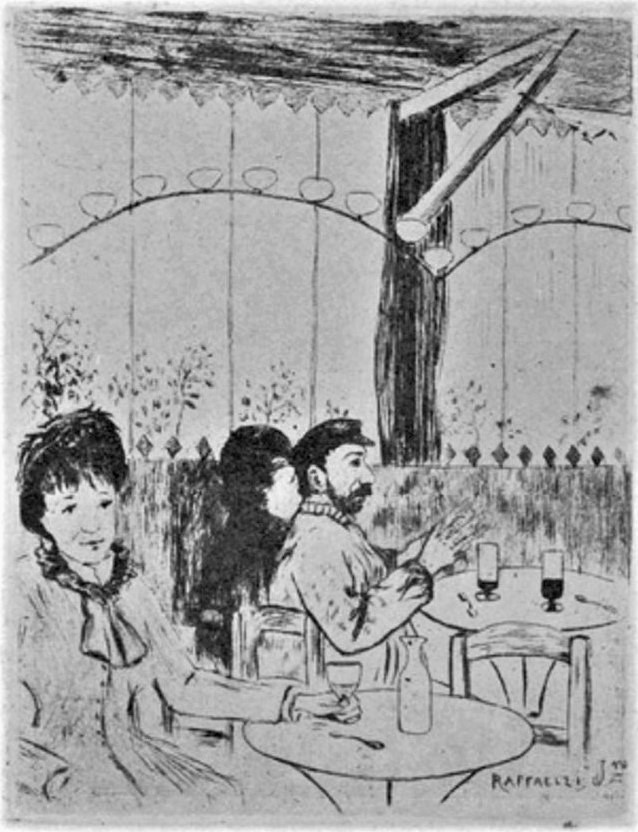
Jean-Marius Raffaëlli, 5IE-1880-180-4, Six eaux fortes. Maybe: 1880ca, seated man drinking, etch, xx, Delteil 1923 (iR40;R138XVI,p201;R90II,p174)
Jean-Marius Raffaëlli, 5IE-1880-180-5, Six eaux fortes. Maybe: 1880ca, two man on a bench, etch, xx, Delteil 1923 (iR40;R138XVI,p202;R90II,p174)
Jean-Marius Raffaëlli, 5IE-1880-180-6, Six eaux-fortes. Maybe: 1880ca, two man carrying a stretcher (coffin) in the snow (St. Ouen), etch, xx, Delteil 1923 (iR40;R138XVI,p202;R90II,p174+156)
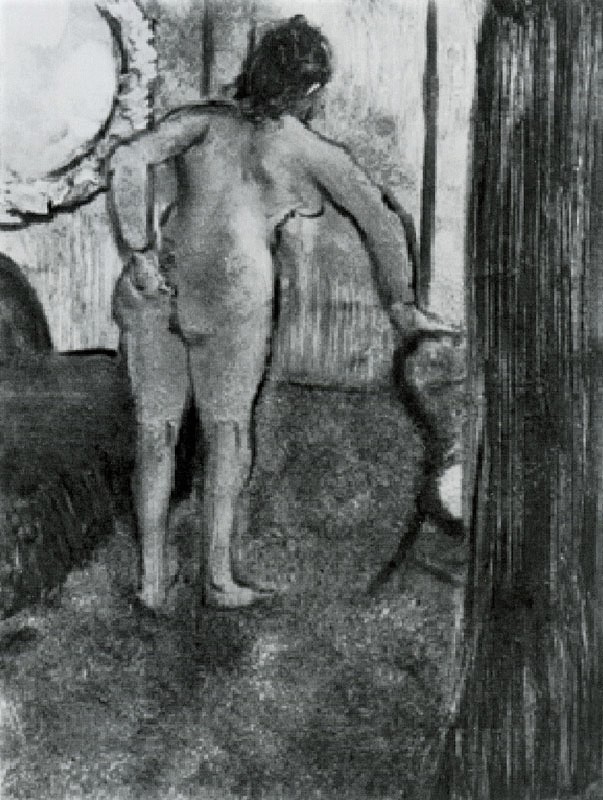
Edgar Degas: 6IE-1881-19+hc4-1: Esquisses noire: Femme nue =? 1879ca, Room in a brothel, monotype + ink, 21×16, Stanford UMA Palo Alto (iR10;R90I,p348;R90II,p180;R2,p363+354;R305,no22=87)
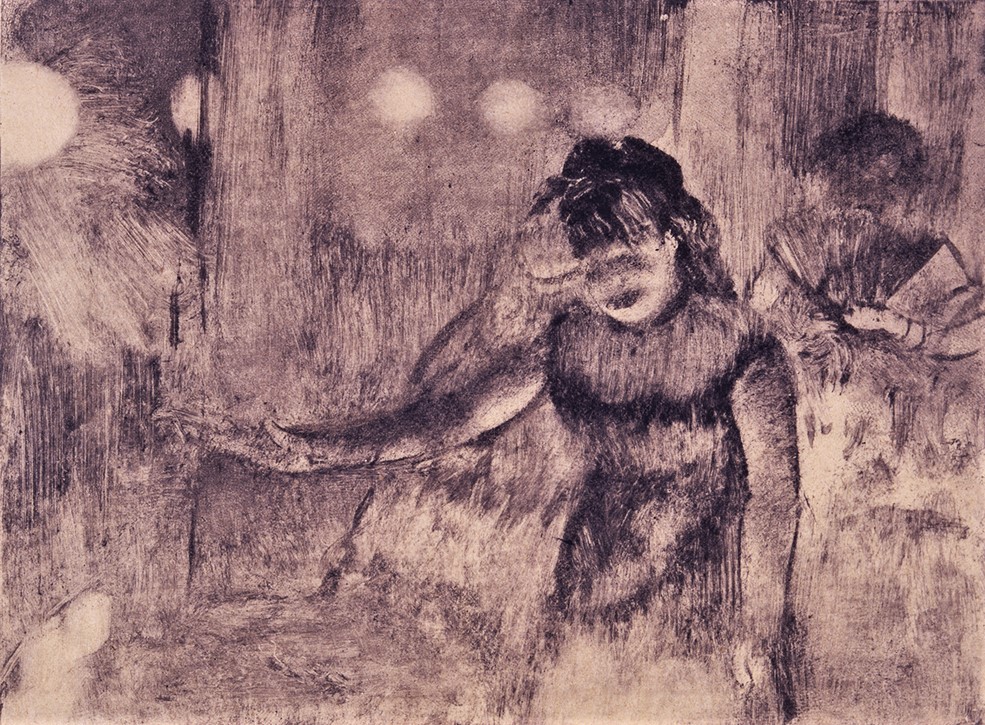
Edgar Degas, 1877-78ca, Mlle Bécat, monotype, 16×12, NGA Washington (M21;R90I,p340+362) =?? 6IE-1881-19+hc4-2, Esquisses noire
Edgar Degas, 1877-78ca, Café Singer, monotype, 12×16, xx (iR91;R90I,p340+362;R305,no8) =?? 6IE-1881-19+hc4-3, Esquisses noire
Camille Pissarro, 8IE-1886-109, Récolte de pommes de terre (eau-forte). = 1886, D63+B48, Récolte de Pommes de Terres, etch ps, 28×22, NGA Washington (iR59;R138XVII,no63;R85XI,no48;R90II,p268;M21)
Camille Pissarro, 8IE-1886-110-1, Rue de l’Epicerie à Rouen (eau-forte). Now: 1886, D64+B47, Rue de l’Epicerie, Rouen, etch ps, 16×14, A2017/06/10 (iR11;R138XVII,no64;R85XI,no47;R90II,p268)
Camille Pissarro, 8IE-1886-110-2, Rue Malpalue à Rouen (eau-forte). Now: 1885, D53+B42, La rue Malpalue, à Rouen, etch, 50×43, A2017/12/14 (iR11;R138XVII,no53;R85XI,no42;R90II,p268)
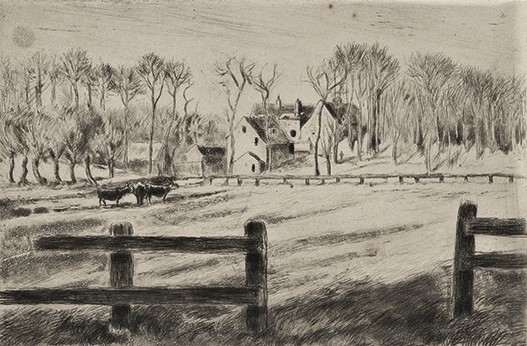
Camille Pissarro, 8IE-1886-111, Vaches et paysage (eau-forte). =1885, D59+B37, Prairie et moulin (à Osny), etch, 16×24, A2017/06/15 (iR11;R138XVII,no59;R85XI,no37;R90II,p268)
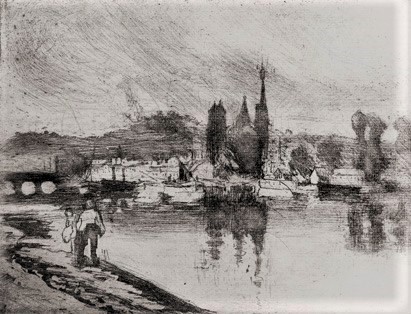
Camille Pissarro, 8IE-1886-112-1, Port de Rouen, effet de pluie (eau-forte). =!? 18xx, D44+B38, Effet de pluie à Rouen, ps, 12×13, Metropolitan (R90II,p268;R138XVII,no44;R85XI,no38;M23)
Camille Pissarro, 8IE-1886-113-1, Paysage à Rouen (eau-forte). =1884, D50+B27, View of Rouen (Cours-la-reine), etch, 15×20, MFA Boston (iR59;iR10;iR163;R138XVII,no50;R85XI,no27;R90II,p269;M22)
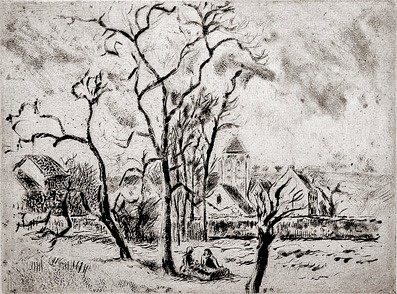
Camille Pissarro, 8IE-1886-113-2, Paysage à Osny (eau-forte). = 1885, D62+B54?, Paysage à Osny (Church of Osny), etch, 12×16, CdE BN Paris (iR59;iR164;R138XVII,no62;R85XI,no54;R90II,p269)
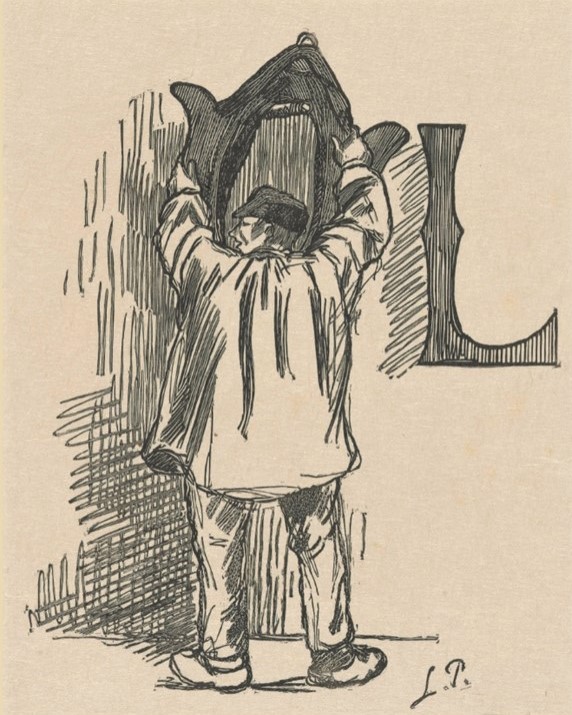
Lucien Pissarro: 8IE-1886-122, Illustration de Mait’Liziard (nouvelle de M. Octave Mirbeau); gravure sur bois, no.1, Lettre L. =1886ca, (Mait’ Liziard) Lettre L., woodcut, 14×11, VGM Amsterdam (aR7;M73;R90II,p271+249)
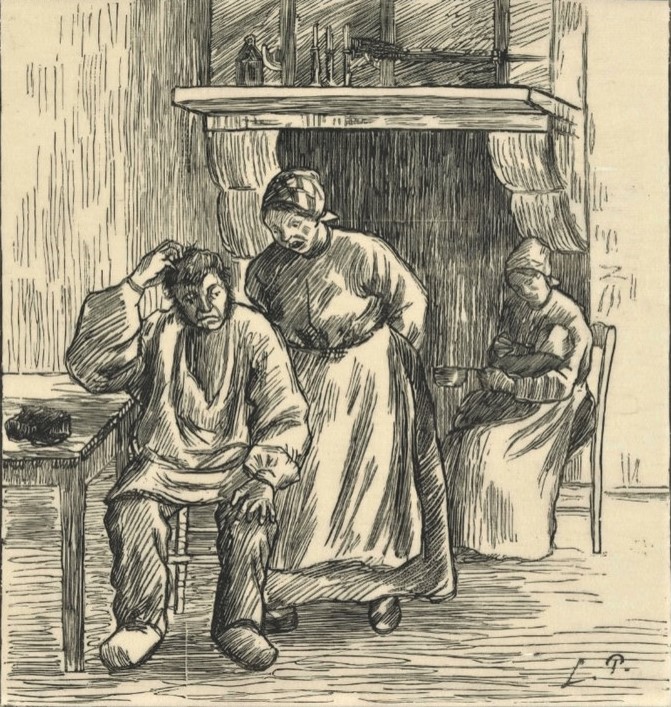
Lucien Pissarro: 8IE-1886-122, Illustration de Mait’Liziard (nouvelle de M. Octave Mirbeau); gravure sur bois, no.2, Bon Guieu! Qu’a a ronf’e =1886, Bon Guieu! Qu’a a fronf’e, woodcut, ?cm, La Revue illustrée 2, no13, 1886/06/15 (R90II,p271+249)
Lucien Pissarro: 8IE-1886-122, Illustration de Mait’Liziard (nouvelle de M. Octave Mirbeau); gravure sur bois, no.3, All’enfe, a soufflé =1886ca, All’enfe, à soufflé, woodcut, 17×16, VGM Amsterdam (M73;R90II,p271+249;R2,p445)
Lucien Pissarro: 8IE-1886-122, Illustration de Mait’Liziard (nouvelle de M. Octave Mirbeau); gravure sur bois, no.4, Tiens, tiens, mais c’est Liziard =1886ca, Tiens! tiens! mais c’est Liziard!, woodcut, 11×16, VGM Amsterdam (aR7;M73;R90II,p272+249;R2,p445)
Lucien Pissarro: 8IE-1886-122, Illustration de Mait’Liziard (nouvelle de M. Octave Mirbeau); gravure sur bois, no.5, Cul de lampe =1886, Crying woman, woodcut, 25×16 (13×9), VGM Amsterdam (M73;aR7;iR155;iR10;R90II,p272+249)
Lucien Pissarro: 8IE-1886-123-1, Tête de paysan; gravure sur bois =? 1884, Head of a farmer, woodcut after drawing Camille Pissarro, 13×12, VGM Amsterdam (M73;R90II,p272+250;R311,no18)
Lucien Pissarro: 8IE-1886-123-2, Lapin; gravure sur bois =1884-86, Rabbits (Les Lapins), woodcut after a drawing of Camille Pissarro, 16×24 (7×15), VGM Amsterdam (M73;iR10;M66;R90II,p250+272;R311,no9)
Lucien Pissarro: 8IE-1886-123-3, Femme à l’herbe; gravure sur bois =1884, Woman gleaning, woodcut after a drawing of Camille Pissarro, 24×17, VGM Amsterdam (M73;R90II,p272+250;R311,no1)
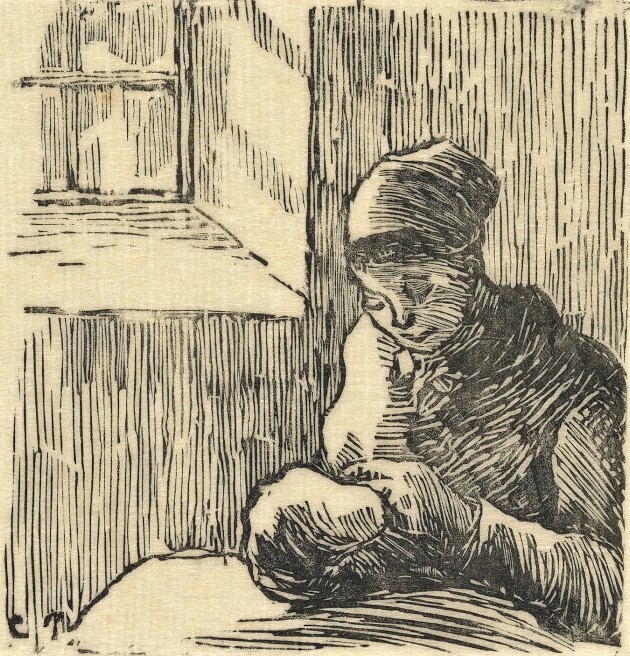
Lucien Pissarro: 8IE-1886-123-4, Femme lisant; gravure sur bois =1884, Femme lisant, woodcut after a drawing of Camille Pissarro, 33×24, VGM Amsterdam (M73;R90II,p273+250;R311,no2;M66)
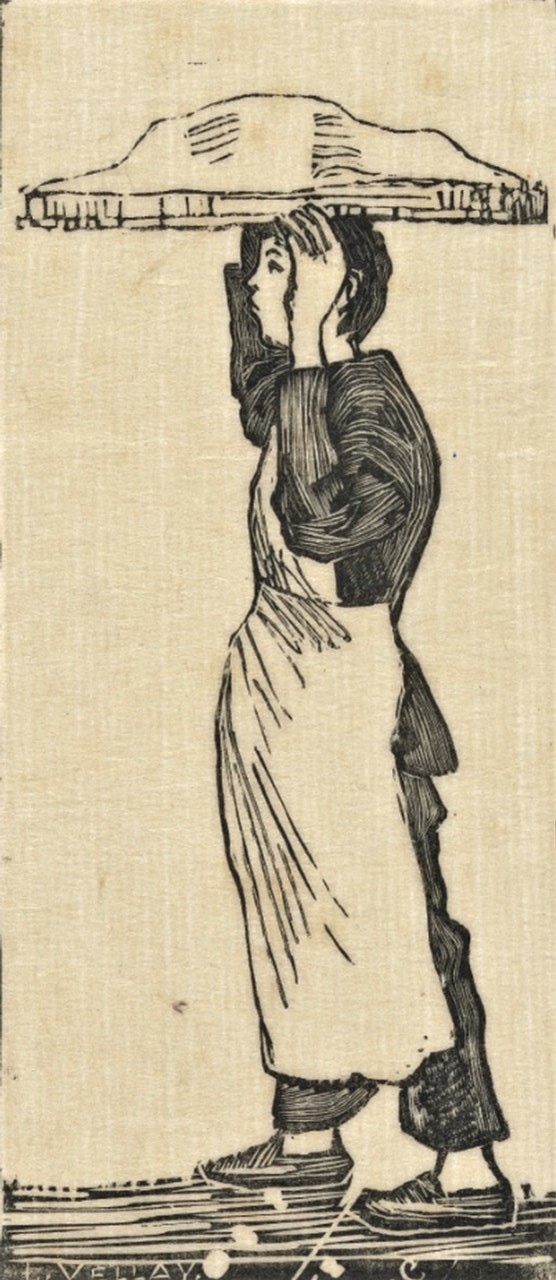
Lucien Pissarro: 8IE-1886-123-5, Pâtissier; gravure sur bois =1884ca, Le Pâttisier, woodcut after a drawing of Camille Pissarro, 24×17 (14×6), VGM Amsterdam (M73;iR59;aR6;R90II,p273+250;R311,no8;R89,no57)
Lucien Pissarro: 8IE-1886-123-6, Marchande de marrons; gravure sur bois =1884, Marchande de marrons (Seller of chestnuts), woodcut after a drawing of Camille Pissarro, 32×24, VGM Amsterdam (M73;R90II,p273+250;R311,no3)
Lucien Pissarro: 8IE-1886-123-7, Paysan sarclant, gravure sur bois =1884-85, CR202, Les Sarcleurs (Weeders), woodcut after a drawing of Camille Pissarro, 31×23, VGM Amsterdam (M73;R90II,p273+250;R311,no6)
Lucien Pissarro: 8IE-1886-123-8, Ravaudeuse; gravure sur bois =1884, Femme Ravaudant, woodcut after a drawing of Camille Pissarro, 23×17, VGM Amsterdam (M73;R90II,p273+250;R311,no5)
Lucien Pissarro: 8IE-1886-123-9, Curé à la promenade; gravure sur bois =1884ca, Le Curé, woodcut, 8×8, Tate London (iR10;M62;iR59;aR6;R90II,p273+250;R311,no7;R89,no56)
Explination techniques of engraving:
There are several forms of engravings or printmaking art (iR3; iR5). Here I will render some simple and basic information. For more information you can use the links to articles on WikiPedia (iR3). Engraving is the practice of incising a design onto a plate. Etching is the process of using a strong acid to cut into unprotected parts of a metal plate (cupper, zinc or steel). The plate is covered with wax. With an etching needle the artist removes the wax and draws lines. The plate is then dipped in a bath of acid. The acid bites into the metal plate leaving behind the drawing. The plate is covered with ink. The ink is wiped away, leaving the ink in the etched lines. The plate together with a sheet of paper is put through a printing press. The ink in the etched lines leaves a print on the paper. Drypoint etching (Fr.: point-sèche) is a variation of the normal etching proces. The artist works directly on the plate with a needle. The edges that are formed after drawing lines in the metal plate are used. These edges (or burrs) also hold ink that will be printed on the paper. This edge can be larger or smaller depending on the angle with which the needle is drawn into the plate, creating a feathery black line with a fine, white center. The technique is easier to use. The amount of (good) prints that can be made is more limited. (iR3;R465,p102) Mezzotint achieves tonality by roughening a metal plate with thousands of little dots made by a metal tool. Aquatint produces areas of tone rather than lines. The printing is done with multiple plates in different colours. This technique uses powdered rosin (resin) to create a tonal effect. Lithography can be used to print text or images onto paper. The image to be printed was drawn with a greasy substance, such as oil, onto the surface of a plate. The other parts were treated with acid and made wet. An oil-based ink was then applied, and would stick only to the original drawing. This technique allows that many prints could be made. Woodcut means that the artist carves an image into the surface of a block of wood. These cut out areas will carry no ink. Photogravure or Heliographic printing is a photo-mechanical process whereby a copper plate is grained and then coated with a light-sensitive gelatin tissue which had been exposed to a film positive, and then etched with acid, resulting in a high quality intaglio plate that can reproduce detailed continuous tones of a photograph. The picture isn’t rendered reversed. (R158,p208;R465,p103).
Félix Bracquemond: 1853, SDtl, Self-Portrait as an etcher, drawing enhanced with pastel and gold-toned paint, 93×68, Harvard Cambridge (iR10;iR135;iR1;R73,p7;R52,p8;R85III,no1;R52,p8;M32) =S1853-169, Portrait de l’auteur, dessin; = EU-1855-2619, Portrait de l’auteur, dessin; =?? 1IE-1874-23, Portrait (dessin)
Marie Bracquemond, 8IE-1886-4, Portrait de M. F. Bracquemond =1886, Felix Bracquemond in his studio, 55×42, private (iR2;iR59;R2,p448;R90II,p25)
Félix Bracquemond: 1IE-1874-24-4, Portrait de M Edwards = 1872, B38, Edwin Edwards, etch, 16×15, BNF Paris (iR6;iR284;R73,p45;R2,p119;R90II,p15;R85III,no38) =!? SNBA-1907-93c.
Overview number of engravings exhibited: At the 8 ‘impressionist’ expositions held from 1874-1886 in Paris there were about 209 engravings exhibited, about 10% of the total amount of about 2053 exhibited art-works. Here below you will find an overview of the number of engravings that were exhibited. In total the engravings were indicated by just 60 catalogue numbers. But in reality many catalogue numbers contained several engravings. Most engravings were shown by Félix Bracquemond, namely 61. Per year the amount of exhibited engravings varied very much.
In 1874 42 engravings were exhibited, namely 32 of Félix Bracquemond. In 1876 at least 48 engravings were exhibited including many of Legros (25), Lepic (11) and Desboutin (13). In 1877 Degas showed 6 monotypes. In 1879 just 6 engravings were shown. In 1880 most engravings were exhibited, namely 82, which is 26,2% of the whole! Many engravings were intended for the publication ‘La jour et la nuit’. Félix Bracquemond also showed maybe 25 engravings. In 1881Degas showed 3 monotypes outside the catalogue. In 1882 there were no engravings exhibited. In 1886Camille and Lucien Pissarro showed 22 engravings.
Account per year: The suggestions are often quite certain. Of etch the artist mostly made a few states and several prints of one state. So, it is more likely that at least one print has been preserved. At an early stage engravings were catalogued by Beraldi (from 1885-1892 =R85) and Delteil (1906 onwards =R138). All this makes identification more easy. Still, mostly it is not indicated which state was exhibited, I assume mostly the latest and most finished, but this is uncertain.
In 1874 there were 42! engravings exhibited by 5 partakers, namely by Félix Bracquemond: 32x (nos.24-28). Lepic showed 3 etchings (no.78-80). Giuseppe de Nittis probably showed 4 etchings (no.117), though this was not indicated in the catalogue. Léon Ottin showed 1 lithogrape for which I have no suggestion: 1IE-1874-133, Une bergerie sans moutons, lithographie. Rouart showed 2 untitled etchings (no.157+158), for which I render 1 undated as very uncertain option and a later dated etching to compare.
So in total there were 42 engravings exhibited, depicted in just 11 catalogue numbers, about 18,7% of the total amount of about 225 art-works.
In 1876 there were 48! engravings exhibited by just 3 partakers. Desboutin showed at least 13 engravings, all dry points (nos. 67-72+hc1).
Maybe all the 25 art-works of Legros were engravings (nos.81-92), with the numbers 81-4 +82 +83-4 +85 +88-1 being dry points and no. 83-5 containing two lithographes . Lepic showed at least 7 and assumably 11 etchings (no.135-137).
So in total there were probably 49 engravings exhibited, about 16,4% of the total amount of about 298 art-works.
Of the partakers in 1877 only Degas exhibited engravings, namely at least 6 monotypes (nos.58-60). Some maybe were a bit reworked with pastel and than can be seen as mixed techniques. But because the title ‘Dessins faits à l’encre grasse et imprimés’ indicate pure monotypes I count them all as engravings. So in total there were 6 engravings exhibited, 2,4% of the total amount of about 249 art-works.
In 1879 just 2 partakers exhibited engravings: Félix Bracquemond 4x (no.3-6); Somm 2x (no.228+229).
So in total there were 6 engravings exhibited, about 2,2% of the total amount of about 272 art-works.
In 1880 the following 8! partakers exhibited engravings: Félix Bracquemond maybe 25x! (no.5); note: of no.4, the portrait of Goncourt there also are etchings, but he showed a drawing. Cassatt 10x (nos.25-32); for no.27-1 I render to compare a drawing; Degas maybe 8x (no44); Forain 2x (no.53+54); Levert at least 2x (no.112); Pissarro 18x! (nos.139-143); Jean-François Raffaëlli at least 10x (no.164+166+167); I couldn’t find a suggestion for 167-1. Jean-Marius Raffaëlli 6x (no.180).
So in total there were about 81! engravings exhibited, 26,2% of the total amount of about 309 art-works. The largest amount of the 8 ‘impressionist’ expositions.
Of the partakers in 1881 only Degas showed engravings, assumably 3 monotypes outside the catalogue (hc4 ‘Esquisses noire’). So there were just 3engravings exhibited, less than 2% of the total amount of about 187 art-works.
In 1882 there was not 1 partaker that exhibited engravings.
In 1886 only 2 partakers exhibited engravings: Camille Pissarro exhibited 8 etchings (no.109-113) Lucien Pissarro exhibited 14! woodcut engravings (no.122+123).
So in total there were 22 engravings exhibited, about 7,3% of the total amount of about 301 art-works.
So, in total there were about 42+49+6+6+81+3+0+22= 209 engravings exhibited, which is about 10,2% of the total amount of about 2053 art-works.
Per year the amount of exhibited engravings varied very much. The actual amount of exhibited engravings was much more than the catalogue numbers.