1866-67, Dinner service Rousseau, after the etchings of Félix Bracquemond, ceramic, xx, Uni Pennsylvania (iR10;R85,no530-554). Exhibited EU-1867.
Introduction: At the 8 ‘impressionist’ expositions held from 1874-1886 in Paris there was also applied art exhibited. Most often they were engravings or drawings meant for book illustrations or porcelain designs (also mentioned on the page on the other techniques). But it also included enamel ornaments and other forms of applied art. At another page you will find the 35 fans that were exhibited, also a form of applied art. In total there were about 34 bookillustrations shown, maybe 27 designs for earthenware, 6 other forms of applied art and maybe 4 illustrations for newpapers. So, a total of maybe 71 art-works and when we include the 35 fans of 106 art-works, which is about 5% of the total amount of art-works exhibited at the ‘impressionist’ expositions.
Various forms of applied art:
Léon Ottin in 1874:
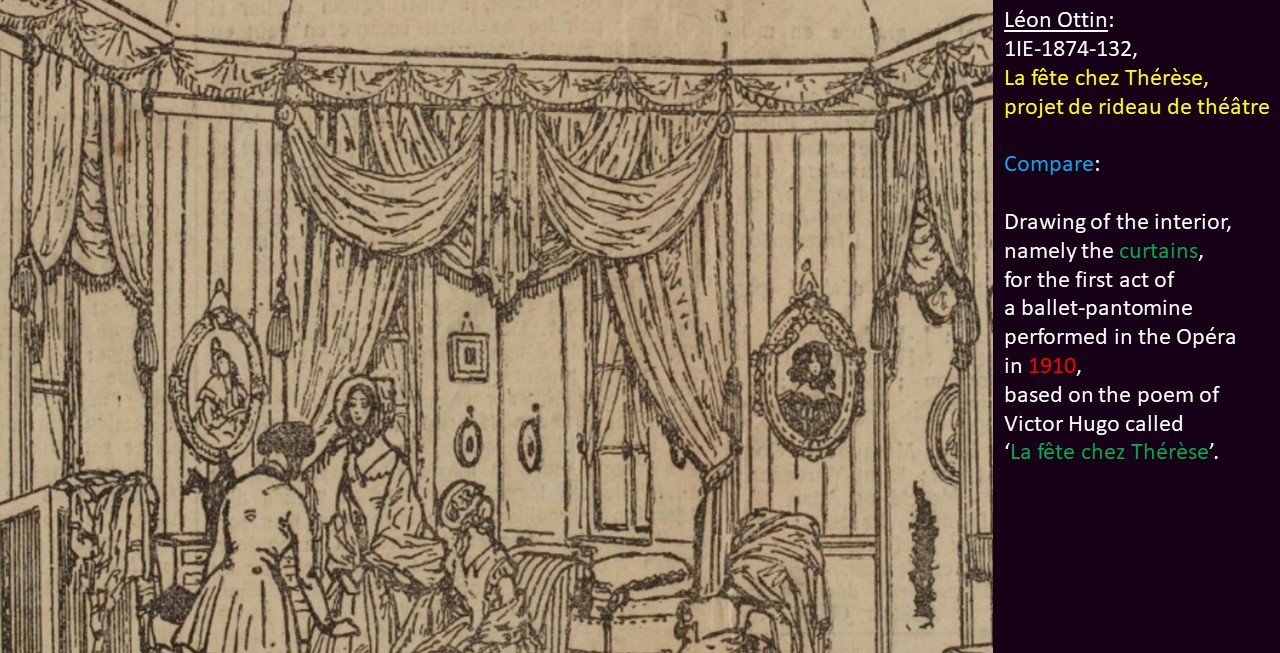
In 1874 at the 1st ‘impressionist’ expositionLéon Ottin exhibited a (drawing of a) curtain made for a theater (no.132). To compare I render a drawing of another artist:
1IE-1874-132, La fête chez Thérèse, projet de rideau de théâtre.
Léon Ottin: 1IE-1874-132, La fête chez Thérèse, projet de rideau de théâtre. Compare:
Forain in 1879:
In 1879 at the 4th ‘impressionist’ expositionJean-Louis Forain exhibited 2 screens (no.105+106), both loans by Alphonse Daudet. I render works of another artist to compare:
4IE-1879-105, Un écran; appartient à M. Alphonse Daudet
4IE-1879-106, Un écran; appartient à M. Alphonse Daudet
Jean-Louis Forain: 4IE-1879-105, Un écran; appartient à M. Alphonse Daudet. Compare:
Jean-Louis Forain: 4IE-1879-106, Un écran; appartient à M. Alphonse Daudet. Compare:
Henry Somm in 1879: Henry Somm made many bookillustrations; illustrations for newspapers and magazines; designs for programs, menus, invitations, visiting cards, vignettes, almanacs and also was involved in performance art. In 1879 Henry Somm showed two Calenders.
4IE-1879-228, Calendrier de 1878, gravure à la pointe sèche
4IE-1879-229, Calendrier de 1879, gravure à la pointe sèche
Henry Somm: 4IE-1879-228, Calendrier de 1878, gravure à la pointe sèche. Compare: 1880, Beraldi 19, Calendrier pour 1881, ps, 38×28, A2016/05/20 (iR241;iR10;iR11;R2,p270;R85XII,no19)
Henry Somm: 4IE-1879-229, Calendrier de 1879, gravure à la pointe sèche =1878, Beraldi 18, Calendar for 1879, etch ps, 31×39, Cabinette des Estampes Paris (iR40;R2,p251;R90II,p141+119;iR26;iR10;R85XII,no.18)
Forain in 1881:
In 1881 at the 6th ‘impressionist’ expositionJean-Louis Forain showed 4 drawings, which were untitled and not reviewed. From 1876-1925 Forain made illustrations for several newspapers (R43,p57; R50,p64;R88;aR4;aR21,p12), especially for ‘Le Courrier Français’ (since 1887) and ‘Le Figaro’ (1891-1924; R43,p7+19;R50,p27+36;R88;aR4). His illustrations were brought together in ‘La Comédie parisienne’ (1892) ‘Les temps difficiles’ (1893), ‘Doux pays’ (1897), ‘De la Marne au Rhine’ (1920). Behind the satirical humor of his illustrations Forain was a moralist (R43,p8), he revealed the truth of the political and social life of France (aR21,p12). Maybe Forain showed in 1881 some of these illustrations. But maybe it were just rendom drawings. 6IE-1881-26, Dessin 6IE-1881-27, Dessin 6IE-1881-28, Dessin 6IE-1881-29, Dessin
Jean-Louis Forain, 6IE-1881-26, dessin. Very uncertain: 18xx, Femme debout, de trois quarts à gauche, portant un chapeau plat, dr, 40×26, DAG Louvre (M5a,RF24304,R;R2,p354)
Jean-Louis Forain, 6IE-1881-27, dessin. Very uncertain: 18xx, Homme en habit noir conversant avec une femme en robe de soirée, dr, 28×22, DAG Louvre (M5a,RF23411,R;R2,p354)
Jean-Louis Forain, 6IE-1881-28, dessin. Very uncertain: 18xx, La visite, pencil, 35×28, A2008/11/19 (iR11;iR14;aR17=iR40)
Jean-Louis Forain, 6IE-1881-29, dessin. Very uncertain: 18xx, visiting the artist in his studio, ink, 37×32, A2009/03/10 (iR11;iR15;R2,p354)
Zandomeneghi in 1881:
In 1881 Zandomeneghi exhibited a Panel for a dining room (no.160), a loan by an unknown mister G. To compare I render two panels of two other artists:
6IE-1881-169, Panneau pour une salle à manger; appartient à M. G.
Federico Zandomeneghi: 6IE-1881-169, Panneau pour une salle à manger; appartient à M. G. Compare:
Meyer showed enamels in 1874:
At the 1st ‘impressionist’ exposition in 1874 Alfred Meyer showed 5 enamel art-works (nos.87-91). I assume they were ornaments and jewellery, so applied art. I render 6 compilations to compare:
1IE-1874-87, Étienne Marcel prévôt des marchands, émail
1IE-1874-88, Dona Maria Pacheco, épouse de Don Juan de Padilla, chef de l’insurrection, qui avait pris le nom de Sainte Ligue des communes sous Charles-Quint, email.
1IE-1874-89, Le Firmament, d’après Emile Lévy, émail
1IE-1874-90, Figure d’après Raphaël, émail
1IE-1874-91, Figure d’après Raphaël, émail
Alfred Meyer: 1IE-1874-87, Étienne Marcel prévôt des marchands, émail. Compare:
Alfred Meyer: 1IE-1874-88, Dona Maria Pacheco, épouse de Don Juan de Padilla, chef de l’insurrection, qui avait pris le nom de Sainte Ligue des communes sous Charles-Quint, email. Compare:
Alfred Meyer: 1IE-1874-89, Le Firmament, d’après Emile Lévy, émail. Compare 1:
Alfred Meyer: 1IE-1874-89, Le Firmament, d’après Emile Lévy, émail. Compare 2:
Alfred Meyer: 1IE-1874-90, Figure d’après Raphaël, émail. Compare:
Alfred Meyer: 1IE-1874-91, Figure d’après Raphaël, émail. Compare:
Earthenware and porcelain services:
Marie Bracquemond in 1879:
In 1879 at the 4th ‘impressionist’ expositionMarie Bracquemond showed a large cardboard which was used for a painting on earthenware / faience made for the Haviland earthenware factory. Her husband also was involved in this painting.
4IE-1879-1, Les Muses des Arts (Carton ayant servi pour une peinture sur faïence); appartient à M. Haviland
Marie Bracquemond: 4IE-1879-1, Les Muses des Arts (Carton ayant servi pour une peinture sur faïence); appartient à M. Haviland =1878, The Muses of the Arts, ceramic for Haviland, 300×700, private (R168,p235=no.5;R90II,p121+105;R90I;R88I,p77;aR11) =EU-1878-hc, Les Muses des Arts =!? BJ-1919-148, Les Beaux Arts, project de décoration, dessin; Appartient à M. Georges Haviland.
Marie + Félix Bracquemond: 1878ca, First study for The Muses of the Arts (detail), watercolour+gouache, 48×64, private (R168,p236=no.8)
Marie Bracquemond also showed an untitled earthenware plate (no.2), for which I render 2 uncertain options:
4IE-1879-2, Un plat de faïence (peinture mate)
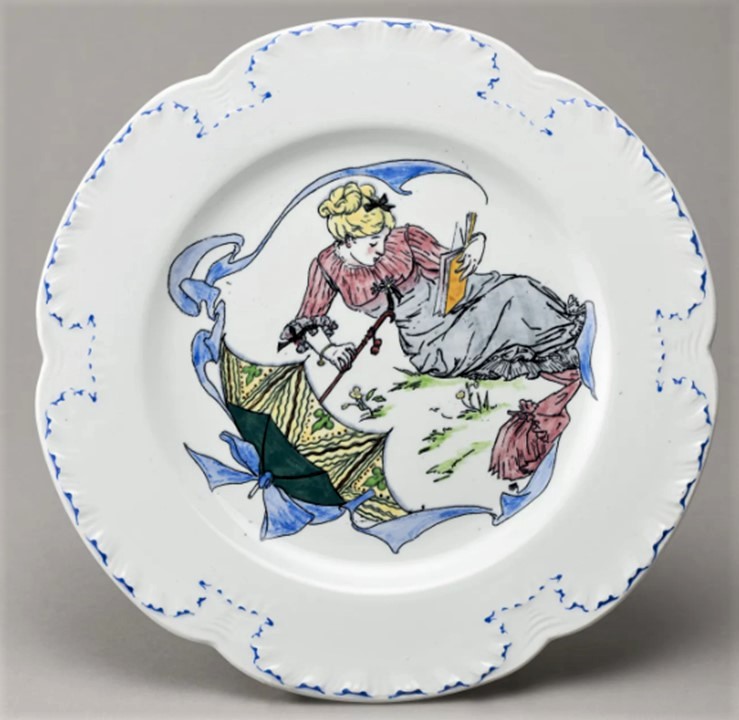
Marie Bracquemond: 1879, Woman with flowerpots, plate service with flowers and ribbons, d27, Philadelphia MA (M28;iR10;iR64) =? 4IE-1879-2, Un plat de faïence (peinture maté)
Marie Bracquemond: 1879, Reading for the dinner, plate, service with flowers and ribbons, d27, private (aR21;iR10;R168,p234=no.4) =? 4IE-1879-2, Un plat de faïence (peinture maté)
Félix Bracquemond in 1880:
In 1880 at the 5th ‘impressionist’ expositionFélix Bracquemond showed engravings for the decoration of earthenware and porcelain services: 5IE-1880-5, Eaux-fortes pour décoration de services de faïence et de porcelaine.
It is unsure how many engravings he showed and for which tableware, but I assume it was made for the Rousseau service↑ and that Félix Bracquemond showed 25 engravings.
Félix Bracquemond, 5IE-1880-5, Eaux-fortes pour décoration… Probably: 1866, B530, Rousseau no.1, Pheasant and reed, etch, 27×42, BNF Paris (iR40)
Félix Bracquemond, 5IE-1880-5, Eaux-fortes pour décoration… Probably: 1866, B532, Rousseau no.3, Fish, flowers, butterfly, etch, 27×42, BNF Paris (iR40)
Félix Bracquemond, 5IE-1880-5, Eaux-fortes pour décoration… Probably: 1866, B531, Rousseau no.2 (or 5), Large flowers, butterfly, snail, etch, 43×27, BNF Paris (iR40)
Félix Bracquemond, 5IE-1880-5, Eaux-fortes pour décoration… Probably: 1866, B533, Rousseau no.4, Water plants, butterfly, etch, 27×42, BNF Paris (iR40;R73,p13)
Félix Bracquemond, 5IE-1880-5, Eaux-fortes pour décoration… Probably: 1866, B534, Rousseau no.5 (or 2), Large rooster, hen, insects, lizard, plants, etch, 27×43, BNF Paris (iR40)
Félix Bracquemond, 5IE-1880-5, Eaux-fortes pour décoration… Probably: 1866, B535, Rousseau no.6, Large duck, cricket, crab, plants, etch, 27×42, BNF Paris (iR40)
Félix Bracquemond, 5IE-1880-5, Eaux-fortes pour décoration… Probably: 1866, B536, Rousseau no.7, Ducks and water leaves, etch, 28×42, BNF Paris (iR40)
Félix Bracquemond, 5IE-1880-5, Eaux-fortes pour décoration… Probably: 1866, B537, Rousseau no.8, Swallow, rooster, flowers, etch, 28×42, BNF Paris (iR40)
Félix Bracquemond, 5IE-1880-5, Eaux-fortes pour décoration… Probably: 1866, B538, Rousseau no.9, Rooster, pheasant, stingray, plants, etch, 28×43, BNF Paris (iR40;R73,p13)
Félix Bracquemond, 5IE-1880-5, Eaux-fortes pour décoration… Probably: 1866, B539, Rousseau no.10, Lobster, plants, birds and fishes, etch, 43×28, BNF Paris (iR40)
Félix Bracquemond, 5IE-1880-5, Eaux-fortes pour décoration… Probably: 1866, B540, Rousseau no.11, Duck with extended wings, quails, butterfly, dragonfly, snail, grasshopper, flowers, etch, 42×28, BNF Paris (iR40)
Félix Bracquemond, 5IE-1880-5, Eaux-fortes pour décoration… Probably: 1866, B541, Rousseau no.12, Ducks, cocks, fish, etch, 28×43, BNF Paris (iR40;R73,p13)
Félix Bracquemond, 5IE-1880-5, Eaux-fortes pour décoration… Probably: 1866, B547, Rousseau no.18, Pheasant, cock, sparrow, etch, 25×34, BNF Paris (iR40)
Félix Bracquemond, 5IE-1880-5, Eaux-fortes pour décoration… Probably: 1866, B548, Rousseau no.19, Big fish (carp), etch, 25×35, BNF Paris (iR41;R73,p40)
Félix Bracquemond, 5IE-1880-5, Eaux-fortes pour décoration… Probably: 1866, B549, Rousseau no.20, Roosters, ducks, goose, pheasant, etch, 25×35, BNF Paris (iR40)
Félix Bracquemond, 5IE-1880-5, Eaux-fortes pour décoration… Probably: 1866, B550, Rousseau no.21, Lobster, etch, 25×35, BNF Paris (iR61;iR40)
Félix Bracquemond, 5IE-1880-5, Eaux-fortes pour décoration… Probably: 1866, B551, Rousseau no.22 (or 15), flowers and insects, etch, 25×35, BNF Paris (iR40;R73,p40)
Félix Bracquemond, 5IE-1880-5, Eaux-fortes pour décoration… Probably: 1866, B552, Rousseau no.23, flowers and insects, etch, 25×35, BNF Paris (iR40)
Félix Bracquemond, 5IE-1880-5, Eaux-fortes pour décoration… Probably: 1866, B553, Rousseau no.24, Fish, crab, shrimp, shellfish, etch, 35×25, BNF Paris (iR40)
Félix Bracquemond, 5IE-1880-5, Eaux-fortes pour décoration… Probably: 1866, B554, Rousseau no.25, Rooster, bindweed, etch, 25×34, BNF Paris (iR40)
Bookillustrations: The most common form of applied art that was to be seen at the ‘impressionist’ expositions were bookillustrations.
Félix Bracquemond in 1874:
In 1874 Félix Bracquemond showed at the 1st ‘impressionist’ exposition a design for the tomb of Théophile Gautier, which was meant for a book:
1IE-1874-24-10, Portrait de M. Th. Gautier (le Tombeau), eau-forte.
He also showed an unpublished frontispiece for Baudelaire’s novel Les Fleurs du Mal:
1IE-1874-27-2, Frontispice pour les Fleurs du mal
He also showed an etch, that was probably made after the novel Capitaine Fracasse (1863) of Théophile Gautier:
1IE-1874-27-5, La mort de matamore (Capitaine Fracasse)
Félix Bracquemond: 1IE-1874-24-10, Portrait de M. Th. Gautier (le Tombeau) =1873, B50, Le tombeau de Théophile Gautier, etch 4of4, 35×26, New York PL (iR61;iR10;R85III,no50;R90II,p16+4;R2,p119)
Félix Bracquemond: 1IE-1874-27-2, Frontispice pour les Fleurs du mal =!? 1861, B378-2, Unpublished frontispiece for Baudelaire’s Les Fleurs du Mal, etch 2/2, 18×12, Metropolitan (iR6;iR19;R73,p37;R2,p119;R90II,p19;R85III,no378;M23) =!? SNBA-1907-171-166b, Les “Fleurs du mal”du Baudelaire; (Frontispice non publié).
Félix Bracquemond: 1IE-1874-27-5, La mort de matamore (Capitaine Fracasse) = 1852-82, B177, The death of Matamore (topic taken from Capitaine Fracasse), etch, 16×23, BNF Paris (iR61;iR26;R2,p119;R90II,p20)
Degas in 1877:
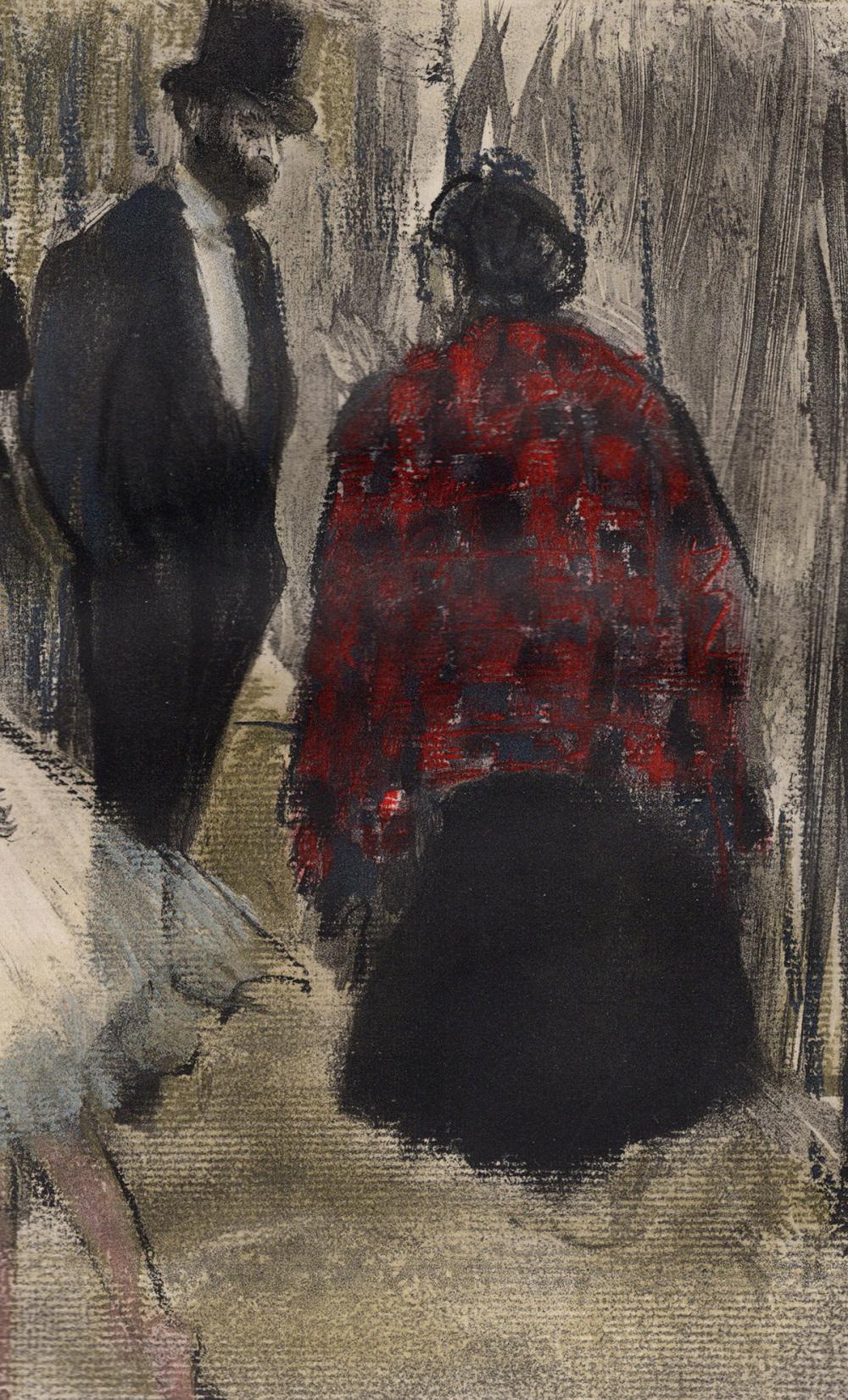
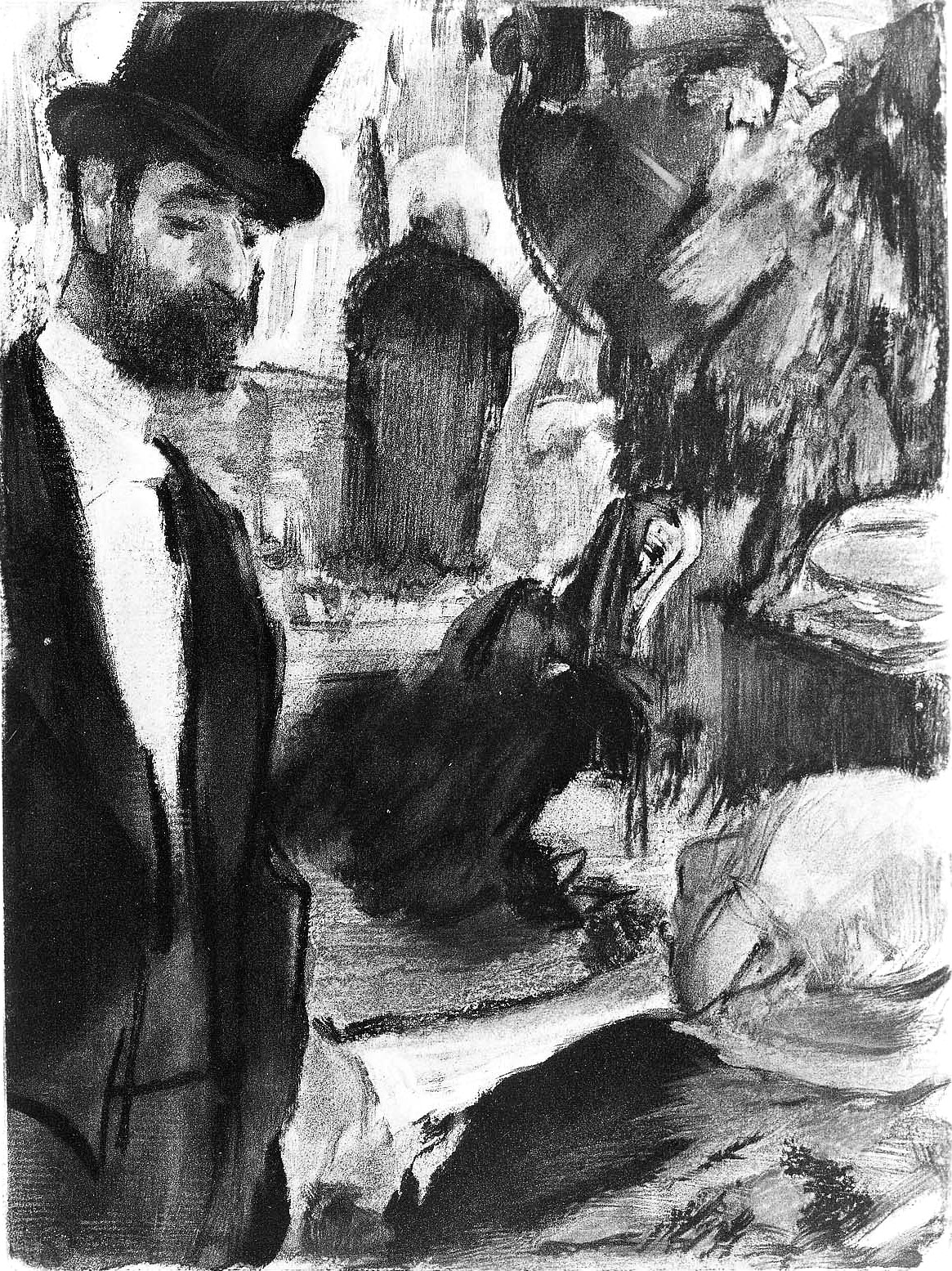
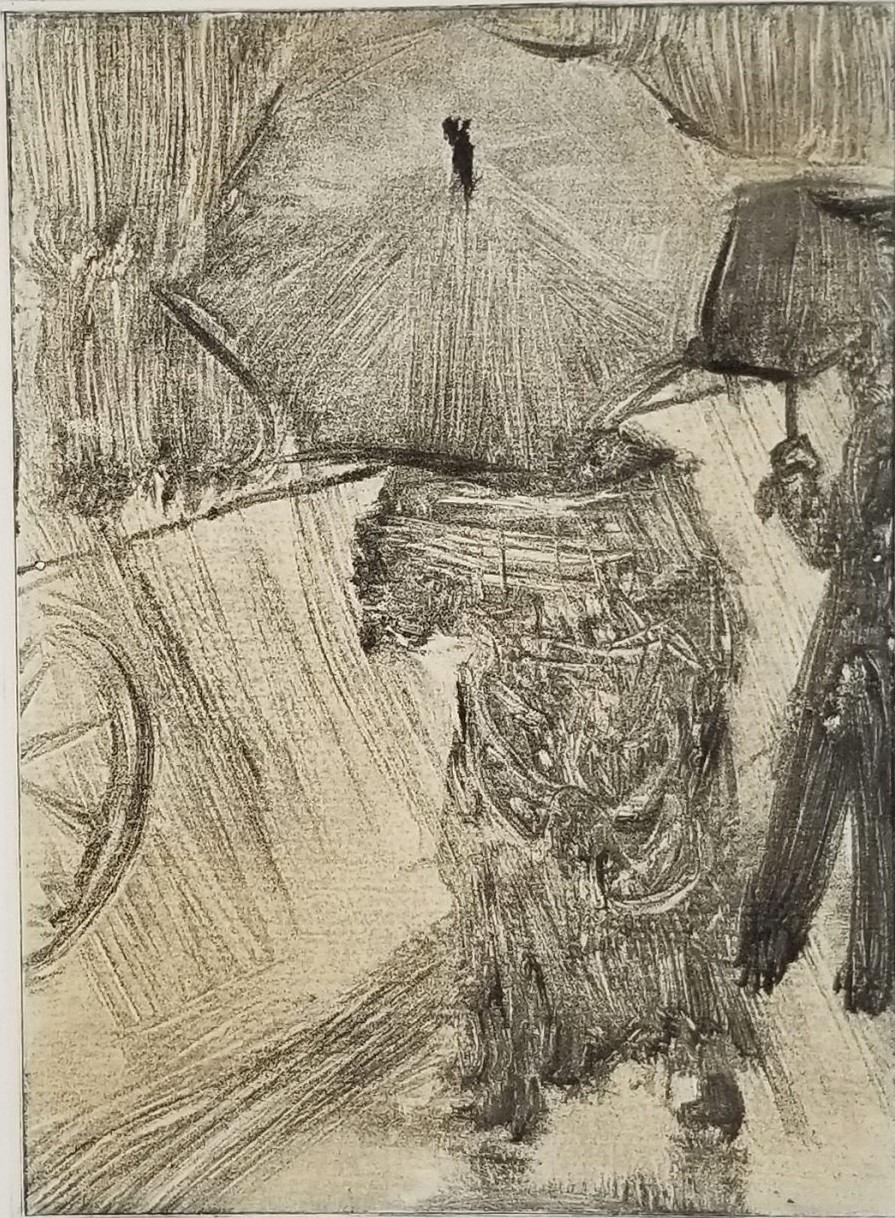
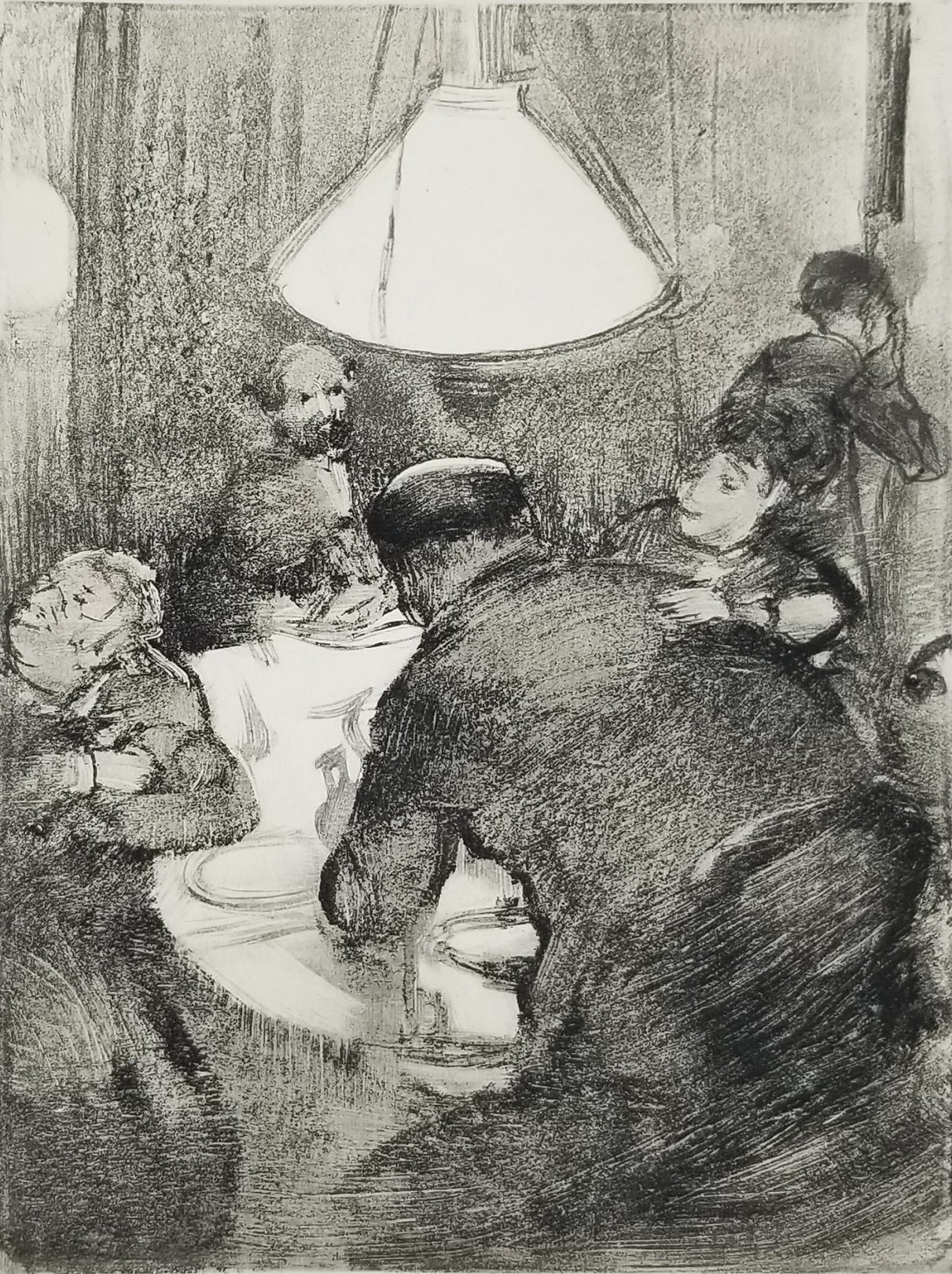
In 1877 at the 3rd ‘impressionist’ expositionEdgar Degas showed ‘drawings’ which were bookillustrations for Monsieur et Madame Cardinal by Ludovic Halévy. He made them with monotype sometimes enhanced with pastel.
3IE-1877-58, Dessins faits à l’encre grasse et imprimés
3IE-1877-59, Dessins faits à l’encre grasse et imprimés
3IE-1877-60, Dessins faits à l’encre grasse et imprimés
Edgar Degas: 3IE-1877-58-1, Dessins faits à l’encre grasse et imprimés =? 1876-77ca, Ludovic Halévy speaking with Madame Cardinal (from Ludovic Halévic: La famille Cardinal), print after pastel on monotype, 27×18, A2023/07/23 (iR17;iR7;iR2;iR15;iR10;aR21;M22;M152;R2,p204;aR21;R90II,p74)
Edgar Degas: 3IE-1877-58-2, Dessins faits à l’encre grasse et imprimés =? 1876-77ca, Ludovic Halévy finds Mme Cardinal in the dressing room (from Ludovic Halévic: La famille Cardinal), print after monotype, 21×16, MFA Boston (M22;M152;aR21;iR10)
Edgar Degas: 3IE-1877-59-1, Dessins faits à l’encre grasse et imprimés =? 1876-77ca, Virginie being admired while the Marquis Cavalcanti looks on (from Ludovic Halévic: La famille Cardinal, p85), monotype + pastel, 16×12, NGA Washington (M21;iR8;iR11;iR10;aR21;R2,p204;R90II,p74)
Edgar Degas: 3IE-1877-59-2, Dessins faits à l’encre grasse et imprimés =? 1876-77ca, Pauline and Virginie Cardinal conversing with admirers (from Ludovic Halévic: La famille Cardinal), monotype, 21×16, Harvard Cambridge (iR10;iR91;iR11;aR21;R2,p204;R90II,p74;M32)
Edgar Degas: 3IE-1877-60-1, Dessins faits à l’encre grasse et imprimés =? 1876-77ca, In the rain (from Ludovic Halévic: La famille Cardinal), print after monotype, 16×11, private (aR21;M22;M152;iR10)
Edgar Degas: 3IE-1877-60-2, Dessins faits à l’encre grasse et imprimés =? 1876-77ca, The famous good friday dinner (from Ludovic Halévic: La famille Cardinal), print after monotype, 21×16, private (aR21;M152;M22;iR10)
Henry Somm in 1879:
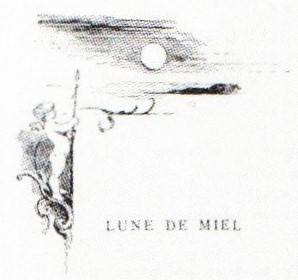
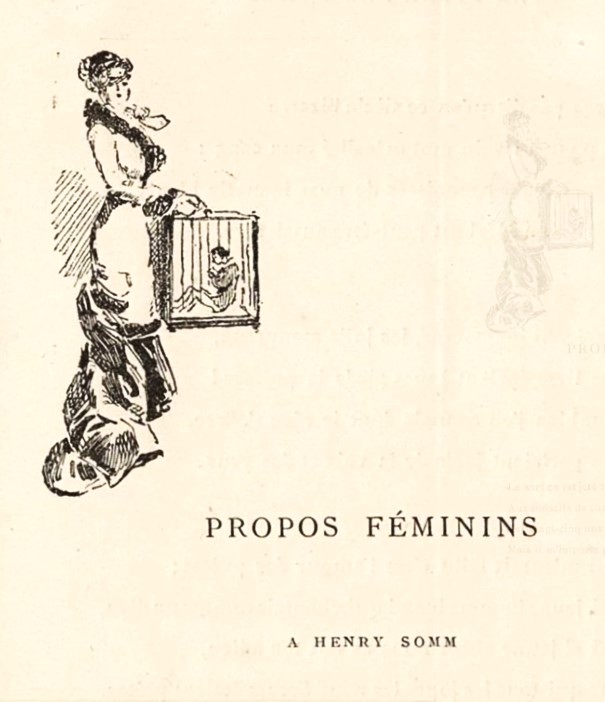
In 1879 at the 4th ‘impressionist’ expositionHenry Somm also showed pen-and-ink drawings to illustrate the Livre des Baisers (book of kisses), by V. Billaud. They were shown within 1 frame.
4IE-1879-230, 1 Cadre, dessins à la plume pour servir à l’illustration du Livre des Baisers, de V. Billaud
Henry Somm: 4IE-1879-230-1, (Promenade) dessin à la plume pour servir à l’illustration du Livre des Baisers, de V. Billaud =? 1879, Promenade, dr, (R90II,p141+119;R90I,p243)
Henry Somm: 4IE-1879-230-2, (Morte) dessin à la plume pour servir à l’illustration du Livre des Baisers, de V. Billaud =? 1879, Morte, dr, (R90II,p141+119;R90I,p243)
Henry Somm: 4IE-1879-230-3, (Lune de miel) dessin à la plume pour servir à l’illustration du Livre des Baisers, de V. Billaud =? 1879, Lune de miel, dr, (R90II,p142+119;R90I,p243)
Henry Somm: 4IE-1879-230-4, (Le Délire continue) dessin à la plume pour servir à l’illustration du Livre des Baisers, de V. Billaud =? 1879, Le Délire continue, dr, xx (R90II,p142+119;R90I,p243)
Henry Somm: 4IE-1879-230-5, dessin à la plume pour servir à l’illustration du Livre des Baisers, de V. Billaud Compare: 1879, Beraldi 10, Le Livre des baisers, front page, etch (aR9=iR387;iR10;iR40;aR8;R90I,p243;R2,p270;R85XII,no10)
Henry Somm: 4IE-1879-230-6, (Propos féminins) dessin à la plume pour servir à l’illustration du Livre des Baisers, de V. Billaud =? 1879, Le Livre des baisers, Propos féminins, dr (aR9;iR10;R90I,p243;R2,p270)
Forain in 1880:
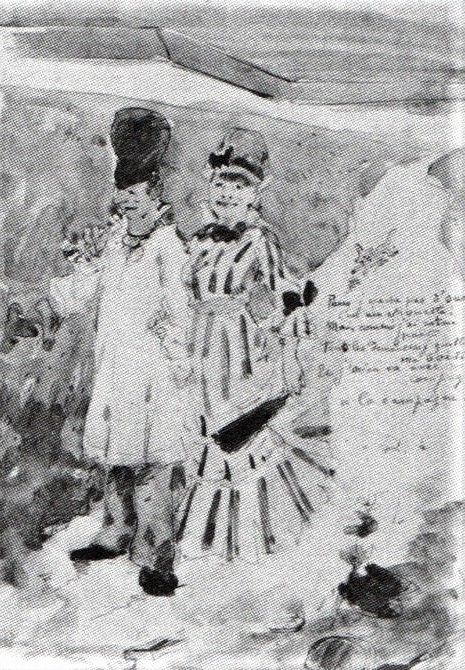
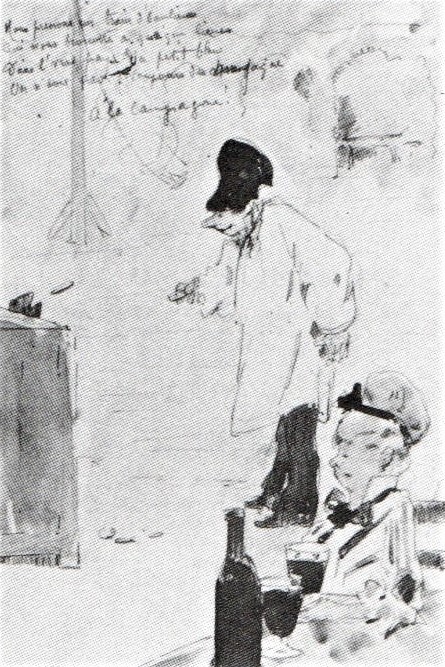
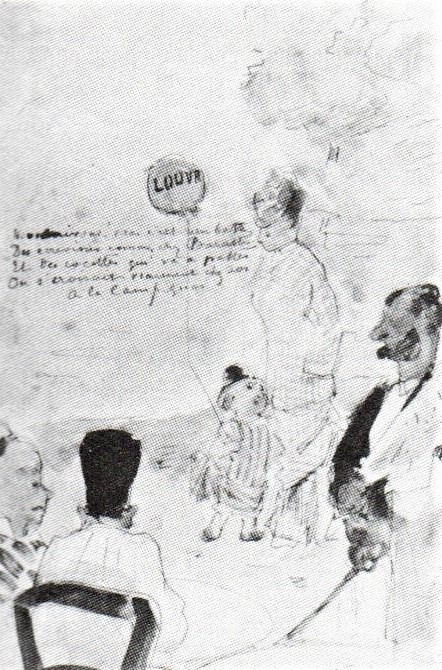
In 1880 at the 5th ‘impressionist’ expositionJean-Louis Forain showed several drawings. A review of Huysmans refers to a book of watercolours with poems of Verlaine (R90II,p149): ‘In a different order of ideas, a book of watercolours, illustrating a poem by Verlaine, is singular and sinister. It’s called the walk of the vagabond in the Country (‘la Promenade du voyou à la campagne’). (R90I,p290). Berson relates it arbitrary to no.52 in the catalogue and renders 3 black and white pictures (R90II,p164+149): 5IE-1880-52, Dessin
Jean-Louis Forain: 1880-52a, dessin =18xx, the walk (Verlaine), wc+ink, 28×20, Kh Bremen (R90II,p164;R2,p311;M58)
Jean-Louis Forain: 5IE-1880-52b, dessin =18xx, At the parc café (Verlaine), wc+dr, 28×19, A1981/12/01 (R90II,p149+164;R2,p311;iR15)
Jean-Louis Forain: 5IE-1880-52c, dessin =18xx, Afternoon in the parc (Verlaine), wc+dr, 28×19, A1981/12/01 (R90II,p165+149;R2,p311;iR15)
Lucien Pissarro in 1886: Lucien Pissarro illustrated and printed several books (R9;iR24;aR8;iR3). In 1894 (or: 1895): Lucien started of the Eragny press together with his wife Esther. It would last till World War I in 1914. Lucien published between 32 and 35 books.
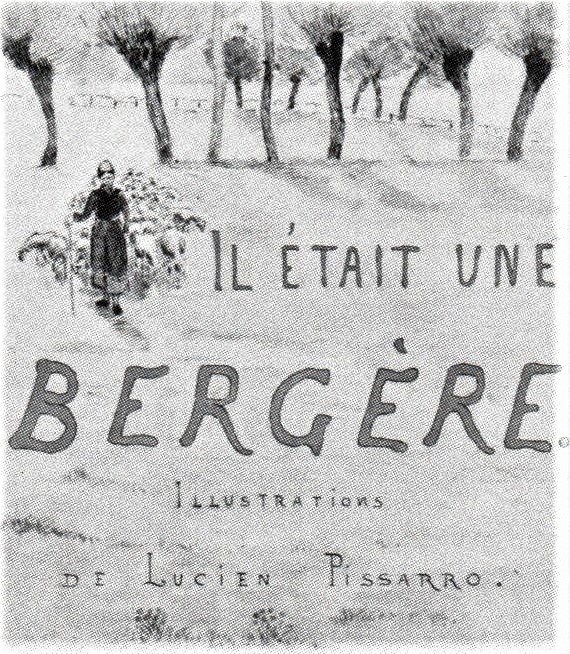
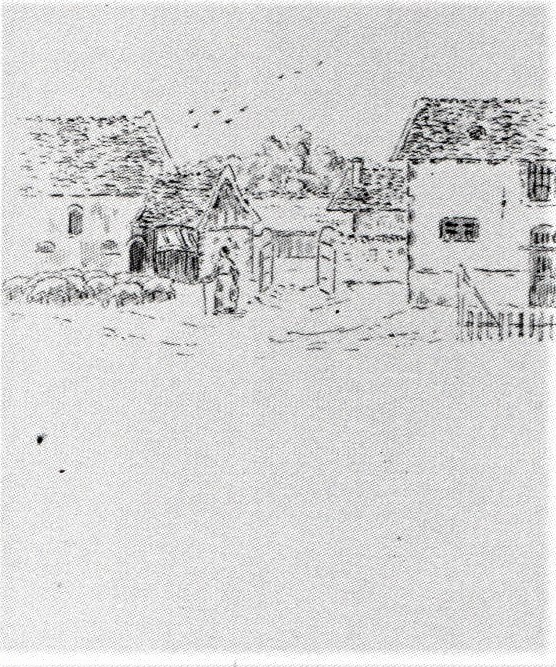
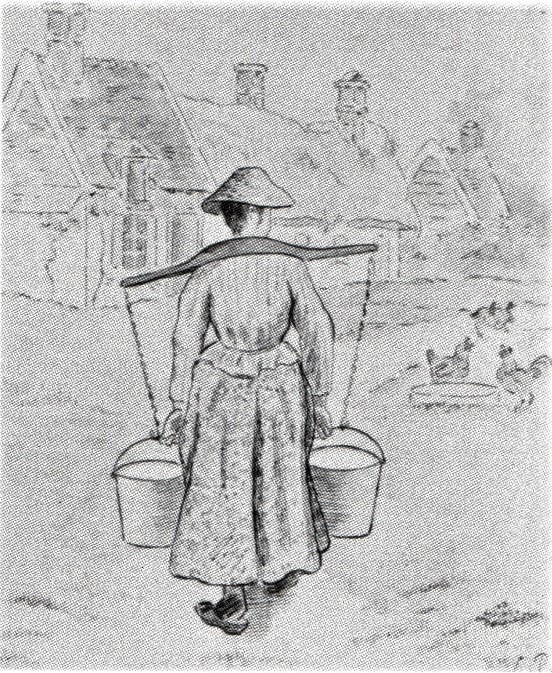
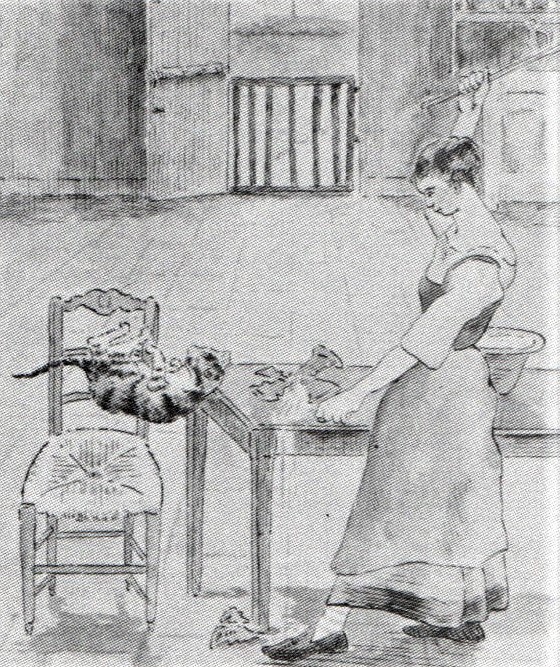
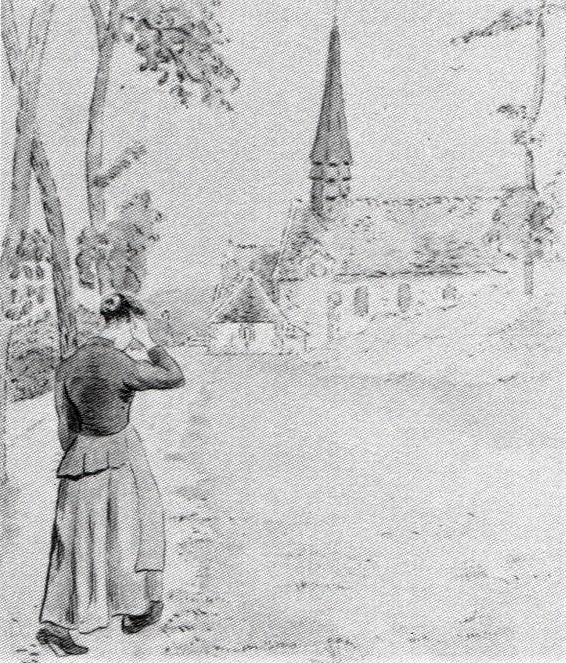
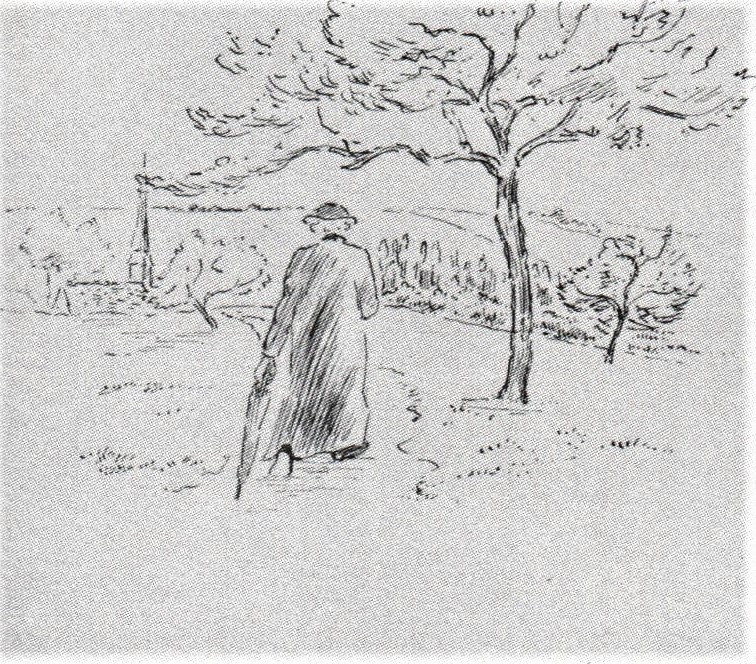
In 1886 at the 8th ‘impressionist’ expositionLucien Pissarro showed maybe 13 watercolours illustrated for Il était une bergère. I render 11 mostly black and white pictures.
8IE-1886-116, Projet d’illustration de « Il était une bergère » (aquarelle)
Lucien Pissarro: 8IE-1886-116, Projet d’illustration de « Il était une bergère » (aquarelle), no.1: Il était une bergère (Illustrations de Lucien Pissarro) (aquarelle) =1884ca, Il était une bergère, dr+wc, 22×19, Ashmolean Oxford (R90II,p269+248;M66)
Lucien Pissarro: 8IE-1886-116, Projet d’illustration de « Il était une bergère » (aquarelle), no.2: Il était une bergère, no.2 =1884ca, Il était une bergère no2, ink+wc, 17×12, Ashmolean Oxford (R90II,p269+248;M66)
Lucien Pissarro: 8IE-1886-116, Projet d’illustration de « Il était une bergère » (aquarelle), no.3: Qui gardait ses moutons, no.3 =1884ca, Que gardait ses moutons, dr, 17×13, Ashmolean Oxford (R90II,p270+248;M66)
Lucien Pissarro: 8IE-1886-116, Projet d’illustration de « Il était une bergère » (aquarelle), no.4: Elle fit une formage =1884ca, Elle fit une fromage (She went to make a cheese), dr+wc, 21×17, Ashmolean Oxford (R90II,p270+249;M66)
Lucien Pissarro: 8IE-1886-116, Projet d’illustration de « Il était une bergère » (aquarelle), no.5: Elle fit une formage =1884ca, Elle fit une fromage (She went to make a cheese; no5), dr, 20×17, Ashmolean Oxford (R90II,p270+249;M66)
Lucien Pissarro: 8IE-1886-116, Projet d’illustration de « Il était une bergère » (aquarelle), no.6: Son chat qui la regarde 1884, Dairymaid (from Il Etait une bergère), wc, 21×17, Ashmolean Oxford (M66;aR2;R90II,p249+270)
Lucien Pissarro: 8IE-1886-116, Projet d’illustration de « Il était une bergère » (aquarelle), no.7: La Bergère en colère =1884ca, La Bergère en colère (The shepherdess lost her temper), dr+wc, 21×17, Ashmolean Oxford (R90II,p270+249;M66)
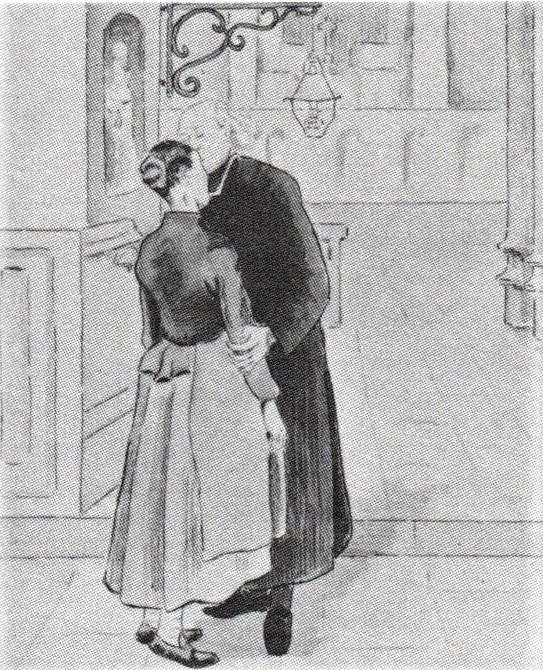
Lucien Pissarro: 8IE-1886-116, Projet d’illustration de « Il était une bergère » (aquarelle), no.8: Elle s’en fut à confesse 1884ca, Elle s’en fut à confesse (no.10), dr+wc, 23×17, Ashmolean Oxford (R90II,p270+249;M66)
Lucien Pissarro: 8IE-1886-116, Projet d’illustration de « Il était une bergère » (aquarelle), no.9: Mon père, je m’accuse 188x, Mon père, je m’accuse (no.11), ink+wc, 20×16, Ashmolean Oxford (R90II,p271+249;M66)
Lucien Pissarro: 8IE-1886-116, Projet d’illustration de « Il était une bergère » (aquarelle), no.10: Nous nous embrasserons =1884ca, Nous nous embrasserons (we’ll embrace in forgiveness), dr+wc, 20×17, Ashmolean Oxford (R90II,p271+249;M66)
Lucien Pissarro: 8IE-1886-116, Projet d’illustration de « Il était une bergère » (aquarelle), no.11: Nous recommencerons =1884ca, Nous recommencerons, dr, 21×17, Ashmolean Oxford (R90II,p271+249;M66)
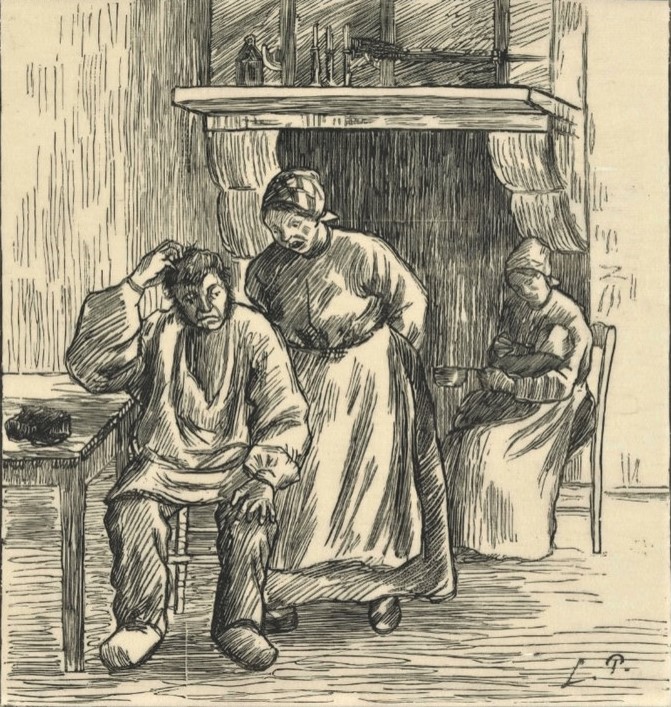
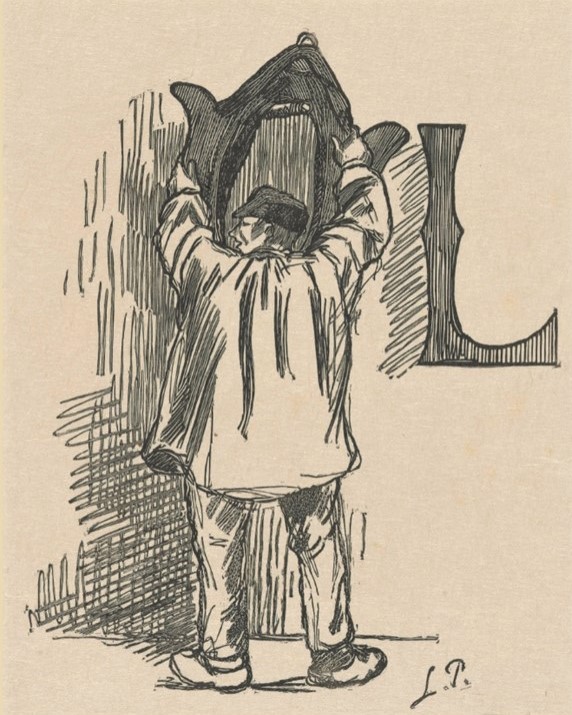
In 1886 Lucien Pissarro also showed illustrations for Mait’Liziard, a novel by Octave Mirbeau. It is unknown how many woodengravings he showed. I render 5.
8IE-1886-122, Illustration de Mait’Liziard (nouvelle de M. Octave Mirbeau); gravure sur bois.
Lucien Pissarro: 8IE-1886-122, Illustration de Mait’Liziard (nouvelle de M. Octave Mirbeau); gravure sur bois, no.2, Bon Guieu! Qu’a a ronf’e =1886, Bon Guieu! Qu’a a fronf’e, woodcut, ?cm, La Revue illustrée 2, no13, 1886/06/15 (R90II,p271+249)
Lucien Pissarro: 8IE-1886-122, Illustration de Mait’Liziard (nouvelle de M. Octave Mirbeau); gravure sur bois, no.3, All’enfe, a soufflé =1886ca, All’enfe, à soufflé, woodcut, 17×16, VGM Amsterdam (M73;R90II,p271+249;R2,p445)
Lucien Pissarro: 8IE-1886-122, Illustration de Mait’Liziard (nouvelle de M. Octave Mirbeau); gravure sur bois, no.4, Tiens, tiens, mais c’est Liziard =1886ca, Tiens! tiens! mais c’est Liziard!, woodcut, 11×16, VGM Amsterdam (aR7;M73;R90II,p272+249;R2,p445)
Lucien Pissarro: 8IE-1886-122, Illustration de Mait’Liziard (nouvelle de M. Octave Mirbeau); gravure sur bois, no.1, Lettre L. =1886ca, (Mait’ Liziard) Lettre L., woodcut, 14×11, VGM Amsterdam (aR7;M73;R90II,p271+249)
Lucien Pissarro: 8IE-1886-122, Illustration de Mait’Liziard (nouvelle de M. Octave Mirbeau); gravure sur bois, no.5, Cul de lampe =1886, Crying woman, woodcut, 25×16 (13×9), VGM Amsterdam (M73;aR7;iR155;iR10;R90II,p272+249)