Introduction:
Ingres was born 1780/08/29 in Montauban (where they have Musée Ingres = M197) and later moved to Paris. He died 1867/01/14 i Paris .
Ingres was one of the most influential painters of the 19th century. In 1825 Ingres became a member of L’Institut and in 1829 professor at the École National des Beaux-Arts. From 1835 till 1841 he was director of the French Academy in Rome. In 1853 he became president of the École. He was the most prominent representative of Néo-Classicism. Note: This page has just been started; additional info and pictures will be added later.
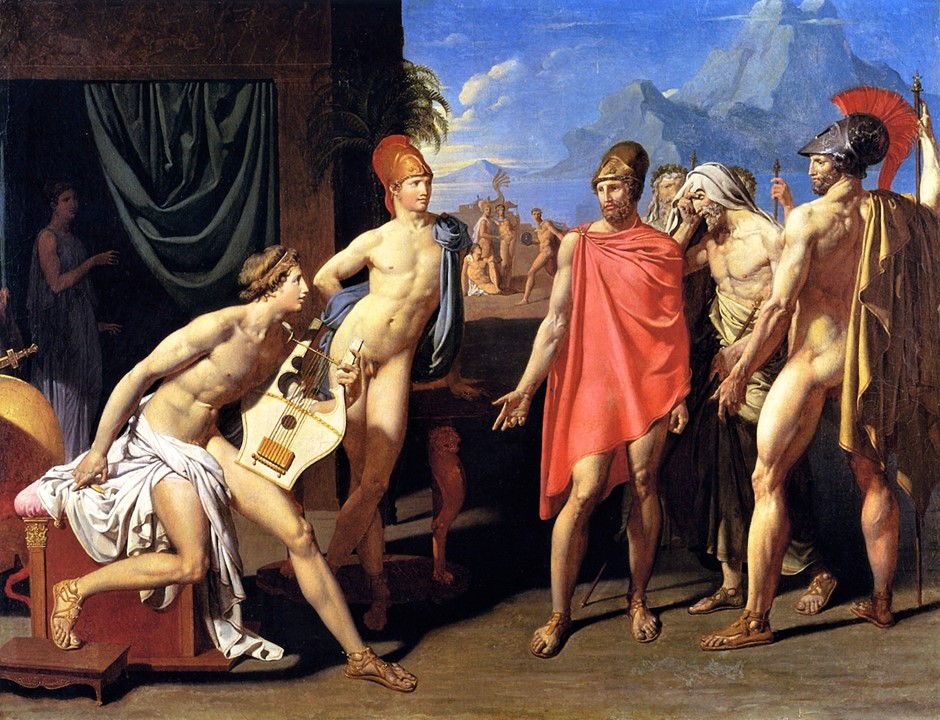
Ingres (1780-1867): 1801, Achilles Receiving the Envoys of Agamemnon, 110×155, MENSBA Paris (iR2;iR23;M9) =Prix de Rome 1801
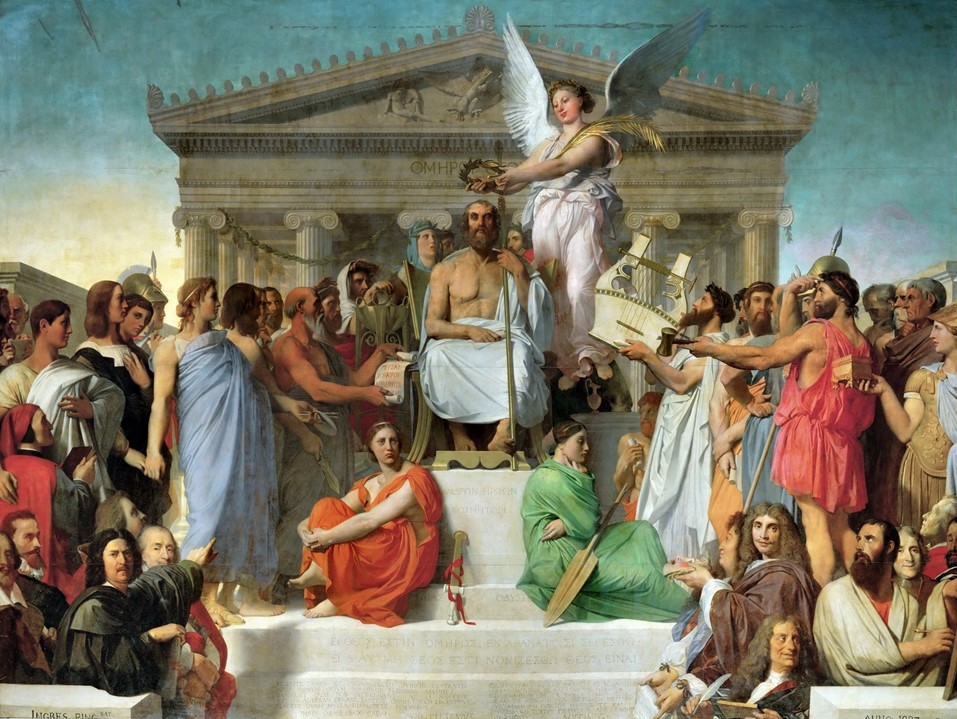
J.A.D. Ingres (1780-1867): 1826-27, The Apotheosis of Homer, 386×515, Louvre (iR2;iR6;iR1;R478,p392;M5) Provenance: commission of King Charles X. Expos: S1827-plafond; S1833-plafond; EU-1855-3345, Homère déifié.
Ingres as an artist: In Paris Ingres joined in 1797 the Atelier of David. He studied at the École des Beaux-Arts from 1799-1801. After failing in 1800 Ingris won the Prix de Rome in 1801. From 1806 till 1824 he lived in Rome and Florence. He made a living by painting portraits. Back in Paris he received several commissions.
His paintings have a cool harmonic colouring. They have an objective and rational charecter.
Gilibert (Jean-François; 1783-1850): 1826, Ingres visiting the new drawing school, 38×46, MI Montauban (iR6;iR10;iR23;M197)
Ingres at the Salon: Ingres made his debut at the Salon in 1802. In 1824 he had a great succes at the Salon.
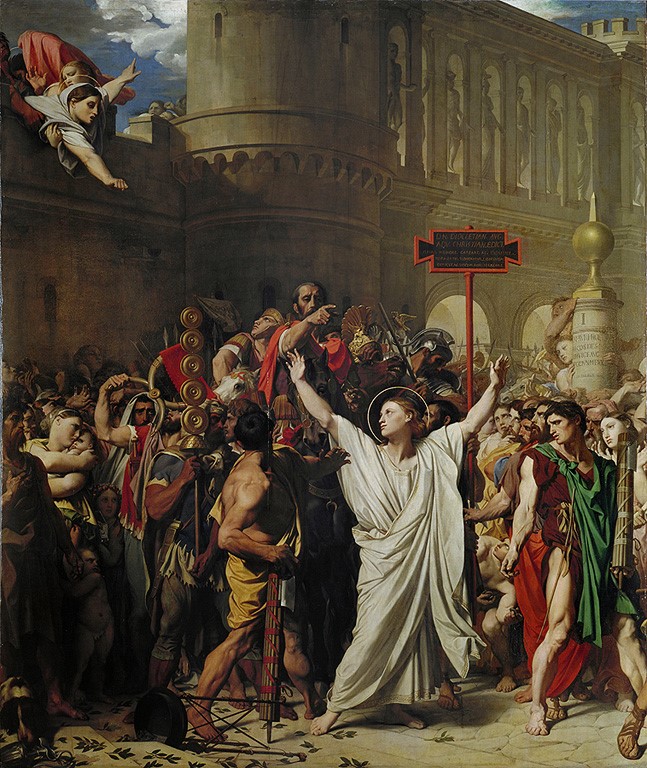
At the Salon of 1834 he received many accusations of historical inaccuracy, for the feminine appearance of the Saint, who looked like a beautiful statue. In anger, Ingres announced that he would no longer participate in the Salon.
Jean-Auguste-Dominique Ingres (1780-1867): 1824, The Vow of Louis XIII, 421×262, Cathedral Notre-Dame Montauban (iR10;iR6;iR1;R231-9+1+2) Expos: S1824-922; EU-1855-3339; EU-1900-C-376, Le Vœu de Louis XIII (Cathédrale de Montauban; S.1824)
Ingres (Jean-Auguste-Dominique; 1780-1867): 1824-34, St. Symphorian, 407×339, Cathedral SL Autun (iR3;iR2;iR1;R231-9) Expos: =S1827-577, Saint Symphorien; =? S1834-998, Le martyre de Saint-Simphorien; =EU-1855-3338, Saint Symphorien (à la Cathédral d’Autun; Salon de 1827); =? 3SdA-1905-23.
Ingres (Jean-Auguste-Dominique; 1780-1867): 1832, Portrait of M Bertin, 116×95, Louvre (iR6;iR1;R231-9;M5) Expos: =S1833-1279, Portraits, même numéro; =EU-1855-3372, Portrait de M. Bertin aîné (Peint en 1832); =3SdA-1905-48.
Ingres, one of the most influential painters of the 19th century:
Ingres was one of the most influential painters of the 19th century. In 1825 he became a member of the Academy (l’Institut) and in 1829 professor at the École National des Beaux-Arts. From 1835 till 1841 he was director of the French Academy in Rome. In 1853 he became president of the École. In 1863 he still was professor at the École.
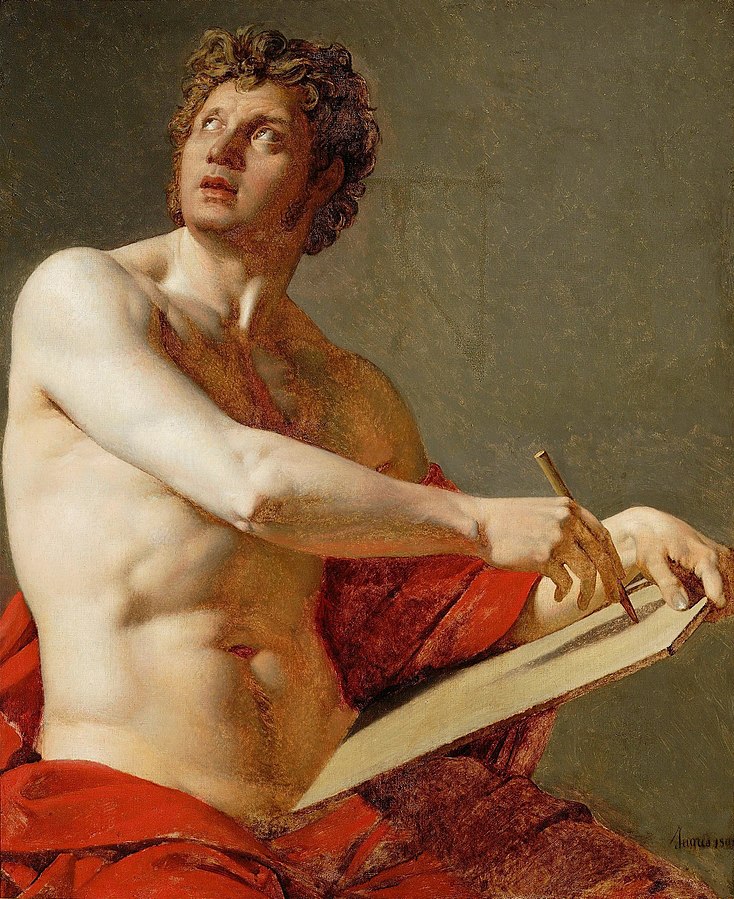
Ingres (1870-1867): 1801, Academic study of a male torso, 98×81, NM Warsaw (iR6;iR10) 1st price prix du torse of 1802 ENBA
Ingres (1780-1867): 1806-20, Chaperon and other details of civil and military costumes from the 14th century, dr, 18×11, MI Montauban (iR23;M197)
Ingres (1780-1867): 1806-20, La Villa Médicis in Rome, dr, 29×23, MI Montauban (iR23;M197). Note: from 1835 till 1841 Ingres was director of the French Academy in Rome
Ingres in the Légion d’Honnour: Ingres was appointed in the Légion d’Honneur, in 1824 as Chevalier, in 1826 as Officier and 1845/05/01 as Commandeur.
Ingres at the Exposition Universelle:
In 1855 the Salon was part of the Exposition Universelle. In a room there was a large review with 41 catalogue numbers containing 68 works, including 25 stained glass cartons and 12 portraits. Many of these works had already been exhibited at previous Salons. (iR1)
Ingres his works were not present at the Exposition Universelle of 1867. He had died the 14th of Januari. Still, there was a posthumous exhibition held at the Ecole des Beaux-Arts (R5,p42).
In 1878 his works were absent.
At the Exposition Centennale in 1889 7 paintings were exhibited and 30 other works, including 27 drawings.
At the Exposition Centennale in 1900 there were 17 paintings shown of him, including 11 portraits (R231-2).
Ingres (1780-1867): 1814, Portrait de Mme de Senones, 106×84, MBA Nantes (iR6;iR23;iR1;R231-1+2;M16) Expos: S1814; EU-1900-C-367, Portrait de Mme de Senones (Musée de Nantes; S.1814)
Ingres (1780-1867): 1808ca, La Baigneuse (à mi-corps), 51×43, MBH Bayonne (iR10;iR108;iR127;M191;R231-1+2+9) Expos: =? EU-1855-3353, Baigneuse; petite étude (à M. Defresne); =EU-1900-C-371, Baigneuse assise, vue de dos (Rome, 1808; à M. Bonnat)
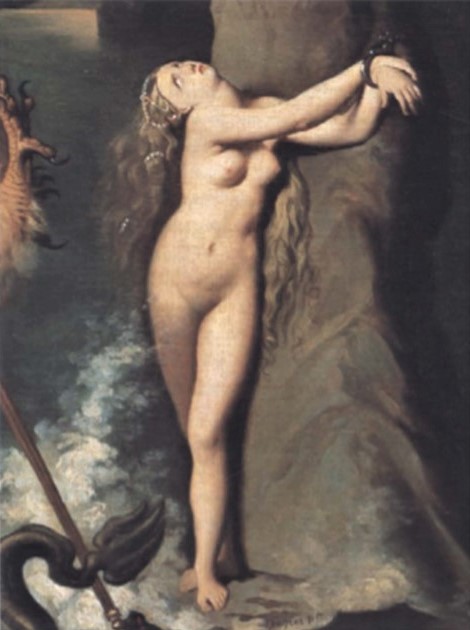
Ingres (1780-1867): 1841, Roger delivering Angélique, 54×46, MI Montauban (iR6;iR10;M197;R231-1+2+9) Expos: =EU-1900-C-380, Roger délivrant Angélique (Musée de Montauban). Compare: S1819-1648, Roger délivrant Angélique; =EU-1855-3349, Roger délivrant Angélique (à l’Empereur; Salon de 1819)
Ingres (1780-1867): 1814, La Grande Odalisque, 91×162, Louvre (iR6;iR2;iR1;R231-9;M5) Expos: =S1819-619, Une Odalisque; =EU-1855-3350, Odalisque couchée (à M. Marcotte; peint à Rome, 1814)
Jean-Auguste-Dominique Ingres (1780-1867): 1821, The Entry of the future Charles V into Paris in 1358, 47×56, WAMA Hartford (iR6;M162;R231-1+2) Expos: S1822; EU-1900-C-375, Charles V, alors régent du royaume, rentre à Paris après l’expulsion du duc de Bourgogne, et reçoit le prévot et les échevins de Paris, que Jean Pastoret et Jean Maillard lui présentent (à M. Bessonneau; S.1822)
Ingres and the Impressionists:
At the 1st ‘impressionist’ exposition in 1874 Ingres was honoured by a portrait of Auguste Ottin and 2 reproductions of Félix Bracquemond↓.
Ingres was admired by Degas and Rouart, they also had works of Ingres in their collection.
Since about 1883 also by Renoir followed more the influence of Ingres. Desboutin portrayed him making an etch after a painting.
Ingres (1780-1867): 1819-39, Roger freeing Angelica (detail), 48×39, NG London (R84,p141;M61). Degas collection.
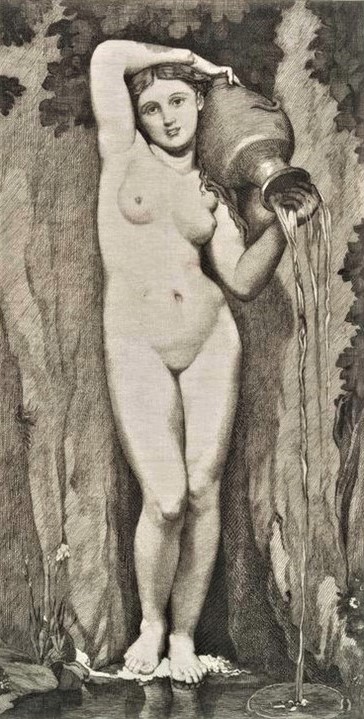
Félix Bracquemond: 1IE-1874-25-5, La Source, d’après Ingres = 1849-70ca, B275, The source (after Ingres), etch, 31×35, NYPL (iR61;iR19;R2,p119;R90II,p18;R85III,no275) =!? SNBA-1907-171-105, La Source, d’après Ingres, appartient à M. Ch. Jacquin.
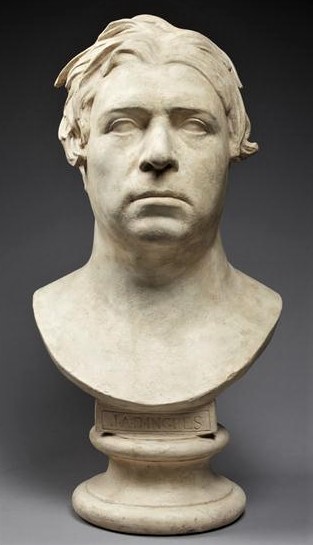
Auguste-Louis-Marie Ottin: 18xx, Buste d’Ingres, plaster, h.53, MIB Montauban (R90II,p26+11;R2,p122;R87,p248;M197) =1IE-1874-126, Buste de Ingres, réduction en plâtre
Auguste-Louis-Marie Ottin: 1840, Buste d’Ingres, marble, xx, M. Ingres Bourdelle Montauban (M197;iR6;iR10) Compare: 1IE-1874-126, Buste de Ingres, réduction en plâtre
Auguste-Louis-Marie Ottin: 1840, Buste d’Ingres, marble, xx, M. Ingres B Montauban (iR6;iR10;M197) Compare: 1IE-1874-126, Buste de Ingres, réduction en plâtre
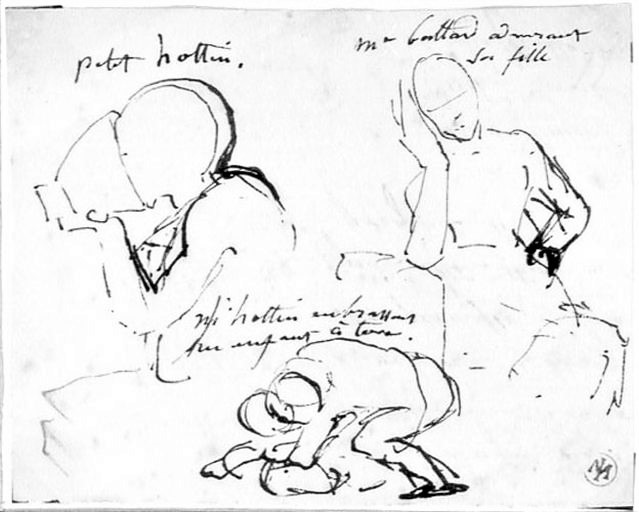
Ingres, 1836, Le Petit Ottin buvant; Mme Baltard; Ottin jouant avec son fils, dr, 11×14, Musée Ingres Montauban (iR23;iR197)
Auguste-Louis-Marie Ottin: 1868, Buste de Ingres (Ingres B.A. 1780+1867), marble, xx, L’Institute Paris (aR16;iR10;iR1;aR18=iR242) =!? S1868-3782, J. P. D. Ingres; buste, marbre; (Pour l’Institut)
Auguste-Louis-Marie Ottin: 1840, SD, Buste d’Ingres (Ingres), marble, 61x28x23, Villa Medici Rome (aR18=iR242;iR195;iR1) =EU-1855-4522, Portrait de M. Ingres; buste, marbre
Auguste-Louis-Marie Ottin: 1855-84ca, Buste de Ingres (JAD Ingres), plaster (?), 53x26x22, Ecole des Beaux-Arts Paris (iR10;iR1;R2,p122;R90II,p26+11;M9). Compare: S1842-1996, bronze; +.EU=S1855-4522, marbre; + S1868-3782, marbre; + 1IE-1874-126, réduction en plâtre
Auguste-Louis-Marie Ottin: 18xx, Buste d’Ingres (JAD Ingres), bronze, 43x27x29, MNCh Versailles (iR357;M5;iR1;aR18=iR242;M195) =S1842-1996, Buste de M. Ingres; bronze.
Posthumous exhibitions:
Many works of Ingres were shown posthumously at the Expositions Centennale in 1889 and in 1900↑.
In 1905 there also was a large review with 68 catalogue numbers of Ingres at the Salon d’Automne, including 23 paintings (of which 15 portrait), 24 studies and fragments, 19 drawings and 2 other works (iR1).
You could say that around the turn of the age, Ingres was notably represented as a portraitist and a draughtsman and not with neo-classicist works.
In 2023 there was an exposition in Château Chantilly.
Recommanded citation: “Meta-Impressionism: Jean-Auguste-Dominique Ingres (1780-1867), one of the most influential painters. Last modified 2025/11/18. https://www.impressionism.nl/ingres-1780-1867/”