Impressionism: a historical reconstruction
Impressionism
according to Mellerio
Introduction:
André Mellerio (1862-1943) was an art-critic, who wrote 1900/05/10 a brochure called “L’Exposition de 1900 et L’impressionnisme”. He wrote ‘The Exposition Universelle of 1900, that is bount to be opened*, renders comparative stages in the evolution of our civilisations, of humanity’. But, Mellerio announces to focus on one shortcoming, namely concerning Impressionism, who were offered a ‘very, limited room**‘. He pleads for a ‘Palais de l’Impressionnisme’. In his brochure Mellerio makes clear his view on Impressionism and who were the Impressionists.
Note*: Infact the Exposition Universelle of 1900 openend 1900/04/14 and the Fine Arts expo the 1st of May.
Note**: In fact the Impressionists were well represented↓.
What is Impressionism?
Mellerio starts with the question: What is Impressionism? He calls it ‘a vague and meaningless term’, referring to the review of Leroy in 1874 and Monet his ‘Impression, soleil levant’*. Mellerio himself defines Impressionism as a group of free individuals, outside the academic control, most of them associated with the School of 1830 (Barbizon), focussed on achieving luminous effects, by using pure colours and a division of tones. Later (p12) Mellerio writes ‘The Impressionists… attributed a predominant role to light in the surrounding environment, neglecting, especially Monet, the anecdotal and picturesque aspects of the landscape’. And: ‘In pursuit of their goal, they adapted a technique that more closely approximated the effects of light, drawing on the scientific advances of their time and research on colours. In short: a more accurate analysis of the constituent elements of a tone, and their separate application on the canvas with the aim of producing a synthesis that is no longer pigmentary, but visual.’
Citing Signac (1899) Mellerio discribes the goal of Impressionism as to ‘give the colour as much brightness as possible. By using the following means: 1. a palette composed solely of pure colours, close to the solar spectrum; 2. mixing on the palet and optical mixing; 3. comma or swept strokes; 4. technique based on instinct and inspiration. (p.12) He criticises the general public who calls every-one an Impressionist, ‘in which painting there is purple in the shadows; more or less shapeless spots; a total absence of design’ (p.5).
Mellerio mentions the influence of Delacroix, Millet, most of all Manet***** and more way back Claude Lorrain and Turner and also Japonism. He discerns a chain of influence from Corot, Dupré, Daubigny and Diaz, through Courbet and Millet to Monet, Pissarro, Sisley and Cézanne (p11).
Mellerio repeats descriptions of others: of Geffroy**: ‘Impressionism, in the works that best represent it, is a style of painting that moves towards phenomenism, towards the appearance and meaning of things in space, and which seeks to capture the synthesis of these things in the appearance of a moment.’; of Pératé*** ‘Breaking down the ray of light, capturing its ethereal pulsation, following it as it glides around objects, enveloping them in a colourful cloak’; of Lecomte**** ‘The definitive abandonment of flat colours incapable of rendering the entirety of a visual impression, and the division of tone to maximise light, constitute the highly effective innovation of the early Impressionist painters.’
So, Mellerio namely describes the painting style of the Impressionists, also by citing others. But, he starts his definition with ‘a group of free individuals, outside the academic control’. Later Mellerio mentions of Degas, that the only thing he has in common with the previous painters is ‘his absolute independence as an artist’ (p8). And more later he opposes ’the slavish imitation of the original masters’ and pleads for ’the true and complete expression of oneselves’ (p28). So, the dichotomy of his definition doesn’t help to specify what is Impressionism and who is an Impressionist. I try to solve this dichotomy to define Impressionism namely as a painting style, but also to discern ‘impressionism’ as a broader independent art-movement.
Note*: He wrongly calls it ‘Impression, coucher de soleil’ (p.3)
Note**: In: La Vie artistique, Paris, Dentu, 1894, 3me Série; Histoire de l’impressionnisme (p.8).
Note***: André Pératé: Un siècle d’art, excerpt from “la Quizaine” (p.24), 1899/12/16.
Note****: G. Lecomte: L’Art Impressionniste (p.24). Paris, 1892.
Note*****: So, Mellerio doesn’t define Manet as an Impressionist, but as an influencer of Impressionism.
Who are the Impressionists?
Mellerio pleads for an ‘authentic demarcation’ of the group of Impressionists. He more extendedly describes Monet, Pissarro, Renoir and Degas. Then shortly Cézanne, Sisley, Morisot, Guillaumin and Boudin. Then he just mentions Caillebotte, Cassatt, Zandomeneghi…* At last he mentions some related artists: Jongkind, John-Lewis Brown, Besnard, Raffaëlli, Lépine, Forain, Gauguin (in his early years), Lebourg, etc*.
In these descriptions Mellerio hardly specifies his characteristics of Impressionism. He mentions of Monet, that he made ‘made light effects the fundamental principle of his work’; he ‘tackled intense sunlight’ and using broad strokes he strove towards precise division of tones. Mellerio praises Pissarro namely for his concern for values and his use of greens (combined with blues). But, mostly he just mentioned the themes the Impressionists depicted and by whom they were influenced.
Later in the Appendix (‘Documentation’) Mellerio renders some literature, including prefaces and articles and expositions on Impressionism and the Impressionists. He does so more extensively on Monet, Pissarro, Renoir, Degas, Cézanne, Sisley, Morisot, Guillaumin and Boudin. And just shortly on Caillebotte, Cassatt and Zandomeneghi.
Mellerio seems to discern 3 circles of Impressionists:
In the most inner circle: Monet, Pissarro, Renoir and Degas.
In the circle around it: Cézanne, Sisley, Morisot, Guillaumin and Boudin.
And in the 3rd outer circle: Caillebotte, Cassatt and Zandomeneghi.
And also a circle of related artists: Jongkind, John-Lewis Brown, Besnard, Raffaëlli, Lépine, Forain, Gauguin, Lebourg.
Note*: The dots (…) and the ‘etc’ doesn’t help his plea for a demarcation.
Remarks on the Impressionists:
As mentioned above, Mellerio hardly described the impressionist painting style of the Impressionists. Still, he used some interesting remarks on these artists, which I will render here below.
On the goal of Renoir: ‘charming the eye with the enchantment of bright, melodious colours’ (p7).
On Degas: ‘his desire was the exact design and precise indication of movement in the bodies of dansers and horses’ (p8).
On Sisley: ‘a landscape painter with a keen eye and a delicate temperament, was preoccupied with Monet’s passionate research’ (p8).
On Morisot: ‘a woman who captured the fragile grace of women in her pearlescent paintings (p8).
On Guillaumin: ‘his vigorous backgrounds and skies, his establishment and tones, goes almost to the point of brutality'(p8/9).
On Boudin: ‘a painter of beaches and harbours, captures the atmosphere of the sea. He also understands the inner workings of boats, like an old pilot’ (p9).
A plea for a ‘Palais de l’Impressionnisme’:
Mellerio criticises the space that is given to Impressionism at the Exposition Universelle in 1900: ‘it is separate, very limited room*. He criticises that the jury mainly consisted of academic painters (p17), that didn’t include the Impressionists** in the Decennial exposition (p18). He misses the more recent works of the Impressionist, some specific works of Monet and Renoir, the gouaches of Pissarro and more paintings of Guillaumin.
Mellerio pleads for ‘a comprehensive exhibition on Impressionism as a whole’ (p23). This was to take place in a special location, away from the crowded multitude of academic paintings. In short… a ‘palace of Impressionism’ (p24). “Alongside the inevitably bureaucratic and administrative power of the state, let us increase the free forces that will counterbalance its omnipotence, and through which the integrity of the artist’s inspiration and expression will be safeguarded for the greater benefit of Art.” (p29)
Note*: Mellerio refers to the ‘dazzling room of Impressionists’ Arsène Alexandre mentions in his article 1900/05/01, see description and link to the whole article: gallica.bnf.fr//bpt6k285127b. In fact, the Impressionists were well represented. 28 of the 57 partakers of the ‘impressionist’ expositions were represented at this Centennial Exposition. They showed almost 11% of all the exhibited paintings. The 5 Key-Impressionists showed 46 paintings, this is 6,7%. Monet and Renoir belonged to the 11 artists that showed more than 10 paintings.
Note**: 8 of the 57 partakers of the ‘impressionist’ expositions exhibited art-works at the Decennial, but this didn’t include the Impressionists defined by Mellerio. But, were they really excluded by this jury or didn’t they want to be included? Renoir (and also Monet and Pissarro) initially refused to exhibit (at the Centennial) (R31,p308). Pissarro at first wasn’t pleased with the whole enterprice. (R116I,p294/5;R88II,p257).
Acquainted with the Impressionist:
In his introduction Mellerio mentions that ‘he has the luck to know personnally the group of artists who form Impressionism’.
In the 1890s he was a young art-critic; a friend of Joseph Durand-Ruel with whom he visited Pissarro; he published in ‘Les Deux Mondes’ namely on Renoir and Pissarro in 1891. 1891/04/04 Mellerio bought a pastel of Pissarro. He wrote articles on the Impressionists namely in 1899 and 1904. 1903/11/15 he was present at the funeral of Pissarro.
But, in sources on Impressionism and the Impressionists Mellerio is hardly mentioned. Some sources only refer to the 1900/05/10 brochure of Mellerio (R22I,p349;R88II,p258;R472,p29).
Sources: R116I,p232+34+246+57+319; R88II,p225; R102,p305; R423,p407; R310,p241; R22I; R460,p295; R166,p298; R1,p664; R3,p710; R5,p287; R8,p423.
Mellerio as an art-critic:
André Mellerio was an art-critic who defended also the Symbolists, namely in his publication of 1896↓. From 1897-1899 he was editor-in-chief of la revue d’art L’Estampe et l’affiche (iR4).
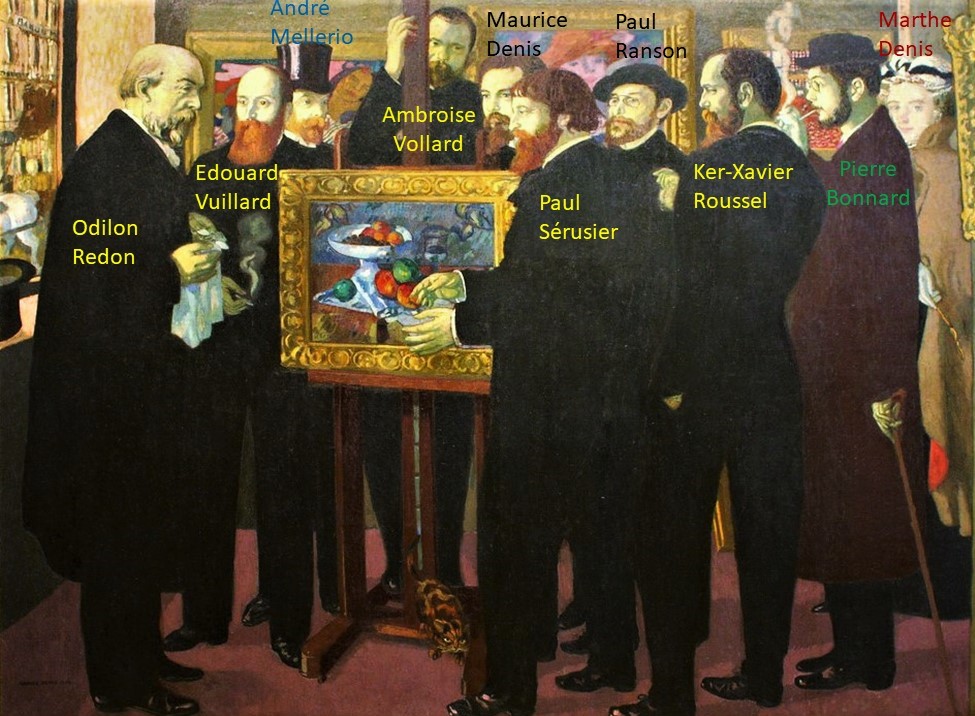
Since 1889 Mellerio was befriended with Redon and connected him with Maurice Denis (R88I,p716), who in 1900 included Mellerio in his painting ‘Homage to Cézanne‘ among painters of namely Les Nabis. Denis earlier in 1897 had depicted Mellerio and his family (iR6). In 1911 and 1923 Mellerio published on Redon. In 1908 he also published on Signac.
Other publications of André Mellerio:
Here below you will find some other publications of André Mellerio in a chronological order:
Les Artistes à l’atelier, Renoir‘; in: L’Art dans les deux mondes, 1891/01/31 (R31,p322)
Les Artistes à l’atelier: C. Pissarro; L’Art dans les deux mondes, 1891/06/06, p.31 (R116I,p347;R201,p227)
Preface on the exposition of S.J. ten Cate (1858-1908) at Durand-Ruel (R88I,p938).
L’art impressionniste; in: Le Journal des arts, 1892/04/15, p.1 (R116I,p347)
Preface on the 1894/04 exposition of Odilon Redon at Durand-Ruel (R88I,p715;iR3).
Le Mouvement idéaliste en peinture. Paris, 1896. (R116I,p347;iR3)
La Lithographie originale en couleurs, 1898 (R88I,p914;iR3)
Exposition d’oeuvres de MM. Monet, Pissarro, Renoir, Sisley (galeries Durand-Ruel, 16, rue Laffitte); in: Bulletin des arts; Supplément à l’Estampe et l’affiche, May 1899, no.4, p.26. (R116I,p347)
Correspondance de Belgique; Exposition des peintres impressionnistes à la Libre Esthétique; in: La Chronique des arts et de la curiosité, 1904/03/26, p104/5. (R116I,p347)
Exposition des peintres impressionnistes français; in: Revue universelle, 1904/04/15, p.215/6 (R106,p413)
Paul Signac; in: L’Art et la couleur; les maîtres contemporains, no.10, 1908. (R106,p413).
Odilon Redon. Paris, 1913. (R315,p503;iR3)
Odilon Redon; peintre, dessinateur et graveur. Paris, Henri Floury, 1923. (iR3; dn721509.ca.archive.org=iR19)
Sources:
My main source is: André Mellerio: L’Exposition de 1900 et l’Impressionnisme. Paris, 1900. (https://dn720502.ca.archive.org/ =iR19=R380).
Other important sources are: WikiPedia on André Mellerio (iR3; iR4); Sophie Monneret (R88); Durand-Ruel & Pissarro (R116).
See the links for other general References (=Rx), the internet references (=iRx) and Musea (=M). See links for practical hints and abbreviations and for the subscription of the paintings.
Recommended citation: Impressionism according to Mellerio. Last modified 2025/10/18. https://www.impressionism.nl/impressionism-according-to-mellerio/”