Impressionism, a historical reconstruction:
Claude Monet
(1840-1926)
Reviews
on the impressionist expositions
Introduction:
On this page you will find summaries of the reviews on Claude Monet. Namely on the ‘impressionist’ expositions he joined in 1874, 1876, 1877, 1879 and 1882. See the account for a more detailed representation of these reviews.
Note: You will just find the reviews of 1874 +1876. The other reviews will be added later.
1874:
Here you will find a summary of the reviews on the 1st ‘impressionist’ exposition related to Claude Monet.
See the link for the art-works he showed in 1874.
Monet was most often mentioned in the reviews and most often as one of the leading partakers. Monet showed his picture of the Boulevard des Capucines (no.97↓), where the exposition was held. Chesnau praised it as ‘never has the ungraspable, the fleeting, the instant of movement been seized and fixed in it’s tremendous fluidity’ and ‘Come closer … and what remains is an indecipherable chaos of palette scrapings’. (R90I,p18) Monet also showed his famous ‘Impression, soleil levant’ (no.98↓). It was the art-critic Castagnary (1874/04/29) who, in his review, linked this painting to the term ‘impressionists’ (R90I,p17) and not Leroy as many claim (R7,p26/27;R54,p75)*. But, Leroy (1874/04/25), in his cynical review does not give extra attention to this work (R90I,p26). Le Déjeuner (no.103↓↓) was very often described and mentioned by Silvestre as ‘The most important piece’ (R90I,p40).
Note*: they probably follow Georges Rivière in his necrology of 1927/01/01 in L’art vivant: “It was a work of Monet that baptisted the groupe as ‘Impressionists’ by Louis Leroy in le Charivari” (1927=R357,p17).

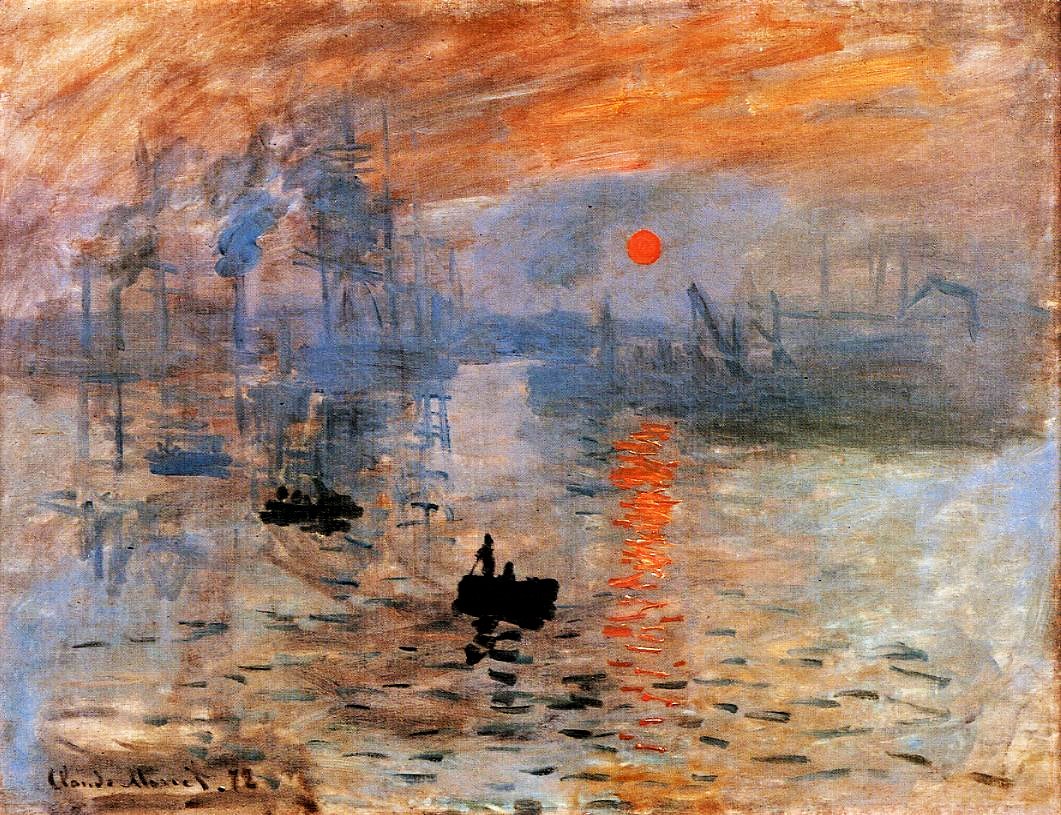
1874: the reviews of Leroy and Castagnary (Impression, soleil levant):
Leroy (1874/04/25) his review in ‘Charivari’ was called “L’exposition des impressionnistes” (R2,p490;R90I,p25/6;R410,p193;R87,p259-261;R5,p88;R7,p26/27). In his negative review Leroy performs a dramatic dialogue with the reactionairy M. Joseph Vincent. Many emphasize that he was the first to use the term ‘impressionism’ and thus was responsible for the naming of the Impressionists (R88II,p235;R3;R87), you will find this opinion repeated at WikiPedia (iR3), Christies (iR15), WikiSource (iR416) and the National Gallery of Art in Washington (M21). Rewald even rendered most of this review in the chapter about ’the origin of the word “impressionism” (R1,p318-324). They all follow Georges Rivière* in his necrology of 1927/01/01 in L’art vivant: “It was a work of Monet that baptisted the groupe as ‘Impressionists’ by Louis Leroy in le Charivari” (R357-1927,p17). Leroy repeatedly used the word ‘impression’, but he just two times used the term ‘impressionnistes’ in his article, without explaining it. And he didn’t give special attention to Impression, soleil levant↓ of Monet, as many suggest.
Instead, it was Castagnary, in a mixed positive review, who explicitly gave the partakers the name ‘impressionists’ and who connected this term with the painting ‘impression, soleil levant’ of Monet (R87,p265; 1874/04/29 in Le Siècle: “Exposition du boulevard des Capucines: Les Impressionnistes” (R2,p490;R90I,p15-17;R87,p264/5). He pleads to use the term ‘impressionists‘, because these painters ‘don’t render a landscape, but the sensation produced by that landscape’ and ‘in the catalogue soleil levant of M. Monet is not called landscape but impression.’ (R87,p265;R90I,p17). So Castagnary is the explicit origin of the term ‘impressionism’ and not Leroy as many state**. This is affirmed by Philip Burty who reviewed 1874/05/30: “The Siècle, having on its staff M. Castagnary, an intimate friend of Courbet and formerly an ardent defender of realism, christened the independent young artists, happily enough, “The Impressionists”.” (R90I,p9). Still, several writers suggest the article of Castagnary also was a negative one (R177,p39), confirming the myth that ‘impressionistes’ was only used as a scornfull name.
This is one of the many myths around Impressionism, presenting the Impressionists as victims of the hostile established art-world.
I’m glad that the 2024 exposition doesn’t follow this myth (R410,p212;R411).
Note*: Sylvie Patry mentions this connection already was laid in 1890 by Lecomte and later in 1924 affirmed by Adolphe Tabarant (R410,p194/5).
Note**: Sylvie Patry makes clear that Le Charivari was a smaller journal; the article had in 1874 not much impact (R410,p194/5).


1876:
Here you will find a summary of the reviews on the 2nd ‘impressionist’ exposition related to Claude Monet.
See the link for the art-works he showed in 1876.
Claude Monet was mentioned in 34 reviews. Bertall (Rv42) mentioned ‘Monet is about to become as famous as Manet. Baignières (Rv41) sees him as the successor of Delacroix. Zola calls him ‘surely the head of the group’ (Rv50+54). Some are clear that his paintings were exhibited in room 2 (Rv16+35+43). His Japonnerie (no.153)↑ is most often mentioned and described. Blémont (Rv35) calls it ‘his most imporatant painting’. Some criticise the colours (Rv36), others the drawing of head and hands (Rv10+47). Many of the other works are summarised as ‘landscapes’, sometimes more specified as ‘views of the Seine near Argenteuil‘ (Rv41). Some paintings are also explicitly mentioned. Dax / Rivière (Rv51) calls no.163 (Le printemps) a masterpiece. Some are critical on his use of colours: ‘He has an unfortunate taste for pinks and blues. Many of his landscapes are loud, fluttering. (Rv32)’; ‘In several other paintings, the artist pushes the decomposition of sunlight too far, the flickering of colours, the shimmering of light. Monet sometimes makes rainbow orgies with all colours and complementary hues. (Rv35)’; ‘Monet shows a collection of bright, explosive landscapes in blue, yelow and much pink. (Rv33)’; ‘His landscapes can’t be found in nature, with these violent tones. (Rv36)’; ’the lila, pink and azur blue landscapes of Monet (Rv45)’. Some are more positive: ‘among the 15 landscapes one finds impressions with astonishing accuracy and tones of rare finesse (Rv47)’; ‘an honest execution, genuine feeling and beautiful light (Rv6)’; ‘an extraordinary brightness. His landscapes are flooded with light. (Rv54)’. Some works could fit at the Salon (no.151+152+154) (Rv33).
1877:
Here you will find a summary of the reviews on the 3rd ‘impressionist’ exposition related to Claude Monet.
See the link for the art-works he showed in 1877.
1879:
Here you will find a summary of the reviews on the 4th ‘impressionist’ exposition related to Claude Monet.
See the link for the art-works he showed in 1879.
1882:
Here you will find a summary of the reviews on the 7th ‘impressionist’ exposition related to Claude Monet.
See the link for the art-works he showed in 1882.
Sources:
See the pages on the reviews per year (note only 1874 +1876 is available).
Most of these reviews are gathered by Ruth Berson (1996=R90I).
See at the bottom of the main page on Claude Monet.
Recommanded citation: “Impressionism: Claude Monet, an overview of the given reviews. Last modified 2026/03/31. https://www.impressionism.nl/monet-reviews/”